Finding 2 — The BMJ "CBT + Exercise" Citation Is Methodologically Laundered
This is Levinovitz's second sleight-of-hand and the more egregious one, because the receipts are public, recent, and from the kind of evidence-grading body the article itself would normally treat as authoritative.
The "moderate evidence for CBT and exercise" framing rests on a body of literature anchored by the PACE trial (White et al.,
Lancet 2011)<a href="
https://fleet.brainworks.ai/foundry/long-covid-wired-critique/#ref-15">15</a>, a £5M UK study championed by Michael Sharpe and Simon Wessely and structurally designed around the deconditioning-plus-mistaken-belief model. Levinovitz acknowledges that PACE was "subject to scrutiny." That is a remarkable euphemism. What actually happened:
The PACE reanalysis
Wilshire, Kindlon, Courtney, Matthees, Tuller, Geraghty, and Levin,
BMC Psychology 2018 (PMID 29562932)<a href="
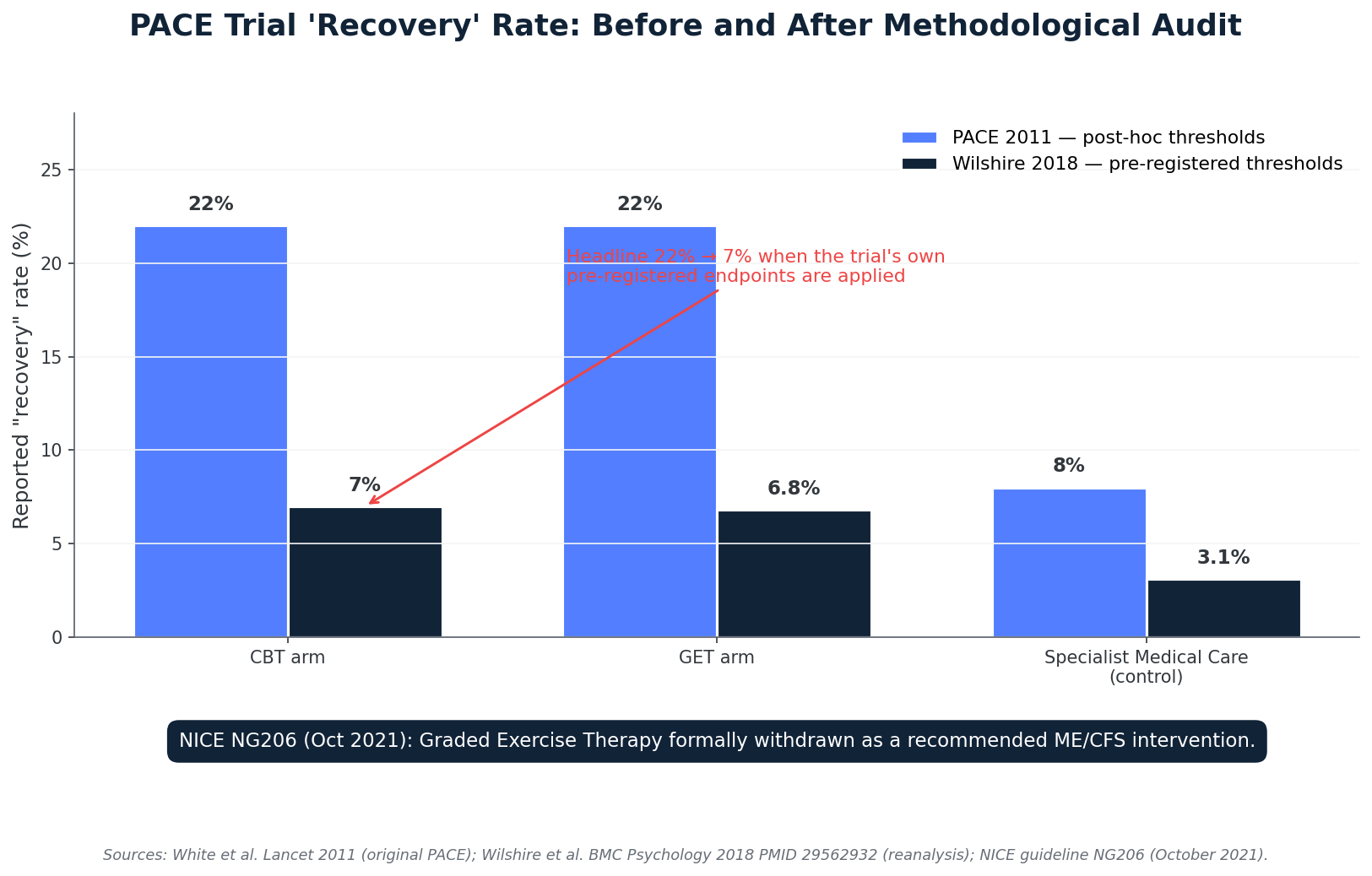
https://fleet.brainworks.ai/foundry/long-covid-wired-critique/#ref-16">16</a>. To be precise: the original PACE recovery paper reported ~22% recovery for CBT and ~22% for GET versus ~7% for specialist medical care (control) and ~8% for adaptive pacing — but only after the trial team revised the recovery threshold mid-trial. When Wilshire et al. reapplied the trial's
pre-registered protocol definitions to the same data (released under FOI), the picture changed: "rates of recovery were consistently low and not significantly different across treatment groups" — approximately 7–8% across
all four arms, with CBT and GET no longer significantly outperforming control after correction for multiple comparisons. The 22% headline that built the PACE-paradigm's clinical authority was, in the reanalysis authors' words, "modest treatment effects … [that] do not exceed what could be reasonably accounted for by participant reporting biases." We note for completeness that David Tuller (co-author, and the most public PACE critic) holds a UC Berkeley senior fellow position funded by crowdfunded patient-advocate donations — a fact he volunteered to Levinovitz. It does not affect the methodology: the reanalysis is reproducible from PACE's own public protocol by anyone with the FOI-released data.
The NICE NG206 reversal (ME/CFS) and the NG188 silence (Long COVID)
Two NICE guidelines need to be distinguished here, because Levinovitz's piece elides the relationship.
NG206 (29 October 2021) is the
ME/CFS guideline<a href="
https://fleet.brainworks.ai/foundry/long-covid-wired-critique/#ref-17">17</a>. NICE formally rewrote ME/CFS guidance: graded exercise therapy as a treatment was
withdrawn; energy-envelope pacing replaced it; CBT-as-cure was downgraded; harm warnings were built into clinical pathways for PEM-positive patients. The reversal was methodologically driven — the committee documented the subjective-endpoint, unblinded-trial, threshold-shifting, harm-underreporting problems across the CBT/GET trial base. NICE itself notes NG206 was developed before the COVID-19 pandemic and that its recommendations "should not be assumed" to apply to post-COVID-19 syndrome — correct caution, not a refutation of the methodological audit.
NG188 —
COVID-19 rapid guideline: managing the long-term effects of COVID-19, NICE's actual Long COVID guideline, substantively updated November 2021 and migrated to the NICE website on 25 January 2024 — does
not endorse graded exercise therapy as a treatment for Long COVID either<a href="
https://fleet.brainworks.ai/foundry/long-covid-wired-critique/#ref-39">39</a>. It builds precautionary language into multidisciplinary rehabilitation pathways and references the same PEM/post-exertional-symptom-exacerbation concerns that drove NG206. The BMJ "moderate evidence for CBT and exercise" framing Levinovitz inherits is misaligned with
both NICE guidelines.
The methodological audit literature
Vink and Vink-Niese,
Healthcare 2022 (PMC9141828)<a href="
https://fleet.brainworks.ai/foundry/long-covid-wired-critique/#ref-18">18</a>, documents the systematic flaws across the CBT/GET trial literature: subjective endpoints in unblinded behavioral-intervention trials (the most methodologically loaded combination in clinical research); harms data under-reported; post-hoc threshold changes; exclusion of severe patients who cannot tolerate the intervention, then results generalized back to the population that was excluded. The CDC's ME/CFS guidance, citing this audit literature, now opens with "ME/CFS is a biological illness"<a href="
https://fleet.brainworks.ai/foundry/long-covid-wired-critique/#ref-28">28</a> — a fact the
Wired piece notes in passing but does not let bear on its main thesis.
The BMJ review Levinovitz cites either predates or sidesteps this audit. The article presents it as the current scientific consensus on Long COVID treatment. It is not. It is an artifact of one evidence-grading framework that has not yet caught up with the methodological reversal. Citing it in 2026 as the state of the evidence is, on the most charitable reading, an oversight; on a stricter one, citation laundering. The rest of the article's framing makes the stricter reading hard to avoid.
Exhibit 3PACE trial "recovery" rate: original post-hoc thresholds (White 2011,
Lancet) vs pre-registered thresholds applied by Wilshire et al. (2018,
BMC Psychology PMID 29562932). NICE guideline NG206 (October 2021) formally withdrew graded exercise therapy as a recommended ME/CFS intervention.