
Abstract
Sleep is a fundamental biological process with broad implications for physical and mental health, yet its complex relationship with disease remains poorly understood. Polysomnography (PSG)—the gold standard for sleep analysis—captures rich physiological signals but is underutilized due to challenges in standardization, generalizability and multimodal integration. To address these challenges, we developed SleepFM, a multimodal sleep foundation model trained with a new contrastive learning approach that accommodates multiple PSG configurations. Trained on a curated dataset of over 585,000 hours of PSG recordings from approximately 65,000 participants across several cohorts, SleepFM produces latent sleep representations that capture the physiological and temporal structure of sleep and enable accurate prediction of future disease risk. From one night of sleep, SleepFM accurately predicts 130 conditions with a C-Index of at least 0.75 (Bonferroni-corrected P < 0.01), including all-cause mortality (C-Index, 0.84), dementia (0.85), myocardial infarction (0.81), heart failure (0.80), chronic kidney disease (0.79), stroke (0.78) and atrial fibrillation (0.78). Moreover, the model demonstrates strong transfer learning performance on a dataset from the Sleep Heart Health Study—a dataset that was excluded from pretraining—and performs competitively with specialized sleep-staging models such as U-Sleep and YASA on common sleep analysis tasks, achieving mean F1 scores of 0.70–0.78 for sleep staging and accuracies of 0.69 and 0.87 for classifying sleep apnea severity and presence. This work shows that foundation models can learn the language of sleep from multimodal sleep recordings, enabling scalable, label-efficient analysis and disease prediction.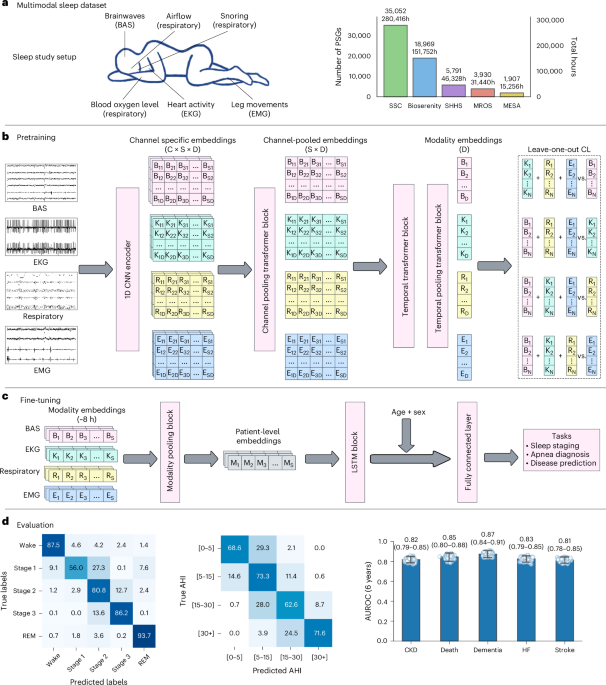
A multimodal sleep foundation model for disease prediction - Nature Medicine
A deep learning-based model, developed using the rich, multimodal data available from polysomnography-derived sleep recordings, performs well on common sleep analysis tasks and predicts future disease risk across a range of diseases.
 www.nature.com


