Change in healthcare utilization before and after COVID-19 using data from 1.5 million individuals 2025 Bygdell et al

Andy

Senior Member (Voting rights)

Abstract​


Background and objective​

Post-infectious sequelae can increase burden on healthcare systems. We aimed to assess the long-term effect of COVID-19 on healthcare utilization across all levels of care.

Methods​

In this register-based cohort study, we included all adult (≥18 years) residents in Sweden's two largest counties with a registered COVID-19 index date between 31 January 2020 and 9 February 2022. Each exposed individual was matched 1:1 to a control without registered COVID-19 on index date based on gender, birth year, vaccination status and the change in number of healthcare contacts between 2018 and 2019. We counted the number of healthcare contacts across all levels of care during the pre-index (13–1 months) and post-index (4–15 months) full-year periods. A difference-in-difference (DID) analysis was used to assess changes in the number of healthcare contacts and specific diagnoses, between each individual's pre- and post-periods, as well as comparing individuals with and without COVID-19.

Results​

The study included 753,905 matched pairs, comprising 1,415,432 unique individuals. Trends in healthcare contacts were parallel between the matched groups prior to the index date. The DID analysis revealed a mean increase of 0.33 (95%CI 0.30–0.36) healthcare contacts following COVID-19, mainly observed from a smaller proportion of the population (5%) and by contacts with primary healthcare. The largest diagnosis-specific difference was observed for reactions to severe stress (0.02, 0.01–0.03). The estimate varied across gender, acute COVID-19 severity, virus variant period and vaccination status.

Conclusion​

This study demonstrates increased healthcare utilization after COVID-19 in a smaller proportion of the population.

Open access
 
They compared 13-1 months before the infection and 4-15 months after the infection. So these differences are not driven by the acute phase.
The largest diagnosis-specific difference was observed for reactions to severe stress (0.02, 0.01–0.03).
Severe stress refers to ICD F43, which includes the unique Swedish code F43.8 Exhaustion disorder. It’s essentially a code for burnout, and many pwME/CFS gets misdiagnosed with it initially.

G93 (mainly G93.3 - so ME/CFS) had a difference of 1.2 % between the groups.

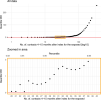
It seems like only a few patients were responsible for the majority of the increase in HC contacts:
Despite the observed increase in the mean number of healthcare contacts, most individuals in both the unexposed and exposed groups had the same number of healthcare contacts before and after the index date (Fig. S5). A decrease in the number of healthcare contacts was equally common in both groups, whereas an increase was slightly more frequent among the exposed (Fig. S5). In the QDID-analysis, an increase in the number of healthcare contacts was observed from the 95th percentile and above. This corresponds to individuals with at least 24 healthcare contacts during the post-index period (4–15 months) and with an IQR of 7–30 in the pre-index period (Fig. 5).
IMG_0490.png

LC gets a mention as a potential driver of the differences:
Some of the main diagnoses associated with increased healthcare utilization were stress, anxiety and fatigue—symptoms that have been closely associated with post-COVID-19 conditions [23], indicating that post-COVID-19 conditions could be a major cause of the increased healthcare utilization after COVID-19.
They acknowledge that the differences might be larger because the control group probably include some infected people due to lack of testing:
Infections during the Omicron period did not increase healthcare utilization as much after infection, perhaps because the infection with the Omicron variant was milder and thus did not result in an increase in healthcare utilization or because there was less frequent SARS-CoV-2 testing in the population during the Omicron dominating period, making it more likely that individuals in the control group had COVID-19 that was not identified which could tend to bias the DID estimate to the null due to misclassification of the exposure.
They seem to take the numbers seriously and advocate for paying attention to the consequences of covid for public health planning:
Scaled to a population level, the DID estimate corresponds to roughly 33,000 additional healthcare contacts per 100,000 individuals diagnosed with COVID-19 during the 12 months following 3 months from infection. Although most individuals show no or only a small change in healthcare utilization, the aggregate effect on the population level implies a substantial increase in the total healthcare utilization.
Our study shows that long-term symptoms after COVID-19 not only have an individual-level effect but could also have a capacity to affect the healthcare system with an increase in the mean number of healthcare contacts. This could have implications for societal allocation of resources to the healthcare system and highlights that SARS-CoV-2 still needs to be taken into consideration when planning healthcare.
 
Last edited:
They seem to take the numbers seriously and advocate for paying attention to the consequences of covid for public health planning:
In the abstract it sounds good. But the devil, as we have learned the very hard way, is in the detail.

What kind of services? Run by? Based on what 'models'? Etc.
 
Back
Top Bottom