Comparable Immune Alterations and Inflammatory Signatures in ME/CFS and Long COVID, 2025, Petrov et al

John Mac

Senior Member (Voting Rights)

Abstract​

Background: Chronic Fatigue Syndrome (CFS), also known as Myalgic Encephalomyelitis (ME), is a debilitating condition characterized by persistent fatigue and multisystemic symptoms, such as cognitive impairment, musculoskeletal pain, and post-exertional malaise. Recently, parallels have been drawn between ME/CFS and Long COVID, a post-viral syndrome following infection with SARS-CoV-2, which shares many clinical features with CFS. Both conditions involve chronic immune activation, raising questions about their immunopathological overlap.

Objectives: This study aimed to compare immune biomarkers between patients with ME/CFS or Long COVID and healthy controls to explore shared immune dysfunction.

Methods: We analyzed lymphocyte subsets, cytokine profiles, psychological status and their correlations in 190 participants, 65 with CFS, 54 with Long COVID, and 70 healthy controls.

Results: When compared to healthy subjects, results in both conditions were marked by lower levels of lymphocytes (CFS—2.472 × 10⁹/L, p = 0.006, LC—2.051 × 10⁹/L, p = 0.009), CD8+ T cells (CFS—0.394 × 10⁹/L, p = 0.001, LC—0.404 × 10⁹/L, p = 0.001), and NK cells (CFS—0.205 × 10⁹/L, p = 0.001, LC—0.180 × 10⁹/L, p = 0.001), and higher levels of proinflammatory cytokines such as IL-6 (CFS—3.35 pg/mL, p = 0.050 LC—4.04 pg/mL, p = 0.001), TNF (CFS—2.64 pg/mL, p = 0.023, LC—2.50 pg/mL, p = 0.025), IL-4 (CFS—3.72 pg/mL, p = 0.041, LC—3.45 pg/mL, p = 0.048), and IL-10 (CFS—2.29 pg/mL, p = 0.039, LC—2.25 pg/mL, p = 0.018).

Conclusions: Notably, there were no significant differences between CFS and Long COVID patients in the tested biomarkers. These results demonstrate that ME/CFS and Long COVID display comparable immune and inflammatory profiles, with no significant biomarker differences observed between the two groups.


IMG_0505.png
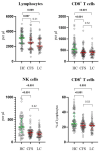
Figure 1. Results from age-adjusted ANCOVA test, showing distribution of lymphocytes, NK and CD8+ T cells in the three studied groups as individual points (circles). Exact p values are provided. Results are presented as median values and interquartile ranges (coloured lines).

IMG_0506.png
Figure 2. Results from age-adjusted ANCOVA test, showing serum levels of IFN-γ, TNF, IL-4, IL-2, IL-10, and IL-6 in the three studied groups as individual points (circles). Exact p values are provided where statistical significance was established. Results are presented as median values and interquartile ranges (coloured lines).

IMG_0507.png
Figure 3. Results from age-adjusted ANCOVA test, showing z-score ratios of Th1 ctokine profile, Th1/Th2 + Treg ratio, proinflamatory/antiinflammatory profile, and IRC/CIRS ratio in the three studied groups as individual points (circles). Exact p values are provided where statistical significance was established. Results are presented as median values and interquartile ranges (coloured lines).
 
Using ANCOVA to adjust for age differences, we found no significant distinctions between the two syndromes in almost any of the examined lymphocyte subsets or cytokine biomarkers. These results suggest overlapping immunological chnages and support the possibility of common underlying mechanisms in both conditions. The prominent low lymphocyte numbers documented in this study might be a result of chronic immune activation caused by viral infections, leading to immune exhaustion, a phenomenon depicted before [49,50,51,52,53].
They are keen on viral persistence theories.
On the other hand, the presence of an underlying infection, combined with low NK and CD8+ T cells with possible impaired function in viral defense, may be one of the reasons why patients report frequent common viral infections, causing the flu-like, GI symptoms typical for ME/CFS [54].
It doesn’t look like they understand ME/CFS. The flu-like feeling is rarely constant, it’s usually only experienced when in PEM.

They spend an unreasonable amount of time talking about depression, like here:
The increased CD4+/CD8+ ratio observed in both groups, compared to HC, could potentially serve as a marker for disease severity and could be used for monitoring therapy effectiveness. This statement can be supported by the observed negative correlation between CD4/CD8 ratio and the qSUM z-score. An early meta-analysis shows a link between depression, commonly observed in CFS/ME patients [62,63,64,65], and an increased CD4+/CD8+ ratio [66].
They also seem confused about what inflammation is:
The presence of chronic low-grade inflammation may be a potential cause of the symptoms characteristic of ME/CFS, including musculoskeletal pain and persistent fatigue [78]. The presence of low-grade inflammation in ME/CFS is determined by the predominance of the Th1 cytokine profile, which was also seen in the patients in our study and has been documented by other researchers [79]

I have no idea if this data is relevant, but I don’t think their interpretations are of much use..
 
Sounds like the healthy controls weren't sedentary
Healthy subjects were enrolled based on the absence of an active SARS-CoV-2 infection, confirmed by positive PCR/anti-SARS-CoV-2 IgG, and an absence of Long COVID-19/CFS symptoms.
could that impact these results?

In any case, it's interesting that LC and ME/CFS were so similar. We often see LC more of an intermediate halfway between HC and ME/CFS in these kinds of tests. I wonder if these LC patients were more ME-like than others have been. Haven't looked into it very far though.
Participants in the LC group were categorized as such, based on a positive SARS-CoV-2 PCR test and persistence of symptoms (fatigue/post-exertional malaise, dyspnoea, joint pain, cognitive impairment, sleep disturbances, cardiovascular and gastrointestinal symptoms) more than 4 months after recovery that cannot be explained by other conditions.
 
I would say that the data posted by @Utsikt show nothing of explanatory interest. The populations almost entirely overlap. There is a tail of outliers in the controls which produces the statistical difference in at least some measures. Maybe because they are active, yes. I think this is all noise.
 
The statistical tests used age as a covariate, but suspect that the data points shown do not take this into account. The HC group had a mean age of 31, and the LC group of 51.

They also don't give much info about how the patients were selected. Suspect the study was done on patients in Bulgaria?

There's also a weird lack of variability in the IL-2 measurements in the HC group.

1765452534413.png
 
Big diff in NK cells. Don't need any p value to see that. Just eyes.

HC looks evenly distributed. CFS compressed and lower.

These guys haven't discovered histograms? Why do they insist on using this weird jitter plot?

I've seen this jitter plot elsewhere. Is it because these guys don't know Python/R and are using some software to generate them,?
1768393960853.png
 
Last edited:
These guys haven't discovered histograms? Why do they insist on using this weird jitter plot?

I've seen this jitter plot elsewhere. Is it because these guys don't know Python/R and are using some software to generate them,?
I'm not a fan of the overlapping points here making it hard to see exactly how many there are. But otherwise these types of plots are very common in papers on biological markers. As far as I can recall, histograms are rarely used for something like comparing cell counts.
 
There's also a weird lack of variability in the IL-2 measurements in the HC group.
My guess is that all the points with identical values were below the limit of detection, and were just given an abitrary low value. That might be what this sentence is talking about:
All values below the OOR [out of range] were calculated as LOD/2 [limit of detection/2].

Edit: Though that doesn't explain why some points are also below this value, and one is even at 0.
 
Last edited:
These guys haven't discovered histograms? Why do they insist on using this weird jitter plot?

Histograms are almost completely useless in this situation. We need to see the individual data points. I am not particularly impressed by the differences. Most values are within the normal range. Some of the spreads are truncated but artefacts can do that. Higher NK values in normals might reflect more physical activity recently or something.
 
I prefer these jitter plots because they show each datapoint, which isn't the case with a histogram.
Why would you need to show each datapoint on a one-axis graph? Showing the point doesn’t add any information that can’t be extracted from a histogram, and the histogram has the added benefit of showing the distribution of values.

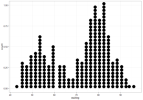
I guess they could make a stacked dot histogram (imagine this vertically).
IMG_0556.png
 
I guess they could make a stacked dot histogram (imagine this vertically).
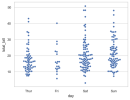
It's basically the same thing except the exact value can be shown in a swarm plot, instead of being put in bins of arbitrary width in a histogram.

swarmplot_5_0.png

But swarm plots where the points are overlapping, like in this paper, don't seem as helpful because you can't see the distribution clearly.
 
It's basically the same thing except the exact value can be shown in a swarm plot, instead of being put in bins of arbitrary width in a histogram.

View attachment 30130

But swarm plots where the points are overlapping, like in this paper, don't seem as helpful because you can't see the distribution clearly.
The bins are a good point, but how much granularity do you realistically need?

On that graph, would it be sufficient to round to the nearest point? At some point pixels and resolution of the image will create arbitrary bins, so it’s not like it’s entirely avoidable. So when is the tradeoff worth it for easier visual comparison?

You could keep the raw values for analyses and just use the bins for the visual presentation.
 
Why would you need to show each datapoint on a one-axis graph? Showing the point doesn’t add any information that can’t be extracted from a histogram
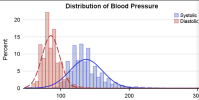
Think what you show is called a dot plot. Histograms are normally used to group different values on the x-axis. It turns continuous x-values in categories or bins so that each data point is no longer visible, just the frequency of each bin.
 
On that graph, would it be sufficient to round to the nearest point? At some point pixels and resolution of the image will create arbitrary bins, so it’s not like it’s entirely avoidable. So when is the tradeoff worth it for easier visual comparison?
I'm not sure what you mean by round to the nearest point.

Is it difficult to compare groups in the plot I shared? Along with an overlaid median line and maybe box plot, it seems to be good to see differences in distribution.

I guess a histogram looks a little less visually messy.
 
I'm not sure what you mean by round to the nearest point.
Oh I understand. Basically bin them to the width of one of the circles.

Yeah, I mean like here's a paper where after they corrected an error in their plot, they switched to the binned dot plot/histogram type visualization. I like the exact values on the left better.

Edit: But I can see an argument for it looking more organized for easy comparison.
1761435739543.png
 
Last edited:
Seems like there's a pretty large difference in age between the patient population and controls.

The "Clinical Examination" that was conducted doesn't necessarily give me the feeling that this group knows what the sydromes they are studying look like.
 
Oh I understand. Basically bin them to the width of one of the circles.
I meant to the nearest value in increments of 1, but that almost looks like the width of a dot in this case.
Yeah, I mean like here's a paper where after they corrected an error in their plot, they switched to the binned dot plot/histogram type visualization. I like the exact values on the left better.
Those are not histograms, though. Histograms start at the left and stack towards the right, like using «align left» in a text document. The new plot in that paper uses the equivalent of «centre text».

If you use align left with binned dots, you’d get my preference.
Think what you show is called a dot plot. Histograms are normally used to group different values on the x-axis. It turns continuous x-values in categories or bins so that each data point is no longer visible, just the frequency of each bin.
I think they can be combined like I tried to explain above.
 
Back
Top Bottom