Immune reset and immune retune: approaching cure? 2026 Isaacs

Jaybee00

Senior Member (Voting Rights)
Paywalled

The emergence of potent depletion therapies for the treatment of refractory autoimmunity has led to the concept of immune reset. Understanding whether immune reset equates to cure, and whether cure is achievable through non-depleting approaches, depends on the identification of immune biomarkers for measuring healthy and pathological immunity.


"Immune Reset"Rebooting the immune system by depletion of B cells, like a reboot of a computer, to achieve cures vs autoimmune diseases“

Seems like your cells become less colorful with CAAR therapy….
 
Last edited:
The emergence of potent depletion therapies for the treatment of refractory autoimmunity has led to the concept of immune reset.

`Er, no. The concept of immune reset led to the emergence of potent depletion therapies for autoimmunity - as described quite specifically in Edwards and Cambridge BJR 1998. We explained why immune reset was a possible goal and suggested using the newly developed drug rituximab as a basis for B cell depletion therapy.

If Topol likes to be 30 years behind the times, that's his problem, but I do wonder if treatment of autoimmune disease would be a bit further on if people bothered to think it a bit more.
 
If Topol likes to be 30 years behind the times, that's his problem, but I do wonder if treatment of autoimmune disease would be a bit further on if people bothered to think it a bit more.

Topol is just quoting John Isaacs, the author of the article. He is a professor of clinical rheumatology /RA specialist from New Castle University. Do you know him?


Professor John Isaacs​

Professor of Clinical Rheumatology​

  • Telephone: +44 (0) 191 208 5337
  • Address: 4th Floor, William Leech Building
    Medical School
    Framlington Place
    Newcastle upon Tyne
    NE2 4HH

Background
My team’s work is focussed in two major areas:


· The development and testing of novel immunotherapies for autoimmunity, with a particular interest in therapeutic tolerance induction.

· Rheumatoid arthritis – immunopathogenesis, biomarkers and novel therapeutic strategies including treatment stratification


Major current therapeutic projects include the development of an autologous tolerogenic dendritic cell therapy for rheumatoid arthritis (AUTODECRA, funded by Versus Arthritis ); the first ever clinical trial of a drug targeted at the synovial fibroblast in rheumatoid arthritis (TRAFIC, funded by the Medical Research Council); an experimental medicine study to identify the biological factors that underpin disease flare in rheumatoid arthritis (BIO-FLARE, funded by the Medical Research Council); we are also part of an EU Innovative Medicines Initiaitive, Rheumatherapy-Cure (RT-CURE), which aims to prevent rheumatoid arthritis by targeting ‘at risk’ individuals with tolerogenic therapies.


Therapeutic tolerance induction remains a ‘holy grail’ for human autoimmunity although there is now a concerted international effort to demonstrate that this is an achievable aim. A major limitation is a lack of understanding of the immune dysregulation inherent in most human autoimmunity, and consequent lack of ‘tolerance biomarkers’. These are essential in order to conduct rational therapeutic tolerance trials. This is a key aim of the MRC/ABPI Immunology and Inflammation Initiative for inflammatory arthritis, RA-MAP, for which I am Chief Investigator. By performing a systems immunology analysis of a cohort of patients with early rheumatoid arthritis, we will dissect the immunopathogenesis of the disease which, in turn, will provide key biomarkers.


All of our work is supported by cutting edge facilities, including the state-of-the art Wilson Horne Immunotherapy Centre and Versus Arthritis Experimental Arthritis Treatment Centre, a clinical research facility dedicated to the investigation of novel immunotherapies which incorporates arthroscopy and high resolution ultrasound scanning. We are a member of the NOCRI Translational Research Collaboration for inflammatory arthritis, for which I was the inaugural national lead. Our laboratory is based in recently refurbished, open plan laboratory facilities alongside other internationally renowned immunology researchers. I am also a principal investigator of the Versus Arthritis Centre of Excellence in Rheumatoid Arthritis Pathogenesis, alongside colleagues in Glasgow (PI Iain McInnes) and Birmingham (PI Chris Buckley)


Local roles:


  • Professor of Clinical Rheumatology
  • Director, Therapeutics North East
  • Deputy Director, NIHR Newcastle Biomedical Centre for Ageing and Long-Term Conditions.
  • Director of Research/Associate Medical Director, Newcastle Hospitals NHS Trust
  • Director, Newcastle Biomedicine Versus Arthritis Experimental Arthritis Treatment Centre
  • Director, Wilson Horne Immunotherapy Centre
  • Consultant Rheumatologist, Newcastle upon Tyne Hospitals NHS Foundation Trust


National and International roles:

2018-20 - Scientific Chair, European League Against Rheumatism (EULAR)

2020-21 - Member, UKRI/ DHSC Oversight Committee for Covid-19 Immunology in the UK

2019-23 - NIHR Senior Investigator

2018 - MRC Precision Medicine Group

2017 – Versus Arthritis Fellowships Expert Advisory Group

2016 – Member, NIHR/NOCRI Translational Research Collaboration for Inflammatory Disease

2014 - Member, MRC Translational Research Group
 
Topol is just quoting John Isaacs, the author of the article. He is a rheumatologist/RA specialist from New Castle University. Do you know him?

I do indeed know him. He was a great fan of T cell theories in 1998 but when I showed that rituximab worked and he showed that anti-T cell therapy didn't he joined my phase III rituximab trial. After I dissociated myself from Roche because they had failed to inform me of a death during my trial Isaacs and his then boss, Emery, tried to publish stuff on the trial without my permission. I managed to get an abstract booklet for a major meeti9ng to carry a bank page where their abstract was removed at the last minute!

The guy has had head in the sand for 30 years. Finally he may have realised which way the wind is blowing. It is pathetic.

So why is Topol citing a review as dumb as this? Why doesn't Topol know any better? If he is so ill-informed why does he keep tweeting stuff and writing flabby review articles with others who do the same?
 
https://sciencedaily.com/releases/2026/02/260210040608.htm

"Why does the same virus barely faze one person while sending another to the hospital? New research shows the answer lies in a molecular record etched into our immune cells by both our genes and our life experiences. Scientists at the Salk Institute have created a detailed epigenetic map of human immune cells, revealing how inherited traits and past exposures—like infections, vaccines, or even environmental chemicals—shape immune responses in different ways."

The article says that both B and T cells encode long-term memory, so just depleting B cells might not be enough.
 
The article says that both B and T cells encode long-term memory, so just depleting B cells might not be enough.

If you read Edwards and Cambridge you will see that this is known to be true for the normal immune response. However, there are specific reasons for thinking that it may not be true for autoimmunity - a useful one being the fact that after 50-odd years of looking nobody has found convincing evidence of abnormal T cell memory responses to the autoantigens the B cells recognise. There are no T cells against IgG to go with rheumatoid factor. There are, unsurprisingly, no T cells against DNA in lupus.

There does remain a possibility that depleting B cells is not enough but that was recognised from the outset. I guess the author still has trouble recognising that he built his career around the wrong theory, despite having it explained to him on several occasions why he had no good reason to. I knew Isaacs very well. We used to chat at length in airports when coming home from speaking at conferences. He never seemed to see why the T cell received dogma might be wrong.

I have not read the article but from what I hear it is no different from what he was saying in 1996.
 
Some summary quotes —

In the past 5 years, however, encouraging early results of deep B cell depletion through the use of chimeric antigen receptor (CAR) T cell therapy and other modalities have led to increasing use of the term ‘immune reset’ (or ‘B cell reset’). However, in this context, what defines reset? Does it equate to cure, and are there alternative routes to resetting autoimmunity?

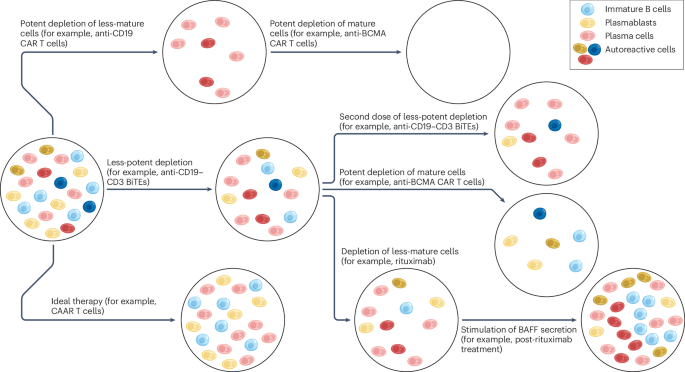
Whether B cell depletion achieves sustained, drug-free remission the clinical manifestation of immune reset — and, potentially, cure is probably dependent on the eradication or neutralization of all autoreactive B cell clones. Even rituximab, which is now regarded as a relatively weak B cell-depleting therapy, can provide sustained benefit in some patients (T. Garcia and D. Isenberg, personal communication). This beneficial effect might reflect the stochastic and serendipitous eradication of autoreactive clones or an incomplete (particularly in the tissues) reduction beyond a crucial threshold. A number of therapies now rank between rituximab and CAR T cells in terms of depth and breadth of depletion, including bi-specific and tri-specific T cell engagers and glycoengineered monoclonal antibodies. The breadth of depletion is determined by the B cell lineage target, broadening from CD20 (some B cells) and BCMA (predominantly plasmablasts and plasma cells) to CD19 (B cells and plasmablasts) and CD38 (B cells, plasmablasts and plasma cells).

An emerging challenge is managing relapse, particularly when less-potent depleting agents are used […] The balance between B cell depletion and B cell regeneration also requires thought, with sustained depletion increasing infection risk.

The ‘elephant in the room’ of this discussion is the inability to identify and specifically eradicate disease-causing B cell clones. This gap has complicated the use of rituximab since its initial approval, which has led to numerous treatment schedules comprising distinct doses and dosing intervals, none of which are biomarker guided in terms of when to re-dose. It has become clear that monitoring total peripheral blood B cells is an inadequate measure in the standard clinical setting.

Another important consideration is whether non-depleting therapies, which have fewer potential hazards than cell depletion, could achieve reset. Regulatory, as opposed to cytotoxic, CAR T cell therapy could be an option. By contrast, many therapies are being developed to tolerize autoreactive T cells. These therapies are mostly non-depleting and might be considered to ‘retune’ rather than ‘reset’ the immune system; instead of eradicating autoreactivity, they retune it back towards the healthy state.

As with immune reset, however, whether immune retune equates to cure remains unclear and, again, requires the development of relevant biomarkers.

The emergence of deep B cell depletion might signal a turning point in the management of at least some autoimmune diseases. As with all therapeutic revolutions, small-scale clinical trials must be accompanied by cutting-edge translational research and experimental medicine. This approach will enable iterative improvement of these revolutionary therapies and their optimal application. Ultimately, head-to-head trials of different therapies will be needed to demonstrate their relative efficacy and safety and the optimal management of relapse.

The early success of deep B cell depletion also speaks to the important interactions between B cells and T cells and that sufficient B cell depletion can also control the activity of autoreactive T cells.
 
It seems he is reluctantly admitting that we were right but cannot bring himself to cite the people who got long trm remissions in lupus in 2000 - Maria Leandro and myself (with Isenberg providing the patients somewhat reluctantly).

I am reminded of a certain Sir Simon for various characteristics that I prefer not to allude to directly.
 
Back
Top Bottom