Managing chronic fatigue conditions with overlapping symptoms, and the health policies and social services supporting those affected, 2025, Tate et al

Dolphin

Senior Member (Voting Rights)
Tate WP, Peppercorn K, Bowden N, Charlton F. Managing chronic fatigue conditions with overlapping symptoms, and the health policies and social services supporting those affected.
Med Res Arch. 2025 Dec 1;13(11).
https://esmed.org/MRA/mra/article/view/7104
https://esmed.org/MRA/mra/article/view/7104/99193549742

Abstract​

Complex chronic conditions present a formidable challenge to clinicians to diagnose and manage for their patients, and the diseases are still relatively poorly understood.

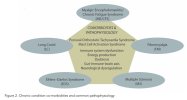
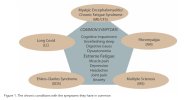
The chronic fatigue conditions, Myalgic Encephalomyelitis/Chronic fatigue syndrome, Long COVID, Fibromyalgia, Ehlers-Danlos syndromes and Multiple sclerosis, share many overlapping symptoms that reflect similar physiological responses, sometimes leading to misdiagnosis, yet the conditions are distinct and are being managed as separate diseases.

The characteristics of what is known about each condition is described here, and as well for two co-morbidities, Postural Orthostatic Tachycardia Syndrome and Mast cell Activation Syndrome intimately linked to the physiological dysfunctions of the chronic conditions.

The pathophysiological changes in immunological function, neurological regulation, metabolism and energy production, and the microbiome affecting the gut-immune brain axis are discussed and compared for each condition.

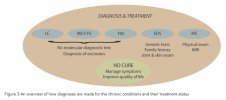
The difficulties encountered for diagnosis, and the current lack of effective treatment option are highlighted.

Evidence is presented that affected patients have pressing needs, and that there are currently barriers that prevent access to more effective health support, result in patients being isolated lifelong from employment, and that block access to the essential social services.

Effective public health policy is needed to ensure these inadequacies in public health support are overcome, and financial support is provided to ensure all patients have an enhanced quality of life.

There may be significant benefit for affected patients if research and collective knowledge of these conditions and comorbidities are shared and more integrated, to promote better understanding for their management, provide a wider range of common treatment options, and stimulate more co-ordinated health policies for the management of patient support.

Multiple sclerosis is far better served than the other conditions and could provide the model for how chronic conditions could be managed better.
 
To clarify: this part of the abstract is well meant:
Paper said:
Evidence is presented that affected patients have pressing needs, and that there are currently barriers that prevent access to more effective health support, result in patients being isolated lifelong from employment, and that block access to the essential social services.

Effective public health policy is needed to ensure these inadequacies in public health support are overcome, and financial support is provided to ensure all patients have an enhanced quality of life.

There may be significant benefit for affected patients if research and collective knowledge of these conditions and comorbidities are shared and more integrated, to promote better understanding for their management, provide a wider range of common treatment options, and stimulate more co-ordinated health policies for the management of patient support.

Multiple sclerosis is far better served than the other conditions and could provide the model for how chronic conditions could be managed better.
Everything before it is not necessary to make this argument. The causes or the conditions are not relevant to how they are managed from a public health perspective.

And while there is some overlap in the symptoms, the overlapping symptoms are so generic that you could have included any other chronic disease as well.

So I really don’t understand their approach. Especially when they get tangled up in a lot of babble so it’s easy for readers to dismiss them. There are much better ways to argue for the need for better care, and I fear this can do harm in positioning ME/CFS and the other conditions as the people that just believe they are sick.
 
From what you say, this sounds like the most useful recommendation.
I think it’s placed under neurology in the hospital departments in Norway. Everyone has a neurologist, there are MS-nurses that are in charge of coordinating their healthcare and other required services. There is well-functioning longitudinal tracking of the disease trajectory and national registers. Unless required due to equipment at hospital, the care can be performed at home.
 
agree with the feedback so far and I'm just scanning thru and dipping in as I'm getting 'disappointed' by the sectoins

reading from the 'energy metablosim' section onwards tho has sparked a thought

which is that problem of the bucketing of this term 'fatigue' used by bps (and goodness knows who else doing it for various conveniences) rather than it being a whole area that is really important in human function just disappeared into a disability bigotry they want to dismiss

I don't know how useful the support pwMS get with this, other than they are more believed in general because of their diagnosis and all that goes with it. But as we know that is different and can't be assumed that means all those who they come across take that aspect properly seriously in the sense of believing what they are saying is the impact rather than the hand-waive variation of it. Because the healthcare system decided 'this is the amount 'alotted' to it' regarding all sorts of tangibles and intangibles (like sympathy or willingness to understand)


If we were in a world where someone was wanting to take this whole area - and I am not sure it is 'lack of energy' rather than 'exhaustion and non-recovery' issues and I can't describe right now why these distinctions feel important if someone is putting a bit hypothesis board together of how these things interact. I guess a term I'm also reaching for is something like mapping?

then getting in front of people who have a range of diagnostic/taking histories beyond 'just to write it for notes' but really in the Oliver Sacks trying to work out what an illness is type way most of whom know physiology or biomedical stuff and/or are good with things that could be really helpful in working out methodologies/methods to see what's happening to different angles etc a variety of people with different conditions could be interesting.

And it's certainly interesting when I think of those I've known with other diseases that have treatments that happen to also sort their 'feeling awful and exhausted' at the same time as the other things said illness is more known for. Eg do those with RA or PA have any parts of their symptoms in this milieu that are actually similar x-fatigue (or exhaustion or type of feeling ill) as any pwme have?

Which I've added in as a bit of an important caveat to say that whilst I see benefits to the compare-contrast, the grouping could be an issue in red-herring if it creates arbitrary boundaries to what does and doesn't get on that list to be compare-contrasted etc.?

Particularly when there may be more clues or at least more known of the 'what has been found so far physiologically/mechanism-wise' with that disease, albeit perhaps with gaps, for some of the conditions and it could be interesting to compare and contrast where and how the patterns and specifics of what is bundled under 'ah fatigue... hand-wave' but includes more specific things like crashing out, exhaustion, if there are muscle 'can't lift' vs twitches or doing so with shakes from exhaustion and yes fatiguability vs 'fatigue' whatever things need new add-ons to differentiate the huge amount of things dumped under that


And when /if the world stopped thinking bigotedly and started realising how if they stopped reframing to try and pretend whatever all these things under this are (and I note @Utsikt point that it is actually quite momentous to separate it from depression and the likes - where it is 'feels like' and motivation complicating it) how actually doing this area properly accounts for a huge important step forward . and could elicit important knowledge that is useful for other illnesses we mightn't think of putting under this, or side-effects, or things that could help healthy people too even.

But boy do I feel that this also comes with risks grouping things together in a world that starts off bad things with bucketing to disappear the detail that means any problem-solving with happen.
 
The abstract indicates a total lack of understanding of the medical conditions (and non-conditions) being addressed. I think it is important to say loud and clear that this sort of review is unhelpful and may be seriously counterproductive. Charities and advocacy organisations should also make that clear.
 
The abstract indicates a total lack of understanding of the medical conditions (and non-conditions) being addressed. I think it is important to say loud and clear that this sort of review is unhelpful and may be seriously counterproductive. Charities and advocacy organisations should also make that clear.
I have a problem with this new term being used elsewhere that appears to be another one that has come out of nowhere without consultation or water-testing of this term 'overlapping conditions'

That combination of those two words is inferring something very specific which simply cannot be true.

some might be able muddy that fact and try and 'walk it back' by phrases like 'overlapping in some of the things they put up with, or some of the symptoms seem the same' - but they have chosen not to instead use words that focus on those 2 very different and very separate aims or points

It's doing the bpsers dream for them of bucketing us all into MUS

ANd just because MS is in there on this paper ...

well I know that there seems to be more being done if you have MS from a medical care point of view, and I'm guessing it is a postcode lottery and don't know whether some of the 'surrounding care' has come from charities and public being more on board or the medical side of things for all of the better stuff

But I would not be surprised if anything that is helping those with MS with any of the specific symptoms on the list in this paper is at best 'halo-effect' of taking people with MS seriously, and isn't it surprising if you have the right staff/people/personality types instead of being dumped with the opposite then normal, kind people know what 'help' is in the true sense of the word rather than the using the word to cover up being counter-productive sense the latter group does.

And is nothing necessarily to do with the larger world being particularly more serious or caring about these listed symptoms in someone who has MS vs we all get. ie is MS fatigue really taken seriously or is that just a side-effect of the better people taking care of those with MS and having some care?
 
Last edited:
Sometimes less is more. If they had limited themselves to sections 5 and 6, that could have made for a useful paper. As it stands I fear it is unhelpful

5. Current barriers to health services, employment, and social services
6. An Aotearoa New Zealand case study: inadequacies and inequities in public health policy
 
It is seriously disappointing. It's going to be difficult/impossible to convince people that this is the confused muddle that it is. It is going to harm people's credibility if they start trying to use this in advocacy. All of the authors are widely regarded as heroes in the New Zealand ME/CFS community. For sure, they meant well.

It's as if the authors haven't realised that not everything written in published abstracts is true.
 
Last edited:
The abstract indicates a total lack of understanding of the medical conditions (and non-conditions) being addressed. I think it is important to say loud and clear that this sort of review is unhelpful and may be seriously counterproductive. Charities and advocacy organisations should also make that clear.
Fiona Charlton is the President of ANZMES, which, until recently at least, was the main national ME/CFS charity. I expect ANZMES plans to use this to lobby the government for better care for people with ME/CFS in New Zealand.
 
I really don't know how to begin to tackle the issues this paper creates.

To start with the journal. I thought it was odd that the paper would be published in the 'European Society of Medicine' Medical Research Archives journal, so checked to see if it is credible. It seems it is not.

AI says this. I checked the sources cited, they seem to be legit.
The European Society of Medicine (ESMED) is widely considered a predatory organization by universities and researchers, suspected of being run by Knowledge Enterprises, Inc. (KEI) to profit from high publication/participation fees, despite emails promising prestigious indexing that often prove false. While ESMED's website presents itself as a legitimate community promoting health, critics highlight its deceptive practices, including potential fake editorial board members and misleading claims about indexing (e.g., "Medical Research Archives" journal), urging researchers to be cautious of their solicitations.

It sounds as though there are issues with peer review processes.

This is a post on a Research Gate thread about the journal
Multiple emails from Medical Research Archives of the European Society of Medicine asked me to contribute. The editor is someone named L. Smith who is not mentioned anywhere online. At first, I ignored them but eventually, after repeated emails I said yes. After that they asked me to pay to contribute and graciously offered me a 15%discount when I said I couldn't.

This is a predatory journal that looks out for young researchers from developing countries who might be relatively more desperate to get published. My advice is to stay away from such journals. They are a scam.
and another
I have had the same experience. This journal has an editorial board of 48 MD, PhD, with only 2 based in Europe which is the first hint that this a made up board of experts as the journal is suppose to be related to the European Society of Medicine. There is no editor-in-chief nor deputy E-in-C which is also very unusual as there is a need of experience leadership to overlook the peer-review process and take responsibility when it goes wrong (second hint).

They claim that " the European Society of Medicine is more than a professional association, it is a community. Our members work in countries across the globe!!! Why not calling it the World or International Society of Medicine.

Their overall strategy is to get you to work for the journal but you have to pay for it (3250$ or Euro same rate!!! or 900$ if you join the Society). This is modern slavery considering that the journal has no impact factor and not indexed. One must be quite desperate to publish in such a journal.
 
To start with the journal. I thought it was odd that the paper would be published in the 'European Society of Medicine' Medical Research Archives journal, so checked to see if it is credible. It seems it is not.
That is concerning. Even if the journal is actually better than it sounds here, if that’s the perception people have of it, papers published there will be seen as lacking credibility, irrespective of quality
 
Sometimes less is more. If they had limited themselves to sections 5 and 6, that could have made for a useful paper. As it stands I fear it is unhelpful
To expand on this

The authors appear to have adopted the opposite strategy of more is more. Pile on published finding after published finding, including preliminary or shaky ones, just as long as they seem to support the cause. All, I suspect, in the desperate hope that this results in the illnesses being taken more seriously after decades of being ignored and stigmatised. Understandable impulse, I’ve succumbed to it myself, and more than once, but it’s almost always counterproductive

Sure, it’ll play well with many patients who will feel seen and give grateful, positive feedback. But patients are not the audience that matters here. The people who matter here are politicians, health authorities, welfare departments and so on. And to them, with all their inevitable prejudices, it’ll read like a case of the lady doth protest too much

The core purpose of the paper, as far as I can see, is to illustrate how comparable chronic illnesses are treated very differently. Then there are various bits tacked on, some at length, but they detract from rather than add to the core argument

An argument that could be made more compellingly by cutting to the core, e.g. roughly like this:
  • select 3 poorly served but reasonably well recognised illnesses (ME/CFS, LC & FM) and 3 better served ones (MS, lupus?, RA?) that are similarly disabling and similarly fluctuating and variable
  • focus sharp on factors like QoL comparisons, workforce/eduction participation, research funding, eligibility for disability allowance, that sort of thing
  • this is bound to show that all 6 illnesses impact people similarly severely but some of them get much less support of any sort
  • there’s plenty here for a whole paper so let those figures speak for themselves
  • and don’t drown them out in the mind of the reader by getting sidetracked into lengthy introductions, hypotheses about pathology presented as facts, or whether the illnesses are bio or psych – it would only remind readers of their prejudices, and none of it is necessary for the core argument anyway
I don’t know if there’s a possibility of withdrawing this paper and starting over, do a rewrite and expansion of sections 5 and 6 and publish in a better journal?
 
I don’t know if there’s a possibility of withdrawing this paper and starting over, do a rewrite and expansion of sections 5 and 6 and publish in a better journal?
I support that idea. Perhaps the problem with the journal would give the authors a reason to have another shot at the paper.
At the very least, it would be great if they don't publicise the paper and don't attempt to use it for advocacy.


I thought I might start going through the statements to illustrate how poorly founded many of them are, but I've run out of enthusiasm for now after just tackling one.

I'd also point Professor Tate to his previous papers proposing that ME/CFS is an HPA axis problem, with the idea partly founded on an assumption that people with ME/CFS have low cortisol levels. None of the words 'cortisol', 'HPA axis', 'adrenal' and 'pituitary' appear in this paper, illustrating I think, how easy it is with ME/CFS to make a hypothesis built on shaky data and convince oneself that it is the answer, but for that hypothesis not to stand the test of time. Making a hypothesis is of course a good thing, but we really need our researchers to understand how bad most of the research on ME/CFS has been and so to critically look at the evidence for every statement that they make. And to not pretend that a hypothesis is a certainty.


Here's one statement in the introduction of this paper, actually, the very first statement.

Myalgic Encephalomyelitis/Chronic Fatigue syndrome (ME/CFS) is the name given to a post-viral/stressor syndrome that develops in the susceptible 5-10% of the population after a triggering event, typically a virus infection (80%) but also other major stressor events (20%)1.
I don't know how we would know what percentage of the population is susceptible to developing ME/CFS. We don't even have decent ME/CFS prevalence figures or know what factors cause ME/CFS, let alone an idea of how many people might get ME/CFS if they were exposed to the right combination of causes. Surely at this point, the susceptibility figure is unknowable?

The reference given there for the sentence as a whole is Charles Shepherd's MEA Purple Book, which is not a primary reference. I don't have access to that. If someone has a copy, can you please look to see if that susceptibility range is in there? I'm not actually sure if the Purple Book reference is for the 5-10% susceptibility figure, or just for the 80% following a virus infection (which is actually another guess presented as a certainty).

Aside from it not being right to present a wild guess as a fact, the susceptibility statistic helps to 'other' people with ME/CFS. Yes, there will be some people who are more susceptible to developing ME/CFS than others, but, for all we know, perhaps nearly anyone could get ME/CFS given the right circumstances. With the 'susceptible 5-10%', it is far too easy for the majority of prejudiced people to overlay that small percentage with their idea that ME/CFS is a disease of hysterical women who have suffered childhood trauma or similar, and assume themselves to be perfectly safe.

I searched the internet to see if anyone has supported the 5 to 10% susceptibility figure with any data. Two of the authors of this latest paper, Tate and Peppercorn, made the same susceptibility percentage assertion in their recent DNA methylation paper, so perhaps that can point us to the source? They say:
For the 5–10% of the population who have genetic or co-morbidity susceptibility to develop LC and ME/CFS [2,10], new COVID infections will continue to generate these debilitating ongoing post-viral conditions at a significant frequency.

I've looked at those two references given there (2 and 10). Both are more papers by Tate and Peppercorn, neither mention or give any basis for the 5 to 10% susceptibility range.

Ref 2 in the methylation paper is another Tate and Peppercorn paper
2. Tate, W.P.; Walker, M.O.M.; Peppercorn, K.; Blair, A.L.H.; Edgar, C.D. Towards a Better Understanding of the Complexities of Myalgic Encephalomyelitis/Chronic Fatigue Syndrome and Long COVID. Int. J. Mol. Sci. 2023, 24, 5124. [Google Scholar] [CrossRef]​
And Ref 10 in the methylation paper is another Tate and Peppercorn paper
10. Tate, W.; Walker, M.; Sweetman, E.; Helliwell, A.; Peppercorn, K.; Edgar, C.; Blair, A.; Chatterjee, A. Molecular Mechanisms of Neuroinflammation in ME/CFS and Long COVID to Sustain Disease and Promote Relapses. Front. Neurol. 2022, 13, 877772. [Google Scholar] [CrossRef] [PubMed]​

I've re-skimmed Reference 2. It is a mashup of a whole lot of theories about ME/CFS and is really really problematic, promoting various unevidenced commercial therapies and medications. It doesn't give a rationale for the susceptibility percentage.

"3. Stress: Managing stress requires a functional HPA axis and avoidance of high or low cortisol levels, all of which are not the typical states in ME/CFS.​
....​
MitoQ, an analogue of CoQ10 specifically targeted to mitochondria, also has promise as an antioxidant therapy for these conditions [117].​
....​
However, behavioural therapies have an important place, if transparent, and are an affordable option that might provide possible benefit to patients incrementally, and not as an instant cure. One such treatment option was brought to our attention recently by a New Zealand patient who, from a low place, obtained incremental benefit over several months from a programme, ‘dynamic neural retraining system’, based around recognising the brain’s neuroplasticity and potential to change its circuitry. There exists the potential to reverse patterns of interoceptive pathways that maintain a ‘sickness response’ where the brain circuity is wired to perceive ‘ongoing danger’ as a result of hormonal or cytokine signalling [64]. The ‘Dynamic Neural Retraining system’ was developed by Annie Hopper, and described in her book, ‘Wired for Healing’ [132]. She managed to reverse her severe neurological symptoms. Now this programme is offered publicly so others with chronic conditions may possibly benefit. The ME/CFS blog site Health Rising recently highlighted one case of a woman who benefited from this programme. Though initially wheelchair-bound with her ME/CFS, she returned to running again in a year after embracing the programme [133]."​
It doesn't say that 5 to 10% of the population have a genetic or co-morbidity susceptibiity to develop ME/CFS. After a discussion and a small survey, the paper concluded the following, which gives no quantitative estimate.

"Collectively, our quantitative analyses and the recent ME/CFS GWAS/combinatorial study suggest that both ‘nature’ in the form of the genetics of the individual and ‘nurture’ from the impact of the environment on their personal health history might together determine the susceptibility to whether a patient develops ME/CFS or Long COVID following exposure to a significant stressor."​

I've also skimmed Reference 10, and, although it manages to pack in just about every possible mechanism for ME/CFS that has ever been even idly suggested, it does not talk about a population susceptibility of 5 to 10%.
 
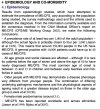
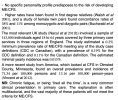
I can't find that claim in s4.1 ("Epidemiology") section of the 2022 ed of the Purple Book. I also can't find any mention of that range by searching for "susceptible" and a few other possible keywords. Here's what it says about the epidemiology:

1.jpg 2.jpg
 
Last edited:
Oops, yes, sorry, typo - 2022, not 2002. (Fixed.)

It doesn't appear in the epidemiology section of the 2009 Purple Book either. I wonder if they may have been conflating the ~5-10% persistent symptoms after certain acute infections (Dubbo, Katz & others) with a general population susceptibility?
 
Back
Top Bottom