
We now have a separate thread for the 2023 Helsinki University conference on Long Covid, here:
Finland: 2023 Helsinki University Long Covid conference
Finland: 2023 Helsinki University Long Covid conference


Auto-translate said:The research report has been published 19.12.2024
"Chronic fatigue syndrome (ME/CFS) is a complex long-term illness whose symptoms can severely limit the functional capacity of affected individuals.
The Invalidiliitto [The Finnish Association of People with Physical Disabilities] conducted a study to investigate the health status, functional capacity and coping in everyday life of people with chronic fatigue syndrome (ME/CFS).
It is estimated that there are up to 10,000 people with ME/CFS in Finland, but their condition and functional capacity have not previously been comprehensively studied using valid self-assessment methods. The information provided will help to ensure that the needs of people with ME-CFS are better met in our society."
Read more on the website of the Invalidiliitto
https://www.invalidiliitto.fi/ajank...s-rajoittaa-merkittavasti-arjen-toimintakykya
To access the research report directly, click on the link below
https://www.invalidiliitto.fi/sites/default/files/2024-12/ME_CFS_raportti.pdf
A peaceful Christmas time for all

Doesn't seem that any media picked up this story. I got today in the mail the printed magazine from the "Finnish Association of People with Physical Disabilities" or "it-magazine" as it's called and it has a tiny few row long summary of the study, with a link to their website to learn more if interested. Rest of the magazine is filled with pictures of smiling disabled people and their stories how they found joy in life etc. Quite disappointing but not exactly unexpected.

Finland provides a rare, high-resolution view of these dynamics—not because it is biologically unique, but because it still maintains relatively comprehensive national health registries and wastewater surveillance.
Much of the most accessible synthesis of this data has been produced by Ilkka Rauvola, an equity research analyst by profession, who publishes independent analyses under the handle @jukka235 and in a Substack newsletter (“Ilkka’s Newsletter”). Rauvola is not a clinician or epidemiologist. His contribution lies in applying rigorous time-series analysis to public data released by Finland’s health authorities.
Rauvola’s analyses show that since 2019, the cumulative share of the population recorded with disease diagnoses has risen across nearly every major ICD-10 category. By 2025, compared with 2019 levels, Finland has seen:
Age-stratified analyses using 2020 as the baseline show increases across all age groups by 2025, including 1.39 times baseline among ages 25–49, 1.47 among ages 50–74, 1.61 among those over 85, and 1.62 among infants.
- Mental and behavioral disorders rise to 1.73 times baseline
- Blood and immune disorders to 1.68
- Diseases of the nervous system to 1.64
- Genitourinary diseases to 1.56
- Endocrine and metabolic diseases to 1.48
- Total disease burden across categories to 1.35
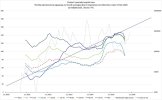
As Rauvola recently noted on his social media post: “In fact, we’re seeing exponential growth in patient numbers across all disease and age groups in Finland. The trend is strikingly linear on a log scale, with no sign of any slowdown since 2020. No health system can take this for long. It’s just a matter of time.”

Any pre-pandemic trend baselines to show the impact of the pandemic specifically?
Long COVID and the concealment of pandemic harm
As COVID completes its sixth year, official statistics obscure the scale of harm, while Long COVID and excess deaths reveal the pandemic’s continuing public health consequences as well as the impact of social inequality.www.wsws.org
View attachment 29904
