BUFFALO, NY — February 19, 2026 — A new research paper was published in Volume 18 of Aging-US on February 8, 2026, titled “Single-cell transcriptomics reveal intrinsic and systemic T cell aging in COVID-19 and HIV.”
www.eurekalert.org
News Release 19-Feb-2026
New single-cell transcriptomic clock reveals intrinsic and systemic T cell aging in COVID-19 and HIV
“These findings underscore the promise of single-cell transcriptomic biomarkers to disentangle the systemic and cell-intrinsic components of immune aging and to measure immune aging.”
Peer-Reviewed Publication
Impact Journals LLC
FacebookXLinkedInWeChatBlueskyMessageWhatsAppEmail
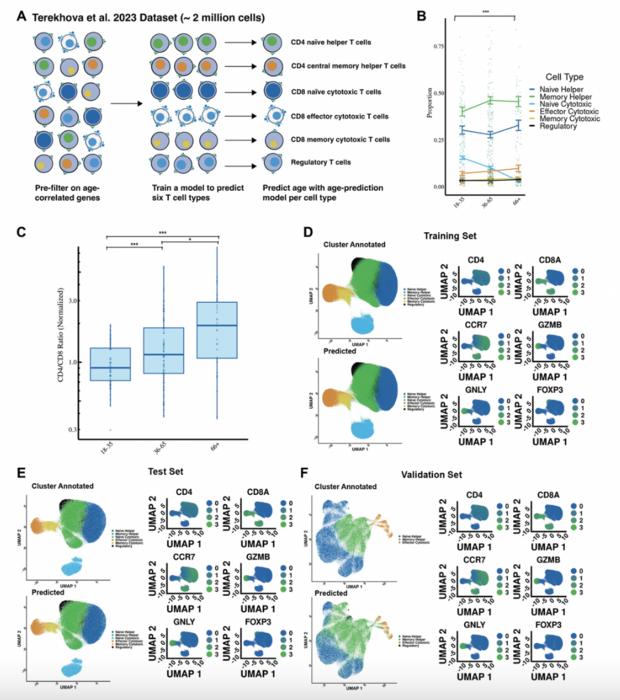 image:
Figure 1. Cell type predictions recapitulate known effects of aging on the immune system. (A) Overview of the study design, including the development of cell type prediction and age prediction models using single-cell transcriptomics. The workflow highlights data preprocessing, clustering, annotation, and model training. (B) Cell type proportion changes in individuals from different age groups. (C) CD4/CD8 ratio increases with age, normalized to individuals aged 18–35. (D) Comparison of predicted versus manually annotated cell types in the training dataset. Cell annotations were based on canonical markers: CD4, CD8A, CCR7, GZMB, GNLY, and FOXP3. Predicted clusters align closely with ground truth annotations, demonstrating the accuracy of the model. (E) Validation of the model in the test dataset, showing high concordance between predicted and manually annotated clusters with quantitative accuracy metrics (97% accuracy; F1 score = 0.97). (F) External validation using the Yasumizu et al. (2024) dataset demonstrates robustness across datasets (83% accuracy; F1 score = 0.80). Statistical significance is indicated: *** Bonferroni-corrected p-value less than or equal to .001, * Bonferroni-corrected P-value less than or equal to .05, # Bonferroni-corrected P-value less than or equal to .1.
view more
Credit: Copyright: © 2026 Tomusiak et al. This is an open access article distributed under the terms of the Creative Commons Attribution License (CC BY 4.0), which permits unrestricted use, distribution, and reproduction in any medium, provided the original author and source are credited.
“These findings underscore the promise of single-cell transcriptomic biomarkers to disentangle the systemic and cell-intrinsic components of immune aging and to measure immune aging.”
BUFFALO, NY — February 19, 2026 — A new research paper was published in
Volume 18 of Aging-US on February 8, 2026, titled “
Single-cell transcriptomics reveal intrinsic and systemic T cell aging in COVID-19 and HIV.”
In this study, co-first authors Alan Tomusiak from the
Buck Institute for Research on Aging and the
University of Southern California, and Sierra Lore from the
Buck Institute for Research on Aging and the
University of Copenhagen, together with corresponding author Eric Verdin from the
Buck Institute for Research on Aging, developed a new single-cell transcriptomic clock called T immune cell transcriptomic clock (Tictock) to measure aging in specific immune cells.
Immune aging increases susceptibility to infection, cancer, and chronic inflammatory disease. Most aging clocks, used to measure it, rely on bulk measurements from mixed cell populations. As a result, they cannot determine whether age-related signals reflect shifts in cell proportions or true molecular aging within defined immune cells.
To address this limitation, the research team used single-cell RNA sequencing, a method that measures gene expression in individual cells. They analyzed nearly two million immune cells from the blood of healthy adults to develop Tictock. This tool integrates automated classification of six canonical T cell subsets with cell-type specific age prediction models. This design enables the separation of systemic aging, reflected by changes in cell proportions, from intrinsic aging, which occurs within individual cells.
When the team applied Tictock to patients with acute COVID-19, they found two clear effects. First, COVID-19 altered T cell composition, including significant reductions in naïve CD8 and naïve CD4 T cells. Second, the infection increased the biological age of naïve CD8 T cells. In people living with HIV who were receiving long-term antiretroviral therapy, T cell proportions remained largely stable. However, naïve CD8 T cells still showed signs of accelerated aging.
The study also uncovered shared biological pathways linked to immune aging. Many of the genes that predicted age were involved in ribosomes, the structures that help cells produce proteins. The researchers also observed that older immune cells often had shorter average transcript lengths, a feature previously linked to aging. These findings suggest that changes in protein production and gene regulation play an important role in immune decline.
“Gene Ontology enrichment of 209 genes shared across six clock models identified common pathways including the cytosolic small ribosomal subunit, TNF receptor binding, and cytosolic ribosome components.”
Overall, Tictock was designed to measure relative aging within defined T cell populations rather than overall biological aging. By distinguishing systemic from cell-intrinsic immune aging, it provides a clearer understanding of how viral infections such as COVID-19 and HIV reshape immune function. This approach enables the study of immune aging at single-cell resolution and may support improved immune risk assessment in clinical and research settings.
Paper DOI:
https://doi.org/10.18632/aging.206353
Corresponding author: Eric Verdin –
EVerdin@buckinstitute.org
Keywords: aging, transcriptomic clock, aging biomarkers, systemic aging, intrinsic aging
Click here to sign up for
free Altmetric alerts about this article.
______
To learn more about the journal, please visit www.Aging-US.com and connect with us on social media:
Click here to subscribe to
Aging-US publication updates.
For media inquiries, please contact
media@impactjournals.com.
Journal
Aging-US
DOI
10.18632/aging.206353
Method of Research
News article
Subject of Research
Cells
Article Title
Single-cell transcriptomics reveal intrinsic and systemic T cell aging in COVID-19 and HIV
Article Publication Date
8-Feb-2026
COI Statement
The authors declare no conflicts of interest related to this study.

