The Role of ME/CFS Phenotype in Outpatient Post-COVID Rehabilitation 2026 Kaiserseder et al

Andy

Senior Member (Voting rights)
Post-COVID-19 syndrome (PCS) shares core clinical features with myalgic encephalomyelitis/chronic fatigue syndrome (ME/CFS), particularly persistent fatigue and post-exertional malaise (PEM). However, the prevalence of ME/CFS among PCS rehabilitation outpatients remains unclear.

Medical records of 216 PCS rehabilitation outpatients (57% female; age 47.7±12.5; January 2021 to April 2022) were retrospectively reviewed. During rehabilitation and at a six-month telephone follow-up, ME/CFS was diagnosed using the Canadian Consensus Criteria (CCC). Demographics, body mass index (BMI), FAS, and 6MWT were compared between phenotype and non-phenotype groups using logistic regression, repeated measures ANOVA, and chi-square tests (α=0.05).

Of 216 patients, 15 (93% female; age 40.6±10.7; BMI 25.7±5.6) met ME/CFS criteria, yielding a prevalence of 6.9%. Compared with non-ME/CFS phenotype, ME/CFS phenotype patients were significantly younger (p=0.01) and predominantly female (p=0.003). Baseline FAS was significantly higher (35.8±6.4 vs. 27.8±8.6, p=0.001) and did not improve (Δ +1.3±4.5 vs. Δ -5.1±6.2, p<0.001). Baseline 6MWT was significantly lower (479±132 m vs. 540±96.1 m, p=0.02) and both groups improved over time, but between-group change was not significant (p=0.49).

Approximately 7% of PCS in outpatient rehabilitation exhibit ME/CFS, characterized by severe, persistent fatigue, female predominance, and attenuated functional gains. While the FAS is a practical screening tool, confirmation via CCC remains essential. Future studies should validate these findings and explore tailored rehabilitation strategies for patients with ME/CFS.

Open access (in German)
 
The figures are worth a look.
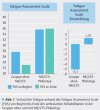
The fatigue figure (blue is fatigue pre-rehab, green is fatigue after rehab, left two columns are the group without ME/CFS, next two columns are the group with ME/CFS):
1775054846515.png
That's "Course/progression of fatigue on the FAS pre- and post-outpatient rehabilitation in groups with and without ME/CFS"
 
Last edited:
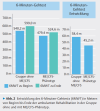
The 6 minute walking test figure:
(blue is pre-rehab, green is after rehab, left two columns are the group without ME/CFS, next two columns are the group with ME/CFS)
1775054998782.png
That's "Change in 6MWT in metres between the beginning and end of out-patient rehab in the group with and without ME/CFS"
 
Last edited:
The 6 minute walking test figure:
(blue is pre-rehab, green is after rehab, left two columns are the group without ME/CFS, next two columns are the group with ME/CFS)
View attachment 31538
That's "Change in 6MWT in metres between the beginning and end of out-patient rehab in the group with and without ME/CFS"
The Cohens D for the mean difference for the six minute walking test for the grade exercise group in the Pace trial was 0.2. And not significant for the CBT group. This looks better than that, but I don't know what the Cohen's D would be here. But the result is very different from the effect on FAS..
 
The Cohens D for the mean difference for the six minute walking test for the grade exercise group in the Pace trial was 0.2. And not significant for the CBT group. This looks better than that, but I don't know what the Cohen's D would be here. But the result is very different from the effect on FAS..
Yeah, they end up a little more tired.

Dropouts are interesting too:
4.5% of those without ME/CFS dropped out vs 26.7% of those with ME/CFS (all of the latter due to "CRASHES").

I cannot see a description of the rehab content. But all ME/CFS patients reported consistent pacing as the most important strategy.
 
Dropouts are interesting too:
4.5% of those without ME/CFS dropped out vs 26.7% of those with ME/CFS (all of the latter due to "CRASHES").
That is telling. I don't suppose they have a sensitivity analysis that assumes that those who dropped out declined rather than stay the same as baseline?

One of the laws of the Pace trial was that things he reported deterioration were assessed by "independent" medics (presumably independent of the study, not necessarily of the psychosocial perspective) and all were deemed to be unrelated to the therapies. What would've been very interesting was to have the reasons patients attributed their decline to, as in thus study. (That said, dropout rates were pretty low, much lower than in some earlier CBT/get trials that also reported spectacular results.)
 
Future studies should validate these findings and explore tailored rehabilitation strategies for patients with ME/CFS.
Ah well here's your problem: you're supposed to do that before you claim the patients. The reverse question is far more meaningful: what is the role of rehabilitation in ME/CFS? None. What is this nonsense? And what they do even mean by "validate these findings"? What findings? This:?
and did not improve
Or that?:
between-group change was not significant
Which actually makes a case that even non-ME/CFS don't really benefit from any of this.

They keep finding that none of this serves any purpose and they can't stop doing it, there is no leadership, no strategy, no thinking involved.
 
I don't suppose they have a sensitivity analysis that assumes that those who dropped out declined rather than stay the same as baseline?
Alas, no.

They have a figure that compares different studies' estimates of prevalence that you might enjoy, though.

One of the laws of the Pace trial was that things he reported deterioration were assessed by "independent" medics (presumably independent of the study, not necessarily of the psychosocial perspective) and all were deemed to be unrelated to the therapies. What would've been very interesting was to have the reasons patients attributed their decline to, as in thus study. (That said, dropout rates were pretty low, much lower than in some earlier CBT/get trials that also reported spectacular results.)
I think those attributions would have been affected by the, ahem, "education" they had been given.
 
The figures are worth a look.
The fatigue figure (blue is fatigue pre-rehab, green is fatigue after rehab, left two columns are the group without ME/CFS, next two columns are the group with ME/CFS):
View attachment 31537
That's "Course/progression of fatigue on the FAS pre- and post-outpatient rehabilitation in groups with and without ME/CFS"
The results for the non-ME-patients weren't that impressive either. Five points lower on average probably should be framed as important and clinically relevant, but that's including placebo effects, possible (probable) lowering of fatigue due to those patients often getting better regardless of the rehabilitation (natural course), and bias due to some patients dropping out.

28 points is just into the range of moderate fatigue (28-34), and 22 points is just into the range of mild fatigue (22-27). A lot of the patients without ME/CFS thus scored in the normal range on the scale (<22 points), especially at the end of the rehabilitation, which corresponds to around the 65th percentile in the population or lower. That's fatigue on what's really a normal level in our society, nothing close to ME/CFS.
 
The results for the non-ME-patients weren't that impressive either.
A lot of the patients without ME/CFS thus scored in the normal range on the scale (<22 points), especially at the end of the rehabilitation, which corresponds to around the 65th percentile in the population or lower. That's fatigue on what's really a normal level in our society, nothing close to ME/CFS.
Yeah, it's hard to know what to make of that group because we get no information on what was wrong with them. All we know is that they got COVID and a doctor wanted them to have rehab. Does that mean they were struggling with daily activities?

If they have reduced their activity level or been advised not to overexert, then their fatigue level might not show as too abnormal, even though it would be very abnormal if they pushed themselves to do their pre-morbid level of activity.

In terms of the 6 minute walking test, they're not awful either.

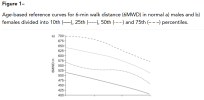
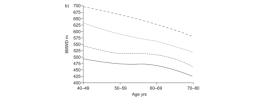
Found these norms for the 6MWD by age and gender here:
1775223302055.png
1775223947164.png

The group without ME/CFS's mean age was "40,6±10,7 vs. 47,7±12,5 Jahre" for those with ME/CFS. And the group without ME/CFS had fewer females than the 93% female ME/CFS group. Unfortunately they don't provide the percentage for the group without ME/CFS.

From the graphs above, that would put the group without ME/CFS at (female) or a bit below (male) the 50th percentile and the group with it around the 25th percentile.

Rehabbing the group without ME/CFS looks a bit like rehabbing the average citizen, based on those measures. But I don't think those two measures necessarily capture their difficulties well. We just don't know what their difficulties are.

When I was mild, I would guess I would have scored in a decent percentile for the 6MWT, but I could only work part-time, could not exercise and activities outside of work were minimal. Fatigue score would have been high though.
 
Back
Top Bottom