2025: The 2019/24 Cochrane Larun review Exercise Therapy for CFS - including IAG, campaign, petition, comments and articles

@Hilda Bastian vis à vis Switzerland ending national subscription, I think this is slightly innacurate. The SAMS has announced it will stop providing money towards the national subscription but given that many universities and university library plus the Federal Office of Public health provides much of the money towards the “national subscription”, I don’t think that means the Swiss national subscription is ending?
 
Interesting that, now, two countries are discontinuing such an arrangement. This is what the Swiss Academy for Medical Sciences webpage says:
The SAMS has decided to end its support for two main reasons. The first is that the Academy, in its role as catalyst, has as a rule financed projects for a fixed period, often shorter than the 10 years of support for the Cochrane Library. The second reason is the absence of any increase in the subsidies granted by the Confederation to the SAMS over the period 2025-2028, forcing the SAMS to make budgetary trade-offs.
Of course, the Academy reiterates its support for evidence-based research. Aware that its decision leaves a gap, it has endeavoured to find other partners to fund the national licence. Unfortunately, prior contacts have not identified an entity willing to take on this responsibility. We are well aware of the inconvenience caused by this situation, which is why we wanted to inform those concerned as soon as possible.
Presumably that means that it will be left to the individual institutions (universities, hospitals, health agencies) to subscribe to Cochrane content via Wiley on an institution-wide basis, as occurs in countries without a national licence.

The "national licence" concept is actually quite unusual - certainly, I've never heard of any other organisation's journal being made available, by taxpayer provision, to everyone coming off a specific country's IP address ranges before. There are some examples of outsourcing, such as NICE CKS (the provision of which is outsourced to Clarity Informatics) but not for a journal; Cochrane seems to have finagled themselves quite a unique arrangement here.

If the statement is taken at face value, SAMS have discontinued their support for financial reasons, rather than due to a fundamental reassessment of Cochrane itself.

Nonetheless, good news.
 
A further mention in a new blog post by HB, "When an Old Weak Theory Leads a Field Astray":
I spent a lot of time recently on another example of this phenomenon. Back in May, the BMJ ran an online opinion piece by Alastair Miller and colleagues arguing that even people with severe ME/CFS can recover if they are guided down a path that begins with “reframing beliefs about illness.”
That theory of ME/CFS – that the mind is central to overcoming the condition – persists in large part due to sustained promotion like this. It comes, as these things tend to do, with a lot of references that gives an impression of solidity. Readers ordinarily don’t have time to do anything other than take all that at face value. This time, I decided to go systematically down the rabbit hole of citations, to understand the the links in the chain of theory that leads to telling people they are, in effect, responsible for their own suffering.
https://hildabastian.wordpress.com/2025/08/06/when-an-old-weak-theory-leads-a-field-astray/
 
That theory of ME/CFS – that the mind is central to overcoming the condition – persists in large part due to sustained promotion like this.

in reference to
Back in May, the BMJ ran an online opinion piece by Alastair Miller and colleagues arguing that even people with severe ME/CFS can recover if they are guided down a path that begins with “reframing beliefs about illness.”

A really important thing for someone to say.

Particularly given eg this specific issue of 'confusion' [due to mixed messages about what was useful for the illness/its cause] that came up as being behind continual delays/non-treatment in Maeve's inquest (summer 2024) that culminated in a prevention of future deaths follow-up (autumn 2024) - although I don't know whether that was sent to the BMJ or those that commissioned this article by Miller et al (and included Garner) that was published in May 2025?

I'd be brave and wonder what was going on when he wrote an article published on 27th July 2024, ie at the actual time of the inquest itself too: https://www.theguardian.com/comment...case-highlights-clashing-nhs-narratives-on-me.

Where he [Miller] tried to pick a slightly different path of rhetoric about what his/their narrative was, about what they claimed they had merely been 'pushing' (as in 'push' communications/education etc) and why. my bolding:

Sadly, it is this conflict between those who think that ME/CFS is a purely psychological condition, with no biomedical basis, and those who believe it is a purely physical condition, with no psychological implications, that has dominated the narrative around this illness.

In mainstream ME/CFS clinics where I’ve worked in the NHS, the conversation is completely different. I know of no colleagues who hold the view that ME/CFS is “all in the mind”. It is just that we currently cannot yet identify a mechanism. Not surprisingly the highly unpleasant and debilitating symptoms are often exacerbated by associated depression and anxiety, and therefore many patients benefit from appropriate psychological interventions such as cognitive behaviour therapy (CBT).

It is also clear to doctors in the field that the individuals who recover best from ME/CFS are those who steer a “middle road” between excess physical activity and excess rest. Patients can’t exercise their way out of the illness but neither will total inactivity deliver recovery. The fact that we use CBT and other behavioural approaches in no way implies that we do not believe this is a physical condition. After all, we use CBT and rehabilitation to relieve symptoms in cancer, in rheumatoid arthritis and following heart attacks. Nobody has ever suggested that those conditions are “all in the mind”.
 
They knew exactly what they were saying. Not owning up to it just goes to show how little credibility they can be given.
After all, we use CBT and rehabilitation to relieve symptoms in cancer, in rheumatoid arthritis and following heart attacks. Nobody has ever suggested that those conditions are “all in the mind”.
And you’re sure those interventions actually achieve anything for those conditions?
 
Apologies for being late to the game on picking this one out and sure it is repeated elsewhere but as there was a link to her rapid response to that Miller et al article (that included Garner): https://www.bmj.com/content/389/bmj.r977/rr-30

I couldn't help but thank her for underlining the following, (particularly considering Miller's assertions/narrative in the third quote box of my comment above):

Perhaps part of why psychologically-based rationales for disease can be widely accepted is because the harm this can do is underappreciated. Miller et al argued that their narrative inspires hope, and people with severe ME/CFS deserve that. But when the unproven theory can’t deliver on the claims, what then? In a study Miller et al cited, researchers found that being told the disease was psychosomatic was the most common reason for suicidal thoughts for people with ME/CFS. [9]
 
Apologies for being late to the game on picking this one out and sure it is repeated elsewhere but as there was a link to her rapid response to that Miller et al article (that included Garner): https://www.bmj.com/content/389/bmj.r977/rr-30

I couldn't help but thank her for underlining the following, (particularly considering Miller's assertions/narrative in the third quote box of my comment above):
Glad she picked up on that. I said it in the thread on the paper and some germans partially (but unfortunately not very explicit) mentioned that in a later rapid response.

Glad to see her take it up and write it out simply and clearly.
 
Not that it applies to any other group either. The whole thing has been revealed as a total scam, regardless of what criteria are used. It makes no meaningful difference for anyone who has fatigue significant enough to warrant a complaint to a health care professional. And even then "I have fatigue" is almost never the actual complaint, all of this is just a corrupt distortion of basic facts with very flawed intent and purpose.

But seeing the pathetic state of Long Covid, stuck in the exact same bind, it's cleat that none of the problems have anything to do with the patients, and everything to do with the terrible state of health care for any issues where the biology is not understood. This is what needs to be fixed. The medical profession needs to do the equivalent of putting on their own oxygen masks before they start thinking about putting it on someone who is unable to. The industrial scale publication and application of flawed pseudoscience is a major scandal in itself, and the industry is clearly incapable of moving out of it.
 
Has anything more happened from Hilda and whatever the plan was that replaced the IAG group doing something else at the time (I will have refreshed myself if anything specific ever got said)?

Do we have anything to indicated anything is going on at all?

Or is that another quietly dropped situation ending up after things were bigged up as an alternative just at the point where there was a choice to do something as momentum and the timeline would have been there?
 
That's a good question, bobbler. I haven’t heard any more. I assume that means Hilda got nowhere, just as we did.

I would have liked to do a formal complaint to the UK charity commission and the publisher of the review, but ran out of energy to pursue it, and no-one else on our committee was able to pursue it. If someone else wants to take it up and lead a complaint, go for it, with forum discussion to make sure it's done as well as possible.
 
I guess we should at least post something on the petition site at some point.

I don't understand how people associated with Cochrane but without a particular attachment to the Larun et al review have been okay with all that went on.
 
I guess we should at least post something on the petition site at some point.

I don't understand how people associated with Cochrane but without a particular attachment to the Larun et al review have been okay with all that went on.
At this point there isn't much to say other than this is just who they are, and that this will age very poorly. But this isn't just Cochrane, almost the whole profession acts this way when dealing with problems like this, which also means that this is who they are, and that this all age very poorly.

There's something I've been meaning to write for a while now, but haven't found the energy and concentration for, about what this will all mean once it's all exposed, once we finally understand the biology and how it goes wrong. Psychosomatic literature is almost entirely devoid of any thoughts about the possibility that it can even be wrong, only the odd musing about how maybe one day someone will figure one small part of it out.

But no one has ever given thought to what it will all mean once it's all exposed as a sham, what the cruel systems they built will mean to the profession's reputation, and all the liability they are incurring. I have never once seen even the smallest thought given to this. This is something I would very much like them to think about for once. It will not look pretty, even more so by the high probability that it will be machine intelligence that does it. If that never happens, it very likely means our civilization won't survive. Science works, slowly, but damn does it work well. Literally better than magic.

There is genuinely more thought given to the possibility of god not existing in the theological disciplines, and that includes clergy. It's stunning how total this belief system, which is clearly compensating for how little evidence there actually is for it. This reflexive circling the wagons is such a big tell. The whole strategy is to always attack and never, ever accept a single loss of face, to overhype everything they do and downplay everything that contradicts it. Nothing legitimate ever works like this.
 
I think once they are proved wrong for ME/CFS they will twist it to say either they never meant people with PEM. Or they will say they never meant they were curing us, but they were providing helpful support by reducing our fatigue, just like they are showing now(not) for other fatiguing conditions like MS.
 
This new article discusses the debate in extensive detail:

Jackson, S. A Normative Pragmatic Inquiry into the Volatility of Norms in Argumentation. Argumentation (2026). https://doi.org/10.1007/s10503-026-09705-3

 
The four versions of the review overlap substantially in content. After its original publication in 2015, it was amended slightly (2017), amended again, more significantly (in 2019), and republished (in 2024) with no change except to an attached editorial note. All four versions of the review are based on the same set of randomized clinical trials identified in a comprehensive literature search completed in 2014. Each of these RCTs attempted to assess the effects of exercise treatment on patients meeting some set of criteria for chronic fatigue syndrome.<a href="https://link.springer.com/article/10.1007/s10503-026-09705-3#Fn12"><span>Footnote</span>12</a> The reviewers’ conclusions varied from one version to the next, but from 2015 to 2024 exercise therapy was consistently represented as something beneficial to patients.
As noted earlier, Cochrane expects authors to respond to comments from the public, following clear guidelines for what should be included in a response. As can be seen in Fig. 3, at first, all comments received responses from the lead author of the review, Larun; then, Cochrane editors took over responding to comments; for a short while, comments went unanswered; and still later, Larun resumed responding. Authoritative prescriptive content from Cochrane suggested that author responsiveness is a participation norm in this situation, but the irregularity with which this norm was followed is quite noticeable.

When Cochrane’s editors began responding to comments, they also attached an editorial note to the review to explain why: a formal complaint about the review had been received and the review was under investigation.<a href="https://link.springer.com/article/10.1007/s10503-026-09705-3#Fn13"><span>Footnote</span>13</a> As will be explained more fully later, the basis for this complaint was Larun’s unsatisfactory responses to public comment.

A revised version was not accepted until October 2019, but even after that, Cochrane continued responding to public comments, now referring to a different editorial note saying that Cochrane intended to launch a process to replace the review with a new approach. In December 2024, Cochrane abruptly announced that the new review had been cancelled. The old review was simply republished with no change in substance, but with a new publication date. Yet another note was attached conveying that Wiley and Cochrane had decided to stand by the decision made in 2019 to publish the amended review, which led to a new round of critical responses. At this point, Larun (the lead author of the review) resumed responding to comments.

Altogether, the texts included in the study are the four versions of the review, editorial notes that signal Cochrane’s stance toward the review, 20 public comments organized into 15 threads, responses to many (but not all) of these comments, the unpublished formal complaint, and a few other documents to which comments referred (such as the Cochrane Handbook, the current version being Higgins et al. 2024).
Recall (from Fig. 2) how Cochrane described its institutional values: “Trusted evidence/Informed decisions/Better health.” These are situated ideals, encompassing both correctness and participation. The last of these three elements is printed in red letters, and it signals that correctness depends, ultimately, on the usability of Cochrane’s products to deliver improvements in health care, but Cochrane (the organization) also aims to promote evidence-based medicine for this purpose. There is no reason to suppose that any given situation allows recourse to only one ideal of correctness, and in this case, it is apparent that there are at least two. These overlapping but clearly distinguishable ideals of correctness became nearly explicit by the last few threads of the debate over the Larun et al. review. Once identified, they could be seen running through earlier threads as well, though in less explicit form.

The first of these situated ideals has to do with pursuit of facts through scientific methods; I will call it “facticity” rather than truth, because this ideal has to do with a commitment to scientific fact-finding as the indisputable foundation for reasoning about health and medicine. If something is believed to be true, this ideal requires efforts to demonstrate its truth scientifically. In this debate, claims about the benefits of exercise therapy for ME/CFS patients gain facticity from RCTs; claims about harms of exercise therapy, though possibly true, lack facticity in this sense. The second ideal has to do with making decisions that lead to better health. This ideal assumes that the contribution of medical science is to supply the facts needed to make correct decisions (not to find facts for their own sake). Since this ideal has to do with whether a factual claim provides a premise for a further conclusion of different logical type (a decision about treatment), it is signaled in argument by suspicion that facts produced without regard for their ultimate use may misdirect decisions. Judged against this second ideal, establishing benefits of a treatment as facts without also using the same methods to establish facts regarding harms carries the risk of promoting use of a treatment even though it may have unknown harms that outweigh its known benefits. Practical reasoning about a proposed medical treatment requires that both benefit and harm be considered, and lack of scientific demonstration of harm does not waive this requirement, especially if there is any (other) good reason to believe that the treatment is risky.
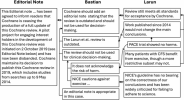
Despite the clues provided by Cochrane’s three-part motto, I first suspected diverging ideals only when I reached the end of the debate, then worked back through all 15 threads to look systematically for confirmation or disconfirmation. Relevant content from thread 15 is shown in Fig. 4. The context for Bastian’s comment, as shown previously in Fig. 3, was Cochrane’s announcement that a promised replacement for the Larun et al. review had been cancelled and the republication of the 2019 version of the review, unchanged, with a 2024 publication date. An editorial note conveying that Cochrane stood by the decision it had made to publish the 2019 version is shown in the lefthand panel of the flowsheet for this thread. The middle panel summarized the argument in Bastian’s comment (submitted on behalf of the Independent Advisory Group that Cochrane had formed to assist in replacing Larun et al. 2019), and the righthand panel summarizes Larun’s point-by-point response.
Notice that Bastian’s comment is directed to Cochrane and is organized around trying to persuade Cochrane’s editors to post a note on the review saying that it should not be used in making treatment decision (that is, that it is not faithful to Cochrane’s stated reason for being).<a href="https://link.springer.com/article/10.1007/s10503-026-09705-3#Fn14"><span>Footnote</span>14</a> Bastian (representing the Independent Advisory Group she chaired at Cochrane’s request) did not actually try to engage with the facticity of the review’s conclusions in the way others had (e.g., by trying to undermine belief in the claim that patients treated with exercise therapy experience report lower fatigue than those treated with contrasting treatments). Instead, Bastian asked Cochrane to again acknowledge the incorrectness of what the review implies for medical practice.

Larun, who had resumed responding to comments after the 2024 republication of the review, organized her response to Bastian around reiterating that the review’s conclusions meet all standards that properly apply to Cochrane reviews. Responding to the substructure of Bastian’s argument, she asserted that the review was not outdated because nothing published since 2014 would change its conclusions, though what made the review “outdated” according to the editorial note attached to the 2019 version had nothing to do with the availability of newer research.<a href="https://link.springer.com/article/10.1007/s10503-026-09705-3#Fn15"><span>Footnote</span>15</a> She countered Bastian’s argument about harm by saying that there is no RCT-based evidence of harms, implying that if there were harms they would have been observed in the "PACE trial" (White et al. 2011).<a href="https://link.springer.com/article/10.1007/s10503-026-09705-3#Fn16"><span>Footnote</span>16</a> Larun’s response to the mention of NICE guidelines is particularly worth noting. NICE refers to the UK’s National Institute of Health and Care Excellence, a producer of treatment guidelines for the British National Health Service and other healthcare systems. To the clinical usefulness of the review, she asserted that “Many patients with CFS benefit from exercise,” and she criticized NICE as “failing to adhere to science” for withdrawing its recommendation of exercise therapy (NICE 2007) when updating its guidance for ME/CFS (NICE 2021). Saying only what is established by the right kind of evidence reflects a commitment to facticity, and criticizing NICE for failing “to adhere to science” reflects at least prioritization of facticity over faithfulness to purpose.<a href="https://link.springer.com/article/10.1007/s10503-026-09705-3#Fn17"><span>Footnote</span>17</a>

Also still applicable to the review are comments by Cochrane's Editor-in-Chief, Dr Karla Soares-Weiser: In the editorial note accompanying the 2 October 2019 publication, she acknowledges that the review "is still based on a research question and a set of methods from 2002, and reflects evidence from studies that applied definitions of ME/CFS from the 1990s."
a few highlights. The language is a bit heavy but I'm sure an AI could summarise :android:
 
Back
Top Bottom