A Brief Questionnaire to Assess Post-Exertional Malaise 2018 Cotler, Jason et al

feeling sick specifically means nauseous here in spoken language. It can definitely be used for the general meaning in other terms. Eg being off sick from work, referring to sick absence.
 
Last edited:
Screenshot 2026-07-30 at 10.13.30 AM.webp

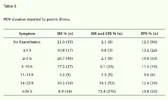
Noting that Table 3 in the paper has an error - 86 PPS people is said to equal 12.3%, while on the next line, 22 PPS equals 13.2%.

Given
The current study included those with myalgic encephalomyelitis and/or chronic fatigue syndrome (n = 376), multiple sclerosis (MS) (n = 157) or post-polio syndrome (PPS) (n = 167).
I assume the percentages are correct, and there is a problem with the numbers, making @Simon M's chart upthread correct.
 
PEM Duration. Three additional PEM items within the DSQ examined duration of symptom exacerbation after activity. Participants were initially asked two questions: “Do you experience a worsening of your fatigue/energy related illness after engaging in minimal physical effort” and “Do you experience a worsening of your fatigue/energy related illness after engaging in mental effort”. If participants answered ‘yes’ to either of these questions, they were then presented with a question measuring PEM duration: “If you feel worse after activities, how long does this last”. Participant responses of PEM duration were coded as: 0 = Not having a problem with energy/fatigue, 1 = 1 h or less, 2 = 2–3 h, 3 = 4–10 h, 4 = 11–13 h, 5 = 14–23 h, and 6 = 24 h or more. Both branching logic questions of symptom exacerbation due to physical activity (k = 0.84) and symptom exacerbation due to mental activity (k = 0.74) have good test-retest reliability [7].

That is what was done regarding the duration question.

There are a few problems there. I'm not sure that someone with MS would necessarily agree that they have a 'fatigue/energy related illness', so, if asked 'Do you experience a worsening of your fatigue/energy related illness after engage in minimal physical effort', they might go 'uh?' and maybe answer No.

Then there's the whole mixing up of all sorts of effects of exertion. People with lots of illnesses feel worse after physical effort, but it does not necessarily involve a delayed onset or the pattern of PEM.

And then there's the odd time scale, with a different number of hours in each range.
I think what Lenny Jason, has identified is a very promising area for further research, with better questions, malaise, and ideally a subjective study asking people with other illnesses who reports in similar something similar to postexertional malaise what they experience. It's a really start, and it shows something important, especially the bimodal pattern. But we need more information.
 
While it has been useful to have good resolution at the lower end of duration to narrow down a cutoff point, the survey has inadequate resolution at the higher end of duration. There is no distinction between PEM that lasts 24 hours or longer? PEM often does not even begin until 1-3 days.

There are four time divisions for 1-13 hours, but only one for 14-23 hours, and only one for 24+ hours.
The bimodal distribution of duration is interesting, but it would look much less pronounced and more like a decaying curve if PEM lasting 24+ hours or longer was given equal resolution as 1-23 hours.
 
Last edited:
Back
Top Bottom