A Short-Term Pacing Intervention in People with Myalgic Encephalomyelitis/Chronic Fatigue Syndrome: A Pilot Study in Portugal, 2026, Ribeiro et al

TiredMathematician

Established Member (Voting Rights)
A Short-Term Pacing Intervention in People with Myalgic Encephalomyelitis/Chronic Fatigue Syndrome: A Pilot Study in Portugal

Ribeiro, Vânia; Azevedo, Paulo; Westermeier, Francisco; Sepúlveda, Nuno

Abstract
Background and Objectives: Myalgic Encephalomyelitis/Chronic Fatigue Syndrome (ME/CFS) remains a disease without a curative treatment. Hence, patient healthcare is mostly based on symptom management and the application of coping strategies, such as pacing. In this strategy, patients learn how to plan their daily physical and cognitive activities according to their perceived energy reservoir (or envelop). However, there is currently no evidence for the feasibility of pacing in Portugal, where ME/CFS is not well recognized.

Materials and Methods: We implemented a 8-week pacing program in Portuguese patients with an official diagnosis of ME/CFS. We focused on recruitment feasibility, protocol adherence, and patient acceptability, with secondary exploratory analysis of pre- and post-intervention variations in the Chalder’s fatigue questionnaire and SF36 physical functioning scores.

Results: We were able to recruit thirteen patients for the study. The patients attended, on average, seven out of the eight sessions expected per participant, with the majority adhering to the research protocol (n=7;53.8%). In a post-intervention survey, the respondents (n=10) considered that the intervention addressed the specific needs of people living with ME/CFS. Concerning the outcome trends, the average fatigue score decreased from 27.5 at baseline to 17.7 after the intervention. The mean physical functioning score increased from 24.6 to 31.7.

Conclusions: This exploratory study supported the feasibility of benchmark studies in Portugal with increased sample size, longer interventions, and including a control group (e.g., specialized medical care), with which eventual placebo effects can be better accounted for.

Web | DOI | Medicina
 
Last edited:
Details of the pacing intervention:
Given the absence of official guidelines for diagnosis and treatment of ME/CFS in Portugal [20], the intervention consisted of an educational program focused on energy management and developed using different sources (Supplementary Table S1), including the United Kingdom’s NICE disease management guidelines (https://www.nice.org.uk/guidance/ng206 (accessed on 9 August 2024)). The program encompassed a single group session per week for eight consecutive weeks. Each session was delivered online (Microsoft Teams) at the same time (16h00) with an average duration of 60 min.
The content of the program was based on the progressive acquisition of knowledge about ME/CFS and pacing as a self-care strategy (see detailed information in Supplementary File (Supplementary Table S1)). The overall aim of the intervention was the empowerment of patients with self-management strategies that could help them to maximize their autonomy, independence and daily activities without exceeding their perceived energy reservoir. The program highlighted the importance of having a sustainable balance between periods of activity (physical or cognitive) and of rest.
The program started with sessions on general knowledge of the disease, including an overview of its putative pathophysiological mechanisms, its symptomatology, the functional impact and putative therapies. After that, the topic related to PEM was addressed.
In following sessions, the participants learned the basic principles and techniques associated with energy management, receiving a template diary for their daily activities and symptoms. They were also exposed to a series of slide shows with additional tools for energy conservation, as well as a digital tool for monitoring their heart rate to be used as means of identifying possible episodes of flare-ups and exhaustion.
Participants were then given information about the factors that commonly influence the energy levels, such as sleep, nutrition, hydration, and emotional management.
The focus of one of the sessions was on communication skills (e.g., assertiveness) that allow patients to communicate their needs better to caregivers and health professionals.
Participants were encouraged to develop these communication skills as a way of building (or strengthening) trust and emotional support among all the parties involved in the disease management process.
The last session focused on the long-term planning that would allow the participants to envision their gradual return to work or school, using all the knowledge provided.
 
The last session focused on the long-term planning that would allow the participants to envision their gradual return to work or school, using all the knowledge provided.
More fantasies about pwME being able to do whatever they want with the right adjustments.

We will never get anywhere on the care side of things until people truly understand how disabling ME/CFS really is. It is the crux of the issue.
 
The program started with sessions on general knowledge of the disease, including an overview of its putative pathophysiological mechanisms, its symptomatology, the functional impact and putative therapies. After that, the topic related to PEM was addressed.

If they see PEM as an afterthought and not part of the 'symptomatology [and] functional impact', they have no business advising patients.
 
In this strategy [pacing], patients learn how to plan their daily physical and cognitive activities according to their perceived energy reservoir (or envelop).
That’s not what pacing is. Pacing is to attempt to avoid PEM, and is just as much about not doing something than how you do the things you do.

It’s like saying that personal budgeting is about when you spend the money, and not what you spend then money on and how much you spend.
However, there is currently no evidence for the feasibility of pacing in Portugal, where ME/CFS is not well recognized.
If they had looked at structural barriers to living safely with ME/CFS, I could have understood this phrasing. But it isn’t, and I don’t understand what they are trying to imply.

The data:
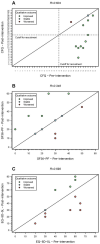
Above the diagonal = improvement
Below the diagonal = worsening
(Edit: it’s the opposite for A for some reason)
IMG_0598.png
The CFQ is arguably the weakest questionnaire, and very easily manipulated:
The average of the Likert-based CFQ score decreased from 27.5 (SD = 2.7) to 17.7 (SD = 8.9), an average reduction of almost 10 points after the intervention. Around 50% of the patients reported a Likert-based CFQ score lower than 18 points, the cut-off used at the recruitment stage. There were only two patients (15.4%) who reported stable or worsening of their perception of fatigue after the intervention (Figure 3A).
The SF36-PF scores are all over the place:
The average SF36-PF score increased from 24.6 (SD = 13.3) to 31.7 points (SD = 16.7) after the intervention (Table 3). In more detail, there were five patients (38.5%) who reported an improvement in their physical functioning after the intervention (Figure 3B). Four patients (30.8%) reported no change in this endpoint, while three patients (23.1%) perceived a worsening of their physical functioning (Figure 3B).
The quality of life decreased(!!):
The mean quality-of-life (EQ-5D-5L) score decreased from 45.8 (SD = 16.8) to 42.1 (SD = 22.2), an average decrease of 3.7 points. This score increased, remained stable or decreased in four, one, and seven individuals, respectively (Figure 3C). For the individual who had a missing post-trial EQ-5D-5L,
Considering that they had no control group, and the participants had to endure 8 hours of «education» and unknown amounts of homework, and they even agreed to participate, the results are less than encouraging.

There is yet again nothing of value here. They have wasted time and resources, and seemingly made some lives worse. Who knows what will happen if the participants adhere to the long term plan if trying to just act healthier.
 
Last edited:
"Hey, you, do the thing you're already doing, which we barely grasp ourselves, but we're billing someone for it"

Compared to the usual CBT + rehab, this is better, in that it's not entirely wrong. That's the bar, which is almost never met: not entirely wrong. It's still far below what is expected out of professionals, who have, yet again, added nothing whatsoever.

About comparable to hiring expensive contractors, and all they do is show you how to use a hammer, sometimes it's an electric hammer, but they teach you to use it manually. If you're lucky.
 
It’s like saying that personal budgeting is about when you spend the money, and not what you spend then money on and how much you spend.
I like this comparison. It highlights the absurdity but also reminds me of the patronising approach some have to poverty ’oh have you tried budgeting’ or ‘well if you didn’t spend on x’ which completely ignores the various ways in which real poverty completely removes choice, the ability to do long term planning and so much more.

If you have enough money you can do things to spend less. If you are really poor you cannot. You just need more to get out of the trap you are in.

The same applies to our limited resource, I hesitate to use the word energy because it’s far more than that but you all understand.
 
Back
Top Bottom