Amisulpride vs. fluoxetine treatment of chronic fatigue syndrome: a pilot study, Pardini et al 2011

EndME

Senior Member (Voting Rights)

Abstract​

Different pharmacologic agents have been evaluated in the treatment of Chronic Fatigue Syndrome (CFS), albeit with moderate efficacy. Among the compounds thought to present with potential to be efficacious in CFS patients stands out low-dose amisulpride, a substituted benzamide that has been shown to be an useful treatment for conditions which exhibit some overlap with CFS such as dysthymia and somatoform disorders. We thus recruited forty non-depressed CFS patients that were randomized to receive either amisulpride 25mg bid, or fluoxetine 20mg uid; all subjects were un-blinded to the treatment regimen. At the time of enrollment in the study and after twelve weeks of treatment, enrolled subjects completed the Krupp Fatigue Severity Scale, the Hospital Anxiety and Depression Scale and a visual analog scale focused on pain and bodily discomfort. Moreover, all subjects were evaluated by a clinician, blinded to the treatment regimen, using the Clinical Global Impression Severity Scale.

Our data revealed a significant improvement both in self-report, and observer-based measures for the amisulpride-treated, but not for the fluoxetine-treated patients. Amisulpride-treated subjects also presented with a significant reduction of somatic complaints, while the amisulpride effect on anxiety and mood levels was not significant. Both drugs were equally well tolerated. Summing up, we showed a positive symptomatic effect of amisulpride, compared to SSRI treatment, in a group of non-depressed CSF patients on self-report and on observer-based measures of fatigue and somatic complaints. If confirmed by larger, blinded studies, amisulpride thus could represent an effective approach to this difficult-to-treat condition.

 
This is a randomized trial comparing amisulpride to fluoxetine. If there's randomization and two groups receiving pills already, why not blind participants to which pill they are receiving?

So the lack of blinding makes it harder to interpret, but it still might be interesting.

The groups didn't differ from each other at baseline on any measures:
At the time of enrollment there was no significant difference between the amisulpride and fluoxetine treatment groups in FSS [Krupp Fatigue Severity Scale] (50.5 ± 7.0 vs. 52.4 ± 5.7; p = 0.5), VAS-pain (59.9 ± 9.5 vs. 55.9 ± 9.5; p = 0.4), HADS-depression (HADS-D: 4.9 ± 0.9 vs. 5.1 ± 0.8; p = 0.5), HADS-anxiety (HADS-A: 5.3 ± 0.8 vs. 5.3 ± 0.9; p = 0.7), SF-12 scores (41.3 ± 7.0 vs. 41.7 ± 7.1; p = 0.9) and GGI-S [Clinical Global Impression Severity] scores (4.9 ± 0.6 vs. 4.6 ± 0.9; p = 0.7).

At 12 weeks, there were differences between the two treatment groups on all the measures except depression and anxiety scores:
After twelve weeks of treatment the amisulpride-treated subjects, compared to the fluoxetine-treated ones, presented both with significantly lower self-reported fatigue levels (FSS scores: 36.3 ± 8.6 vs. 48.9 ± 4.9; p = 0.001, z = −4.2) and lower self reported pain and bodily discomfort levels (VAS-pain scores: 40.5 ± 13.1vs. 53.1 ± 8.3; p = 0.01, z = −3.1), as well as higher perceived QoL (SF-12 scores: 53.2 ± 4.8 vs. 37.6 ± 4.9; p = 0.01, z = 3.6) and lower clinician-evaluated disease burden (CGI-S scores: 2.9 ± 0.6 vs. 4.2 ± 1.1; p = 0.005, z = −2.9). There was no significant difference between the two groups in reported depressive levels (HADS-D scores: 4.1 ± 0.9 vs. 4.3 ± 0.9; p = 0.6) or anxiety symptoms (HADS-A scores: 4.5 ± 1.0 vs. 4.9 ± 1.0; p = 0.6).

If just comparing before to after treatment for the amisulpride group, all the scores showed improvement except depression and anxiety scores. If just looking at the fluoxetine group, it's almost the opposite. The only measure that significantly improved was the depression score.

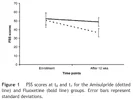
Fatigue severity scale (FSS) score changes over time in both groups:
1785701756954.webp
 
The between group p-values at 12 weeks are pretty low:
  • Fatigue severity scale (FSS): p=.001
  • Visual analog scale-pain (VAS-pain): p=.01
  • SF-12: p=.01
  • Clinical Global Impression Severity (CGI-S): p=.005

But I don't know how much the participants and clinicians knowing about which treatment was received might have influenced it.

Cohort description:
CFS according to published criteria (Fukuda et al., 1994).
forty subjects (twenty-two females, eighteen males

Dosages:
amisulpride 25 mg bid., or fluoxetine 20 mg uid.

Some discussion of amisulpride:
At low doses, amisulpride (100 mg/die or less) preferentially blocks presynaptic dopamine autoreceptors that control dopamine synthesis and release; whereas, at higher doses, it presents postsynaptic dopamine D2-receptor antagonism (Green, 2002). Low-dose amisulpride has been shown to positively impact both negative symptoms in schizophrenia (Green, 2002) and dystimic symtomatology (Rocca et al., 2002). Moreover, substituted benzamides have been successfully used to treat somatoform disorders (Rouillon et al., 2001).
 
When someone gets a very significant positive finding in an unblinded trial, isn't the obvious next step to do a blinded trial? Surely, a grant is easier to get when there's a result like this already.

I don't see any more trials of amisulpride for ME/CFS in the 15 years since this study.
 
Amisulpride was trialed the following year (2012) for fibromyalgia patients:
Amisulpride in the treatment of fibromyalgia: an uncontrolled study

"...an initial dose of 25 mg/day and titrated according to the clinical response and tolerability (mean final dose, 87.5 ± 41.3 mg/day)"

"Pain severity, as measured with the visual analogue scale from the FIQ, remained unchanged. Nonsignificant improvements were observed in depressive or anxiety symptoms using the Beck Depression Inventory and the State-Trait Anxiety Inventory, respectively. Twenty-six patients either withdrew from the study, mainly due to adverse reactions, or were lost to follow-up (n = 11, 27.5 %, for each category). Despite its promising results in some chronic painful conditions and in a related illness, such as chronic fatigue syndrome, amisulpride does not seem to provide any benefit to patients with fibromyalgia. Amisulpride was poorly tolerated by our participants."
 
Last edited by a moderator:
Amisulpride was trialed the following year (2012) for fibromyalgia patients:
Amisulpride in the treatment of fibromyalgia: an uncontrolled study

Interesting. Looks like the dose was somewhat higher than the thread study dose of 25 mg twice per day, and over half of the cohort didn't complete the trial.
Fourteen (35 %) patients completed the 12-week study. The reasons for withdrawal (patients might have more than one reason) were adverse reactions (n=11, 27.5 %), lost to follow-up (n=11, 27.5 %), other (n04, 10 %), and unknown (n=2, 5 %). Half of the dropouts occurred during the first 4 weeks of the study. The mean final dose of amisulpride was 87.5±41.3 mg/day, ranging from 25 to 150 mg/day.
 
https://www.psychiatrist.com/jcp/re...-methylation-result-new-better-antipsychotic/
Amisulpride is currently approved for psychiatric indications, including schizophrenia, in over 50 countries worldwide. However, approval for the treatment of schizophrenia was never sought in the US.

LB-102, an N-methylated analogue of the antipsychotic amisulpride, [is] currently under development for the acute treatment of schizophrenia and other neuropsychiatric illnesses.

The development of LB-102, a methylated analogue of amisulpride, which functions as both a dopamine D2/3 and 5-HT7 antagonist,18 was intended to improve upon the poor blood-brain permeability of amisulpride, while retaining the efficacy for total, positive, and, potentially, negative symptoms, and also limiting peripheral adverse effects due to a smaller periphery-to-central drug level gradient and thus lower total doses of LB-102 being needed. The N-methyl amisulpride (LB-102) produced similar or superior behavioral responses in animal models at significantly lower doses than amisulpride, which itself required 630–910 mg/d to achieve 70%–80% postsynaptic striatal D2 receptor occupancy in humans.19 LB-102’s pharmacologic difference from amisulpride, with much higher blood-brain barrier penetrance, results in a lower frequency of prolactin elevation, as the pituitary gland is outside the blood-brain barrier. Similarly, QTc prolongation would also be expected to be less likely with the lower doses required for LB-102.
 
Back
Top Bottom