Blog: "Scuba diving in the sea makes my LongCOVID symptoms/PEM almost disappear. For the third time."

Mij

Senior Member (Voting Rights)
March 26, 2026

Dirk Paessler's Personal Blog

"I have long-term COVID. Not ME/CFS—I need to clarify that upfront because the distinction is important. My case is moderate: PEM, dysautonomia, and reduced stamina. I'm mostly functional, but always with a tight energy budget. People with severe ME/CFS live in a completely different energy frame—I don't presume to draw conclusions about their situation based on my experience.

But what happens to me when I dive is remarkable."
 
Translated said:
For the third time diving holiday with LongCOVID. For the third time the same thing: After the first dives, something changes. With each day it becomes clearer. After twelve days with daily 1-2 dives (Nitrox 32%, 20-30 meters deep, almost 1h per dive) I feel instantly healthy.

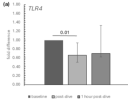
FWIW this paper notes "we observed a transient decrease in mRNA for HMGB1 and a decrease in mRNA for TLR4 immediately after the dive." Fold change for TLR4 —

TLR4.png

The Impact of Recreational Diving to a Depth of 40 m on Selected Intracellular DAMPs (2025)

Increasingly popular, recreational diving is a physical activity that takes place under extreme environmental conditions, which include hyperoxia, hyperbaria and exposure to cold water. The effects of these factors on the human body induce increased levels of reactive oxygen and nitrogen species in divers’ bodies, which may modulate damage-associated molecular pattern (DAMPs), their receptors and the antioxidant response.

This study involved 21 divers who descended to a depth of 40 metres. Determinations of selected intracellular DAMPs (high-mobility group box protein 1,HMGB1, S100 calcium-binding proteins A9 and A8, S100A8 and S100A9, heat shock protein family A member 1A, HSPA1A (Hsp70), heat shock protein family B, (small) member 1, HSPB1(Hsp27), thioredoxin, TXN), their receptors (Toll-like receptor 4, TLR4 and receptors for advanced glycation end products, RAGE), nuclear factor-κB (NF-κB) and antioxidant defence markers were performed before, after and 1 h after the dive.

A significant transient reduction in HMGB1 expression was observed immediately after the dive at both the mRNA and protein levels. We noted an increase in S100A9 expression, which occurred 1 h post-dive compared to the post-dive time point, and a post-dive decrease in TLR4 expression only at the mRNA level. Diving also influenced the expression of genes encoding key enzymes associated with glutathione synthesis, (glutamate-cysteine ligase, catalytic subunit, GCLC and glutathione synthetase, GSS), and reduced plasma glutathione levels. However, no significant changes were observed in the expression of NF-κB, nitric oxide synthase 2 (NOS2) or circulating DAMP receptors (TLR4 and RAGE).

The findings suggest an adaptive response to diving-induced oxidative stress, which appears to be a protective mechanism against an excessive inflammatory response. To our knowledge, this is the first study to analyse the role of intracellular DAMPs in recreational divers.

Web | PDF | International Journal of Molecular Sciences | Open Access
 
I don’t understand. Wouldn’t your internal systems still experience the same pull of gravity in water? You’re just floating due to buoyancy. In space you’re in a free fall at a constant speed.

I have an intuitive feeling that Jonathan is right, but I can't really figure out why... Interesting! I think maybe you can think about it like this:

When standing the body is like a narrow barrel of fluid. The pressure at the bottom of the barrel (corresponding to the feet) is at 2 meter depth, and the fluid pressure is that of 2 meters.

When submerged the water pressure outside the body counter-acts the internal pressure in the body.

So the water acts like a perfect full-body compression stocking.

The water pressure is not exactly the same as being weightless, but has some important similarities.
 
I have an intuitive feeling that Jonathan is right, but I can't really figure out why... Interesting! I think maybe you can think about it like this:

When standing the body is like a narrow barrel of fluid. The pressure at the bottom of the barrel (corresponding to the feet) is at 2 meter depth, and the fluid pressure is that of 2 meters.

When submerged the water pressure outside the body counter-acts the internal pressure in the body.

So the water acts like a perfect full-body compression stocking.

The water pressure is not exactly the same as being weightless, but has some important similarities.
Isn’t that effectively like what happens when lying down because the difference in pressure from top to bottom is just from 15-20 cm? Lying down presumably doesn’t produce the scuba effect, or else he would have told us.

And I assume you’re mostly horisontal when scuba diving. So something else must be going on. I think the compression stocking analogy might be onto something if it affects the peripheral blood supply in a different way than lying down does.
 
Isn’t that effectively like what happens when lying down because the difference in pressure from top to bottom is just from 15-20 cm? Lying down presumably doesn’t produce the scuba effect, or else he would have told us.

Even lying down is different because the underneath parts of you are under the downward pressure of the top parts. In water hat downward pressure is counteracted by pressure from surrounding water. You are weightless for all practical purposes. One of the few differences is that your bone-locked semicircular canals are not affected by the surrounding water so you can still have a sense of being the right way up.
 
Ive recently located a warm swimming pool I’m going to try, I’m very much a water baby and never happier than in water.

I used to find that when I got out of a pool, the gravity really hits me like I’m made of lead. Not met anyone else who has that sensation. Always took me a while to adjust. Fine when in the sea though.
It’s exactly the same as when I’m struggling and crashing, gravity feels heavy. Will be interesting to see next month how I get on after my first dip since before covidtimes.

Would happily live in a warm water tank, 43C ideally, pm me if you want me to take part in an experiment.
 
I think my case of orthostatic intolerance is caused by pooling of blood in the lower part of the body. I have wanted to try swimming for a long time, but pool ladders are impossible for me. Gravity is the same, but the combination of buoyancy, some hydrostatic pressure, the muscle pump during swimming, and a more horizontal body position should improve venous return into the right heart.

The Moon, with gravity about 1/6 that of Earth’s, would be an interesting experiment for people with orthostatic intolerance, but they would likely develop the same kinds of orthostatic disturbances seen in astronauts after spaceflight.
 

I too experienced the same uptick from diving and described the same duration. But there is an experiment that divers used to perform to demonstrate Boyles law which may provoke discussion here. It has dangers, so probably regulated out of the sport by now.

Take a balloon to 40m and inflate by mouth and seal. Release and watch the balloon rise doubling in size every 10 m rise, burst and create I assume surface disturbance of some sort. I never was on the surface at the time but non divers thought it funny.

The whole point was to show the reason to exhale on accents and restrict your rate of accent. Minor bleeds were then part of the sport. A further restriction was no flying for 24 hours after a dive enabling carbon dioxide to be released back into the blood and exhaled .

My take at the time was simplistic in that the blood was oxygenated or inflated with co2 by breathing under pressure which expanded the cells and then took 24 hours to off gas. Now I wonder about cell deformation and cell shape.
For the record straightforward air and 10m for around 30 minutes laying on the bottom of a pool provided the benefit.
 
Nah . I think patients might have noticed if it did? Like the original article it's not just a slight change. The forces on a body when diving are substantial enough to cause rupture . Even tough gym types discover it can be a challenge.
 
But there is an experiment that divers used to perform to demonstrate Boyles law which may provoke discussion here. It has dangers, so probably regulated out of the sport by now.

Take a balloon to 40m and inflate by mouth and seal. Release and watch the balloon rise doubling in size every 10 m rise, burst and create I assume surface disturbance of some sort. I never was on the surface at the time but non divers thought it funny.
Off topic, but as someone involved in teaching Boyles law to students by slowly turning small columns of mercury, this sounds like a lot more fun and I appreciate the detail
 
How many members of this forum would go Scuba diving in their current state? Even if they could, who would do it?

I think we are talking about a different condition altogether. Credit to him though, he acknowledges the difference so at least he is aware.

It is perhaps unfortunate that the overlap of scuba diving with Paul Garner’s relentless self promotion risks us automatically dismissing this. Once I realised it was not intended as a parody, I came to this blog fully prepared to dismiss it out of hand.

I suspect there have been periods in the thirty years plus of my relapsing and remitting ME that, had I had any interest, I could have gone scuba diving. Though it is over ten years since I have been well enough to travel far enough to anywhere scuba diving would be an attractive option other than the not so tropical local municipal baths, I recognise there are some people that had previously been diagnosed with ME/CFS who could have remitted enough to make it an option.

However, I would want some discussion with this person in relation to his distinction between Long Covid with PEM and ME/CFS. Also I would want clarification that what he means by PEM, and if it is what we would understand by that term. Reading the full article what struck me is that his description of this experience is not that different from descriptions here where individuals have found compression garments enable them to increase activity levels. It would be interesting to try to distinguish between an effect of simply wearing a wetsuit and of water pressure.

It is good that the blogger has had such a positive experience though I suspect what is happening is that he has found something that in the short term helps manage symptoms of orthostatic intolerance rather than anything therapeutic more long term. It is good that whatever his condition is that it is only mild and I hope that like Paul Garner he is experiencing some degree of spontaneous remission, but I also hope unlike Garner he retains the understanding that an n=1 anecdote is not generalisable to an entire patient population.

[edited - sorry I went on editing after I had posted not realising it was already post, so I do not know what changes were after formal posting.]
 
Last edited:
Just bear in mind he is running a company for carbon emissionsfull time as a CEO, VP of another company, and regularly scuba dives, that is all. But sure I don't doubt his words. And he is aware he is not ME/CFS and he supports ME/CFS.
 
I am relating to 1978 when zero knowledge regarding ME was published. Remember no Internet, yuppy flu, exercise and think yourself well was the hight of good practice then. Bit like now.
Like many I started mild, did what we now know to be harmful ignored / did not recognise delayed pem and fought hard to resolve what had hit me. I was young then and immortal. In 2004 I took on GE .....

Diving comes in many levels and has become much easier if planned and supported much like disabled swimming. Once in warm water it's relaxing weightless and effortless just breath. Would I do it today? Hell yes if it helped me with no kick back from pem.

But I think you are missing the point. This is a science forum so we should be open to questioning our beliefs and look for evidence rather than dam the unlikely as it does not fit. At present. Just because Paul G made out it was a cure should not close down consideration. Very few people with ME would be daft enought to start to dive, but we have 3 people actually 4 who are reporting a change. Many years ago a Trial paper was published by a Turkish group reporting positive outcomes from I think diving or maybe using a decompression chamber. Look beyond the scuba headline and consider the physical impact . I am just a patient who observed the bloodshot eyes, bruising and locking joints on others. SFN anybody... ? It was and can be a punishing sport or a float in the bath .
 
I used to find that when I got out of a pool, the gravity really hits me like I’m made of lead. Not met anyone else who has that sensation. Always took me a while to adjust. Fine when in the sea though.

We have a heated pool in my building, and many years ago when I didn't have PEM(yet), it took me a week to recover from walking in the shallow end for 20 minutes. My legs and arms felt like lead weights. I felt very unwell too.
 
Back
Top Bottom