Built Me/Cfs safe room in the bush at the back of a house. Design help/suggestions.

It is..but can be done to a decent degree, especially if you can spare some inches in the room, soundproof panels make the room slightly smaller. There is a lot that can be done but you would need a professional to advise, and would cost but perhaps not more than building an outside room.
I don't know whether it defeats the point but the compromise I can think of (which might manage to not tick either box) could be having the separate building for the purposes of sound but it being close with a bridge making trip to the bathroom based in the home/house as short and simple as possible.

I don't know whether this would just be used during the day whilst others are in and what planning says about a pathway vs a new entrance (eg near a loo) or even covered bridge etc but each could add to security I guess, certainly if you were there when dark and alone it might be a boon to have a second door with a secure route back into the home.
 
Last edited:
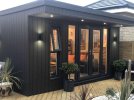
Would a white 15 or 20foot shipping container be suitable? The former cost around £3000 delivered in the UK. Personally I would stress over the multiple odors generated with multiple finnishes and preservative so would aim to keep it very simple. You can buy already insulated internally but again odor is a problem. Sail life on utube has in the last month done a fit out for some starting ideas. Caravan toilet by Thetford which is Electrolux toilet system could work if available to you.

It's secure,watertight , relocatable and sound resistant except with rain on the roof. But the doors need to be locked open for safety.
Unfortunately a shipping container would look most out of place with the house so I was more looking for traditional construction process that doesn’t look different to the house. But people in this area do that and it is more for storage than a nice room.
 
My experience with metal boxes (otherwise known as caravans) is that even the insulated and ventilated ones are insufferable in a British summer. I wouldn't much fancy being inside one in Australia, with the mercury showing nearly double the number of degrees we get here.

Wooden buildings aren't much better. A friend (against all advice) spent about £25k on a properly built summerhouse, only to find it too hot to sit in during the summer and full of invertebrate larvae in the winter. It looks lovely, but as far as function goes she's got the only double-glazed bike shed on the street.

There must be better materials for hot weather, which can be air conditioned for less than the annual GDP of a small country.
Yes the room would have bulletproof insulation, heating and cooling to be comfortable. The latest generation ac’s are pretty much silent.
 
I don't know whether it defeats the point but the compromise I can think of (which might manage to not tick either box) could be having the separate building for the purposes of sound but it being close with a bridge making trip to the bathroom based in the home/house as short and simple as possible.
The above idea would be applicable. My down stairs room has heating but not A/C. So the idea to go to this new room in the garden when is severely hot is probably what I want. If I didn’t use it other people would still use it. The trip to the bathroom is ok for me.
 
The above idea would be applicable. My down stairs room has heating but not A/C. So the idea to go to this new room in the garden when is severely hot is probably what I want. If I didn’t use it other people would still use it. The trip to the bathroom is ok for me.
Sounds fantastic. I feel silly as a mere brit suggesting that focusing funds on blinds etc that you could ideally control pretty individually but that don't break, but in the current winter sun I've got the main one pulled down almost permanently atm so I don't have to drag myself up when I'm dazzled by it being at 'that' angle where it gets right in my eyes in the morning. Particularly if you have a TV and have glare on that etc. And space for lamps as I find it easier to not be dependent on ceiling/wall lighting alone and be able to change up which bits get light to sort of balance it (I get annoyed by dark or bright spots strangely).

Which leads me to never having enough plugs in the right places and don't underestimate storage (blankets, pillows etc but also it's bonkers how much ends up on and underneath and next to my bedside 'table' )

Depending on your tipple I'd be going for a hot water dispenser and fridge (which can be mini but be aware of the ice box taking up space ie get the one slightly bigger than you think if so and mini ones more likely to be noisier I guess? - but I love having an ice box for ice cubes) with something to put them on so no bending, as it is so much easier to either carry or get someone to bring water, mugs, milk closed in a big container and now you can grab a drink easily vs carrying an open drink (or you ending up getting 2 to save a journey etc) but not if the kitchen is right next to it.
 
Last edited:
My experience with metal boxes (otherwise known as caravans) is that even the insulated and ventilated ones are insufferable in a British summer. I wouldn't much fancy being inside one in Australia, with the mercury showing nearly double the number of degrees we get here.

Wooden buildings aren't much better. A friend (against all advice) spent about £25k on a properly built summerhouse, only to find it too hot to sit in during the summer and full of invertebrate larvae in the winter. It looks lovely, but as far as function goes she's got the only double-glazed bike shed on the street.

There must be better materials for hot weather, which can be air conditioned for less than the annual GDP of a small country.
you are making me think of a grand designs episode (or something similar) where a building was built either into the earth or with grass on top of it and at least one side for climate control reasons of some sort - no memory of what it was material-wise underneath all of that
 
One thing to consider for very small dwellings: moisture control. In a large house, likely with plenty of air leaks, moisture is unlikely to cause problems. In a tiny house, it can be a serious problem. Just one human puts out a lot of moisture. When it's cold out, an overlooked thermal bridge would condense the moisture, possibly causing mildew or rot. If it's hot outside and cool inside, moisture might build up in the insulation, again causing decay. In moderate climates, just opening a window or a door for a short time might be enough to control moisture, but in long extreme seasons, it may not be.

My feelings about container houses is that while they might be a cheap base structure, the additions to making it livable (insulation plus cladding) might make it more expensive than standard stud framing. Base structures are inexpensive; it's the fiddly bits (trim, fixtures, kitchens, etc) that make houses expensive.
 
Back
Top Bottom