Changes in systemic GDF15 across the adult lifespan and their impact on maximal muscle power: the Copenhagen Sarcopenia Study, 2021, Alcazar et al

Hutan

Moderator
Staff member
Changes in systemic GDF15 across the adult lifespan and their impact on maximal muscle power: the Copenhagen Sarcopenia Study

Alcazar, Julian; Frandsen, Ulrik; Prokhorova, Tatyana; Kamper, Rikke S.; Haddock, Bryan; Aagaard, Per; Suetta, Charlotte

Abstract

Background
Although growth differentiation factor 15 (GDF15) is known to increase with disease and is associated with low physical performance, the role of GDF15 in normal ageing is still not fully understood. Specifically, the influence of circulating GDF15 on impairments in maximal muscle power (a major contributor to functional limitations) and the underlying components has not been investigated.

Methods
Data from 1305 healthy women and men aged 20 to 93 years from The Copenhagen Sarcopenia Study were analysed. Circulating levels of GDF15 and markers of inflammation (tumor necrosis factor‐alpha, interleukin‐6, and high‐sensitivity C‐reactive protein) were measured by ELISA (R&D Systems) and multiplex bead‐based immunoassays (Bio‐Rad). Relative (normalized to body mass), allometric (normalized to height squared), and specific (normalized to leg muscle mass) muscle power were assessed by the Nottingham power rig [leg extension power (LEP)] and the 30 s sit‐to‐stand (STS) muscle power test. Total body fat, visceral fat, and leg lean mass were assessed by dual energy X‐ray absorptiometry. Leg skeletal muscle index was measured as leg lean mass normalized to body height squared.

Results
Systemic levels of GDF15 increased progressively as a function of age in women (1.1 ± 0.4 pg·mL−1·year−1) and men (3.3 ± 0.6 pg·mL−1·year−1) (both P < 0.05). Notably, GDF15 increased at a faster rate from the age of 65 years in women (11.5 ± 1.2 pg·mL−1·year−1, P < 0.05) and 70 years in men (19.3 ± 2.3 pg·mL−1·year−1, P < 0.05), resulting in higher GDF15 levels in men compared with women above the age of 65 years (P < 0.05). Independently of age and circulatory markers of inflammation, GDF15 was negatively correlated to relative STS power (P < 0.05) but not LEP, in both women and men. These findings were mainly explained by negative associations of GDF15 with specific STS power in women and men (both P < 0.05).

Conclusions
A J‐shaped relationship between age and systemic GDF15 was observed, with men at older age showing steeper increases and elevated GDF15 levels compared with women. Importantly, circulating GDF15 was independently and negatively associated with relative STS power, supporting the potential role of GDF15 as a sensitive biomarker of frailty in older people.

Web | DOI | PMC | PDF | Journal of Cachexia, Sarcopenia and Muscle
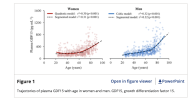
 
I'm interested at looking at the reports of elevated GDF-15 in ME/CFS and related conditions.

This large study of GDF-15 levels across sexes and ages (1305 healthy women and men aged 20 to 93 years) seemed like a useful paper. It gives an indication of normal levels, although it seems that there is quite a difference between various assays and also substantial diurnal variation, so comparisons with absolute values might not be so useful.

Screenshot 2026-05-08 at 6.47.25 PM.png

Growth differentiation factor 15 (GDF15) is a cytokine released in response to stress or injury [1] that has been identified as an important biomarker for cardiovascular disease, metabolic disease, cancer, cognitive impairment, mitochondrial dysfunction, and cachexia.
Notably, among 1301 circulating proteins measured in a cohort of older people from the In Chianti study, GDF15 proved to be among the strongest predictors of mobility limitations when assessed at 9 years follow-up.[12] Thus, circulating GDF15 is considered a potential core biomarker of frailty in older people.
I thought that was interesting - GDF-15 levels are reported to be predictive for mobility limitations 9 years later. Although I suppose physical activity levels might also be predictive of mobility limitations 9 years later.

The influence of GDF15 on functional ability might be due to its effects on the neuromuscular system, because recent studies have shown that elevated GDF15 concentrations were related to muscle wasting in intensive care unit patients,[17] with patients demonstrating muscle weakness during their hospital stay also exhibiting increased plasma and muscle mRNA expression levels of GDF15, respectively, compared with controls.[18] Further, circulating GDF15 levels have been observed to be negatively associated with muscle mass, handgrip strength, and physical performance.

If GDF-19 really is having an impact on muscle function, another question is 'can it have acute impacts?' - as in, could it be implicated in the temporary muscle weakness that we report in ME/CFS. This next bit was interesting because there is conjecture about why plasma GDF-15 is associated with sit to stand power, but not leg extension power. The authors speculate that it is the sustained nature of the sit to stand activity that is the reason for the association.

Notably, elevated levels of circulating GDF15 have been associated with several types of chronic disease and conditions, including acute and chronic inflammation,[31] mitochondrial dysfunction,[2] frailty,[32] and all-cause mortality.[4] Furthermore, GDF15 has been inversely associated with physical performance in older people [9] and proven to be an independent predictor of declining physical function.[30]

In the current study, plasma GDF15 was negatively associated to relative STS [sit to stand] power, which in turn is a strong predictor of physical performance in older people.[20] In contrast, no relationship was observed between GDF15 and maximal LEP.[leg extension power] The discrepancy between the two tests may well be related to differing biomechanical characteristics of the tests. Thus, LEP expresses maximal unilateral lower-limb power produced during an effort lasting <1 s, while STS power expresses average bilateral lower-limb muscle power exerted during a continuous 30 s effort. In this sense, the role of GDF15 as a mitokine [15] could explain the present observation of a stronger association with mechanical muscle power exerted during more sustained efforts. Notably, among the basic components of relative STS muscle power, specific STS power (i.e. absolute 30 s STS power/leg lean mass) was independently (negatively) associated with circulating GDF15 levels in both women and men, indicating that elevated GDF15 levels are associated with reduced functional muscle quality at old age (≥65 years).
 
Previous studies have tried to elucidate the mechanisms by which GDF15 could play a role in skeletal muscle metabolism and function. Both plasma and muscle mRNA expression of GDF15 were found to be higher in intensive care unit patients that developed muscle weakness, which was related to the inhibition of microRNAs involved in muscle proliferation, differentiation, and recovery.[18] A possible mechanism linking the increased levels of GDF15 with impaired neuromuscular function with increasing age has recently been proposed.[33] Increased Akt-independent activation of mTORC1 with ageing has been shown to up-regulate GDF15 gene expression in humans through the activation of the transcription factor STAT3.[33]

Concomitantly, GDF15 led to increased caspase 3 activity, while up-regulating autophagic marker LC3 and inducing increases in protein ubiquitination and oxidation.[33] Of note, this process produced muscle atrophy, loss of type II fibres (especially important for muscle power production), mitochondrial dysfunction, and reductions in maximal isometric muscle force production and exercise capacity.[33] Importantly, in a transgenic mouse model, these Akt-independent mTORC1-induced degenerative effects were partially reversed by silencing of GDF15.[33]

Nevertheless, the identification of a peripheral receptor of GDF15 is needed to better understand its peripheral action on skeletal muscle mass and neuromuscular function. The GDNF family alpha-like (GFRAL) receptor has been identified as a target for GDF15 action in the central nervous system, participating in the negative regulation of feeding behaviour in mice.[34], [35] Interestingly, treatment with a therapeutic antagonistic monoclonal antibody for GDF15-GFRAL reversed cancer cachexia in mice, which was translated to improved function.[36]

However, the evidence on the physiological effects of GDF15 in mice and humans is contradictory. For example, transgenic mice overexpressing GDF15 have increased lifespan compared with wild-type mice, while elevated circulating GDF15 is an independent predictor of all-cause mortality in humans.[10] In addition, studies conducted in mice have demonstrated a positive role of GDF15 in the maintenance of spinal cord motor neurons, preventing the loss of motor axons and reductions in physical performance.[37] In contrast, circulating GDF15 is negatively associated with maximal muscle power and physical performance in humans (present data). Regarding these contradictory observations, it is possible that transient peaks in GDF15 may be beneficial (e.g. after a single bout of high-intensity exercise [38]), while chronically elevated systemic levels are detrimental to skeletal muscle homeostasis and neuromuscular function.

So, a bit interesting. But, I guess first we need to check that there is some good evidence that GDF-15 is relevant to ME/CFS. There's a discussion thread for that here.
 
Last edited:
However, the evidence on the physiological effects of GDF15 in mice and humans is contradictory. For example, transgenic mice overexpressing GDF15 have increased lifespan compared with wild-type mice, while elevated circulating GDF15 is an independent predictor of all-cause mortality in humans.[10] In addition, studies conducted in mice have demonstrated a positive role of GDF15 in the maintenance of spinal cord motor neurons, preventing the loss of motor axons and reductions in physical performance.[37] In contrast, circulating GDF15 is negatively associated with maximal muscle power and physical performance in humans (present data). Regarding these contradictory observations, it is possible that transient peaks in GDF15 may be beneficial (e.g. after a single bout of high-intensity exercise [38]), while chronically elevated systemic levels are detrimental to skeletal muscle homeostasis and neuromuscular function.
Can it be that GDF15 is the body's antidote to weakness and frailty, and it being higher is not showing that it is a cause of weakness, but rather an attempt to compensate for the weakness?
 
That is the impression I have been getting from reading recent papers about GDF-15. It seems to be a response to tissue damage and cell stress that helps the body cope, for example, in cases of starvation, hypoxia and infection. It is also said to be a way for the nervous system to be alerted to peripheral damage.

It seems that there are GDF-15 receptors in part of the brain, but there is a strong belief that there are receptors in the rest of the body too - they just have not been identified yet.

One paper mentioned that it is possible that the GDF-15 signalling system might get stuck, signalling a problem to the brain when there isn't one. But, it seems probably more likely that these slight elevations that we seem to be seeing in MECFS (and MS and RA etc, as well as after exercise) are just due to the body having to make an effort to cope with some perturbation.
 
More reading:
Emerging Roles of GDF-15 in Immunoregulation and Pathogenesis, 2024

Determining the identity of the functional GDF-15 receptor in the periphery, including in diverse immune cell types, is a clear priority. Multiple studies have already confirmed that GFRAL is restricted to AP and NTS neurons (18, 114).

However, it is undeniable that cells elsewhere can respond to GDF-15 despite the apparent lack of GFRAL expression.Interestingly, Artz and colleagues demonstrated that GDF-15 modulation of integrin activation in neutrophils is mediated by GDF-15 binding to the TGF-β receptor I/II complex suggesting that this receptor might also the GDF-15 receptor in other immune cells (115). Indeed, exposure of leukocytes to GDF-15 induces canonical Smad activation that is dependent on the TGF-β receptor (71). Moreover, a more recent study by Wang et al. demonstrated that CD48 (also known as signaling lymphocytic activation molecule 2), can bind GDF-15 in T-cells (75). Critical evaluation and validation of these candidate GDF-15 receptors utilized by diverse lymphoid and myeloid cells will be important in advancing our understanding for how the immunoregulations actions of GDF-15.

After considering the systemic and immune effects of GDF-15, we conclude that GDF-15 is primarily a stress-induced cytokine that promotes host fitness by 1) downregulating inflammation and 2) preserving cellular integrity following tissue injury. It also represents a mechanism for how tissues can communicate distress to the brain and other organs and regulate metabolism. In most instances these responses are likely to be adaptive and facilitate a return to homeostasis. However, under severe or chronic disease conditions, GDF-15 triggered responses might become maladaptive and contribute to further pathogenesis. It remains an open question whether targeting GDF-15 can be used as adjunctive therapy for cancer or severe infectious diseases (116, 117).
 
Back
Top Bottom