John Mac
Senior Member (Voting Rights)
Full title:
Fifteen participants were enrolled at the LC clinic in Rome: eleven with severe LC—defined as >4 persistent symptoms (fatigue, cognitive impairment, poor exercise tolerance, dyspnea, arthralgia, or dysautonomic manifestations) >3 months post-infection—and four asymptomatic post-COVID (APC) individuals.
Fatigue was assessed using the Fatigue Assessment Scale (FAS ≥ 22; severe ≥ 35). Auto-Abs against AT1R, endothelin receptor A, adrenergic (α1, α2, β1, β2), and muscarinic (M1–M5) receptors were quantified, along with blood cortisol and ACTH levels. SARS-CoV-2-specific T-cell responses to Spike and Nucleocapsid proteins were evaluated by ELISpot assay.
In our small cohort, LC patients were younger, had fewer comorbidities (p = 0.03), fewer vaccine doses (p = 0.03), and higher FAS scores (33 vs. 12; p = 0.001).
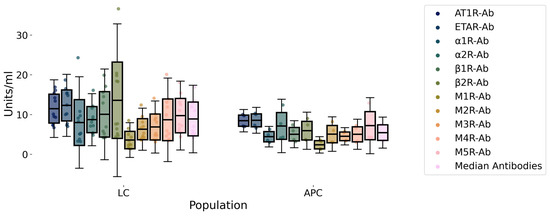
Mean GPCR AAbs levels were higher in LC than in APC (8.88 vs. 5.45 Units/mL; p = 0.17), indicating a coherent autoimmune signature in LC that correlates with symptom development.
Morning cortisol was lower in LC (12.7 vs. 17 mg/dL; p = 0.01), and T-cell responses tended to be weaker.
These findings suggest GPCR AAbs may serve as biomarkers and therapeutic targets for a subset of patients, guiding diagnosis and treatments with IV immunoglobulin or immunoadsorption.
Long COVID (LC) is a multisystemic post-viral syndrome that can persist for months or even years after the acute SARS-CoV-2 infection [1]. It comprises heterogeneous clinical subsets, and it fits within the broader category of the infection-associated chronic conditions sharing numerous clinical and pathophysiological features with Myalgic Encephalomyelitis/Chronic Fatigue Syndrome (ME/CFS)
My bolding
Prevalence of Circulating Autoantibodies Against G-Protein-Coupled Receptors as Potential Biomarkers for Long COVID: Preliminary Investigations
Abstract
This prospective, single-center, case-control study investigated circulating autoantibodies (AAbs) targeting G protein-coupled receptors (GPCRs) in Long COVID (LC) patients to identify potential diagnostic biomarkers and therapeutic targets.Fifteen participants were enrolled at the LC clinic in Rome: eleven with severe LC—defined as >4 persistent symptoms (fatigue, cognitive impairment, poor exercise tolerance, dyspnea, arthralgia, or dysautonomic manifestations) >3 months post-infection—and four asymptomatic post-COVID (APC) individuals.
Fatigue was assessed using the Fatigue Assessment Scale (FAS ≥ 22; severe ≥ 35). Auto-Abs against AT1R, endothelin receptor A, adrenergic (α1, α2, β1, β2), and muscarinic (M1–M5) receptors were quantified, along with blood cortisol and ACTH levels. SARS-CoV-2-specific T-cell responses to Spike and Nucleocapsid proteins were evaluated by ELISpot assay.
In our small cohort, LC patients were younger, had fewer comorbidities (p = 0.03), fewer vaccine doses (p = 0.03), and higher FAS scores (33 vs. 12; p = 0.001).
Mean GPCR AAbs levels were higher in LC than in APC (8.88 vs. 5.45 Units/mL; p = 0.17), indicating a coherent autoimmune signature in LC that correlates with symptom development.
Morning cortisol was lower in LC (12.7 vs. 17 mg/dL; p = 0.01), and T-cell responses tended to be weaker.
These findings suggest GPCR AAbs may serve as biomarkers and therapeutic targets for a subset of patients, guiding diagnosis and treatments with IV immunoglobulin or immunoadsorption.
Long COVID (LC) is a multisystemic post-viral syndrome that can persist for months or even years after the acute SARS-CoV-2 infection [1]. It comprises heterogeneous clinical subsets, and it fits within the broader category of the infection-associated chronic conditions sharing numerous clinical and pathophysiological features with Myalgic Encephalomyelitis/Chronic Fatigue Syndrome (ME/CFS)
My bolding