Comparison of Clinical Global Impression ratings by participants and doctors in PACE trial

Karen Kirke

Senior Member (Voting Rights)
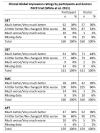
In the PACE trial, both participants and doctors rated whether the participant had improved, stayed the same, or deteriorated between baseline and 52 weeks. I thought it would be interesting to see how those ratings compared. See chart and tables below. (Data downloaded when a subset of trial data was publicly available.)

Interested to hear people's thoughts.
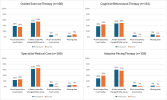
Clinical Global Impression ratings by participants and doctors
PACE trial (White et al. 2011)
1778842108379.png

Data table in next post.
 
Is there also data on whether there is an overlap of these people i.e. a correspondence between self-reported worsening and doctor reported worsening or is this data on individuals not available and you only have the total numbers? In total it looks like there is a small shift towards doctors reporting being better than patient reporting, which might be consistent with doctors believing their treatments works and the bias coming from that or as some doctors might argue the patients are being "dramatic".
 
Is there also data on whether there is an overlap of these people i.e. a correspondence between self-reported worsening and doctor reported worsening or is this data on individuals not available and you only have the total numbers? In total it looks like there is a small shift towards doctors reporting being better than patient reporting, which might be consistent with doctors believing their treatments works and the bias coming from that or as some doctors might argue the patients are being "dramatic".
I want to see the finer-grain detail too.

Next week, brain and pain allowing, I will do some work to see if there is any trend of participants or doctors reporting higher or lower CGI ratings, both overall and by trial arm.
 
Last edited:
That analysis was easier than expected, @EndME! Here it is:

Removed 58 cases (9%) from analysis because either doctor or participant rating or both were missing.

  • Doctor’s rating was higher/better than participant’s rating in 214 cases (33%).
  • Doctor’s rating was the same as the participant’s rating 253 cases (40%).
  • Doctor’s rating was lower/worse than participant’s rating in 115 cases (18%).

There was no difference between the results for GET/CBT vs SMC/APT.
 
Last edited:
This certainly fits with my experience. I’ve had numerous HCPs say that none of their patients get worse. I find that highly unlikely, especially when they tell me to ignore negative anecdotes!
Survivorship bias plays a big role in that too I think. No one who made me worse knows it I think since by the time I worsened I couldn’t see them anymore.
 
This stood out to me:

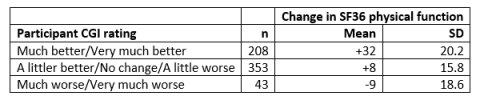
In the PACE trial, 43 participants rated themselves “much worse” or “very much worse” at 52 weeks compared to baseline.

Doctors considered 11 participants to be “much worse” or “very much worse” at 52 weeks.
43? That's absolutely shocking - how was this not reported? What drug that made that many patients much worse and had such minimal improvement even with *totally not research misconduct* would be approved?

But of course if the doctors in history's most biased medical trial say they're not worse...
 
This certainly fits with my experience. I’ve had numerous HCPs say that none of their patients get worse. I find that highly unlikely, especially when they tell me to ignore negative anecdotes!
Maybe some HCPs think that because they don't see the patients for long enough.

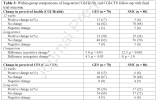
This is from the follow-up to the GETSET trial: Clark et al. 2021 Guided graded exercise self-help for chronic fatigue syndrome: Long term follow up and cost-effectiveness following the GETSET trial.

In the main GETSET trial we found a beneficial effect of GES on fatigue and physical functioning at 12 weeks after randomisation [3]. By 15 months‟ follow up there were no significant differences in either of the primary outcomes between the two interventions.

At 12 weeks, it looked like there was almost no negative change in CGI-Health or CGI-CFS. But at median 15 months, negative change was evident again, despite
Most (91%; 149 of 164) of the long-term follow-up study participants reported receiving a service therapy in their respective centre after their final 12 week outcome assessment.
In other words, intervention did not prevent deterioration.

1778866964575.png
 
43? That's absolutely shocking - how was this not reported? What drug that made that many patients much worse and had such minimal improvement even with *totally not research misconduct* would be approved?

But of course if the doctors in history's most biased medical trial say they're not worse...
Well, it's not that simple. 43 deteriorating does not mean 43 deteriorated because of the interventions. Worsening happens for a certain proportion of any cohort for other reasons, in the same way that improvement happens for a certain proportion of any cohort for reasons unrelated to whatever they're taking at the time.

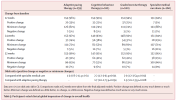
They did report CGI for each trial arm, and the percentage reporting themselves "much worse" or "very much worse" was not higher with GET/CBT compared to SMC/APT (from the PACE trial paper White et al. 2011):
1778868014170.png
 
Well, it's not that simple. 43 deteriorating does not mean 43 deteriorated because of the interventions.
That doesn’t matter. In drug trials all adverse events should be reported, regardless of presumed cause. It should be no different for non-drug trials.
 
That doesn’t matter. In drug trials all adverse events should be reported, regardless of presumed cause. It should be no different for non-drug trials.
And they reported it, it's in the above table. Am I missing something?
 
Back
Top Bottom