Convalescence from influenza. A study of the psychological and clinical determinants, 1961, Imboden et al.

ME/CFS Science Blog

Senior Member (Voting Rights)
An old study that is frequently cited in the psychosomatic literature on ME/CFS. Suspect it influenced a lot of people. It concluded that personality and emotional factors influence recovery from Asian flu in the 1950s.
In August of 1957, a total of 600 subjects were administered the MMPI and the CMI.In the winter of 1957-1958, 26 of these persons reported to the dispensary with an acute illness that was diagnosed as influenza.In 19 of these cases, the diagnosis of Asian influenza was confirmed by serological tests or virus isolation.The 26 persons with influenza were divided into two groups: (1) Recovered group, 14 persons, who became asymptomatic 3-14 days with an average of 7.9 days after the onset of the illness, and (2) Symptomatic group, 12 persons, who retained symptoms beyond 3 weeks.These two groups did not differ from each other with respect to clinical characteristics of their acute illness. Significant differences were observed, however, in the psychological test results and are in accord with the prediction, derived from a previously reported study of recovery patterns following acute brucellosis, that delayed recovery following acute self-limited illness occurs in persons who respond to psycho¬logical tests in patterns characteristic of depression-prone patients. Since the psychological data in this study were obtained prior to the illness, the evidence supports the view that this emotional state or attitude is not secondary to the illness, existed prior to it, and in significant measure was a determining factor in delaying symptomatic recovery from acute illness. In addition, itis probable that the somewhat older age ofthe Symptomatic group also contributed to their slower recovery following influenza.
Convalescence from influenza. A study of the psychological and clinical determinants - PubMed
 
Here's my own summary: in 1957 600 people filled in two questionnaires: the Minnesota Multiphasic Personality Inventory (MMPI) and the Cornell Medical Index Health Questionnaire (CMI).

Asian influenza broke out and 27 out of 600 people got ill. They divided those 27 in a group of 14 that recovered and a group of 12 that had symptoms for more than 3 weeks. All were male except for one. The symptomatic group was 8 years older on average.

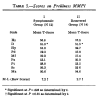
The authors then compared the MMPI and CMI scores between the two groups and found some differences. Here are the results of the MMPI:

1774702833542.png
First note that the hypochondria and hysteria scales showed no significant difference, that was only found for the depression subscale, but the p-value must have been bigger than 0.01 and likely would not have survived correction for multiplicity if the authors had applied this.

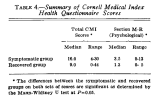
Could not easily find these questionnaires online but I suspect that the one on depression also include somatic symptoms about energy and sleep. The same applies to the CMI scale:

1774702931640.png
So one possible reason for group difference might be that the study failed to take pre-illness differences in symptoms into account?

Otherwise, the sample size is small (n = 12), the groups differed in age, they only looked at symptom persistence for 3 weeks, etc. Even if we ignore that, I don't think it supported the psychosomatic theory because that would have showed as major difference in the hypochondria and hysteria subscales of MMPI.
 
Last edited:
This reserach group of John Imboden at John Hopkins had published a similar study on patients with chronic (> 2 years) symptoms following brucellosis. Here the psychological measurements were taken after the patients were already ill and the sample size was even smaller (n = 8).

It included a paragraph, however, that likely had a lot of influence on people like Simon Wessely and Edward Shorter. Imboden stated:
The chronic-symptomatic patients regarded themselves as more emotionally healthy or adaptable than did the chronic patients who no longer had their somatic symptoms. The latter group tended to see themselves as having emotional difficulty, while the chronic-symptomatic patients thought of themselves as physically ill. This suggests that the somatic symptoms have a self-esteem-supporting function. This possibility is in keeping with the observation that the chronic-symptomatic patients tended to make use of their "chronic brucellosis" as a readily available explanation for any discomfort that occurred. They were, therefore, less inclined to relate their anxieties or feelings of depression to personal issues or problems.
Brucellosis. III. Psychologic aspects of delayed convalescence - PubMed
 
A copy of the CMI questions seems to have been included as a supplement to this paper (link) -- direct link.

There are some very minor linguistic variations between them and the questions as described in the 1951 Brodman paper (link) introducing the CMI - I suspect that the version in the Frontiers paper was translated to Chinese and back again - but they seem to otherwise match.

The diagnosis of "chronic brucellosis" had some popularity for a while in the US. The pioneering microbiologist Alice Catherine Evans, who wrote about her own diagnosis in her memoirs (link), describes a pattern that will be familiar to many of us: an infection, followed by prolonged disability amidst disbelief from an often uncomprehending medical profession, who either considered patients to be malingerers or diagnosed them with neurasthenia. Many cases were probably ME/CFS.
 
Imboden et al - 1961 said:
Significant differences were observed, however, in the psychological test results and are in accord with the prediction, derived from a previously reported study of recovery patterns following acute brucellosis, that delayed recovery following acute self-limited illness occurs in persons who respond to psychological tests in patterns characteristic of depression-prone patients. Since the psychological data in this study were obtained prior to the illness, the evidence supports the view that this emotional state or attitude is not secondary to the illness, existed prior to it, and in significant measure was a determining factor in delaying symptomatic recovery from acute illness.

The good thing is science is (slowly) starting to understand what this relationship actually is. See for example this recent paper on the role of the immune system and autoimmunity —

Dissecting the genetic relationship between severe mental disorders and autoimmune diseases (2026, Brain, Behavior, and Immunity, Open Access) —

Shared genetic loci implicate lipid metabolism and TNF signaling.

With commentary on that paper and others in Rethinking boundaries: Genetic bridge between psychiatry and autoimmunity (2026, Brain, Behavior, and Immunity, Paywall) —

Advances in neuropsychiatric research have increasingly illuminated the fascinating connection between the immune system and mental health, contributing to the rapid dynamic expansion of immunopsychiatry. Traditionally, psychiatric conditions were understood through psychological, neurological, and sociological frameworks using biopsychosocial approach. However, growing evidence suggests that immune system dysfunction and chronic inflammation also play important roles in the development and progression of these disorders. In a recent study published in Brain, Behavior, and Immunity, Wiström and Fuhrer et al. explored whether psychiatric and autoimmune diseases share underlying genetic risk factors, offering new insights into the biological connections between mental health and immune function.

A substantial body of research has shown that individuals with psychiatric conditions such as major depression, bipolar disorder, and schizophrenia often exhibit elevated levels of inflammatory markers. At the same time, epidemiological studies have revealed significant comorbidity between psychiatric and autoimmune diseases. For example, patients with autoimmune conditions like multiple sclerosis, inflammatory bowel disease, and autoimmune thyroiditis frequently experience psychiatric symptoms such as depression, anxiety, and cognitive disturbances. Conversely, individuals diagnosed with severe mental disorders have a significantly increased risk of developing autoimmune conditions such as celiac disease, Graves’ disease, Crohn’s disease, psoriasis, and type 1 diabetes. These bidirectional associations suggest that immune dysregulation may be a shared factor contributing to both psychiatric and autoimmune pathology.

These findings have several important implications for research and clinical practice. First, they provide strong support for the hypothesis that immune system dysfunction contributes to the development of certain psychiatric disorders. Although immune processes are unlikely to be the sole cause, they may represent a key biological component within a broader network of genetic, environmental, and psychological influences. Second, the identification of shared genetic pathways challenges the traditional separation between psychiatric and autoimmune diseases and highlights the need for interdisciplinary approaches that integrate psychiatry, immunology, autoimmunity, and genetics.
 
Just to add:
It included a paragraph, however, that likely had a lot of influence on people like Simon Wessely and Edward Shorter.
Yep. SW and some of the other early psychiatrists were well aware of Imboden; SW references it in the History of Postviral Fatigue Syndrome chapter of the 1991 British Medical Bulletin on PVFS, as do Woods & Goldberg in their chapter. He also references it in his chapter of "Psychological Disorders in General Medical Settings":
SW said:
Studying chronic brucellosis, Imboden et al. (1959) showed that patients who retained their symptoms after infection were distinguished by a convinction of organic disease (namely, continuing infection), a preoccupation with bodily symptoms and a refusal to discuss emotional issues.
SW said:
For example, "chronic brucellosis" has been described as a "spurious disease construct which legitimizes and thereby perpetuates chronic illness behaviour" (Eisenberg, 1988). The inevitable result is that the symptoms persist, so the diagnosis is confirmed, and the process continues. The successors to chronic brucellosis that appear in this chapter are inadvertently fulfilling the same role in many patients.
Also of note is that Imboden went on to co-author a three-part series of papers about hysteria/conversion with Ziegler (link, link, link).
 
Back
Top Bottom