Cross-ancestry genetic architecture reveals shared biological pathways of major psychiatric disorders
Abstract
Psychiatric disorders, including bipolar disorder (BD), major depressive disorder (MDD), and schizophrenia (SCZ), share substantial genetic overlap. We conducted a cross-ancestry multivariate genome-wide association study (GWAS) integrating European and East Asian populations to uncover shared genetic underpinnings.
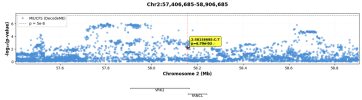
Our analyses identified 403 loci associated with shared polygenic liability to psychiatric disorders, including 88 novel regions. Cross-ancestry fine-mapping highlighted robust shared signals, notably at VRK2 (rs7596038), consistently significant across ancestries. Gene prioritization revealed 90 high-confidence candidate genes enriched in neurodevelopmental pathways.
Single-nucleus RNA sequencing implicated excitatory neurons and astrocytes as key cellular contexts, emphasizing NCAM1–FGFR1 and NEGR1–NEGR1 signaling pathways.
Mendelian randomization analyses provided causal evidence linking shared genetic liability to structural brain alterations, particularly in regions crucial for emotion and cognition. Polygenic risk scores derived from shared genetic liability substantially enhanced predictive accuracy for BD and SCZ, demonstrating strong trans-ancestry validity.
These results advance understanding of shared genetic architecture in psychiatric disorders, highlighting potential therapeutic targets and emphasizing the critical importance of diverse ancestry studies in precision psychiatry.
Web | DOI | PDF | Molecular Psychiatry | Paywall
Feng, Yu; Jia, Ningning; Huang, Peng; Hu, Shaohua; Yang, Sheng
Abstract
Psychiatric disorders, including bipolar disorder (BD), major depressive disorder (MDD), and schizophrenia (SCZ), share substantial genetic overlap. We conducted a cross-ancestry multivariate genome-wide association study (GWAS) integrating European and East Asian populations to uncover shared genetic underpinnings.
Our analyses identified 403 loci associated with shared polygenic liability to psychiatric disorders, including 88 novel regions. Cross-ancestry fine-mapping highlighted robust shared signals, notably at VRK2 (rs7596038), consistently significant across ancestries. Gene prioritization revealed 90 high-confidence candidate genes enriched in neurodevelopmental pathways.
Single-nucleus RNA sequencing implicated excitatory neurons and astrocytes as key cellular contexts, emphasizing NCAM1–FGFR1 and NEGR1–NEGR1 signaling pathways.
Mendelian randomization analyses provided causal evidence linking shared genetic liability to structural brain alterations, particularly in regions crucial for emotion and cognition. Polygenic risk scores derived from shared genetic liability substantially enhanced predictive accuracy for BD and SCZ, demonstrating strong trans-ancestry validity.
These results advance understanding of shared genetic architecture in psychiatric disorders, highlighting potential therapeutic targets and emphasizing the critical importance of diverse ancestry studies in precision psychiatry.
Web | DOI | PDF | Molecular Psychiatry | Paywall