Daratumumab, isatuximab (CD38 drugs)

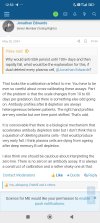
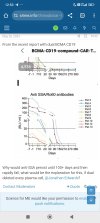
You were referring to the SSA dropping slower than other antibodies and calling it an lab artefact. The link i posted leads to your post.
 

Attachments

  • Screenshot_2025-11-01-12-53-25-438_com.android.chrome.jpg
    Screenshot_2025-11-01-12-53-25-438_com.android.chrome.jpg
    376.3 KB · Views: 7
  • Screenshot_2025-11-01-12-53-20-022_com.android.chrome.jpg
    Screenshot_2025-11-01-12-53-20-022_com.android.chrome.jpg
    243.4 KB · Views: 7
You were referring to the SSA dropping slower than other antibodies and calling it an lab artefact. The link i posted leads to your post.

I was referring to a more detailed and hard to explain shape of a curve, not the persistence of Ro antibodies in the first place.
 
But you said it's unlikely they persist in such a way as the shape of the curve suggests, calling it a lab artefact?

Anyway, seems we can agree it wasn't. So seems those SSA antibodies whether they are from salivary glands or from BM, are harder to get rid of than even total IgG?! As they're last ones to go :-/
Do you think it's from glands? I'm afraid it is.

The interesting part is the study said none of the patients had Sjogrens but if their SSA is so high and so hard to knock down which would mean that it is coming from glands most likely, then by definition they do have SjD with positive gland focus score, probably, right? As dr Donald Thomas said 40% of SLE have SjD, but they tend to exclude it in SLE just by asking "are your mouth dry?" .
 
So seems those SSA antibodies whether they are from salivary glands or from BM, are harder to get rid of than even total IgG?! As they're last ones to go :-/
Do you think it's from glands? I'm afraid it is.

No, I think that is implausible. I have written papers on Sjogren's gland immunohistology and although there can be follicular structures with lots of B cells the number of plasma cells present in most cases is small.
 
No, I think that is implausible. I have written papers on Sjogren's gland immunohistology and although there can be follicular structures with lots of B cells the number of plasma cells present in most cases is small.
So they have no role in the disease or only locally? I know its only 1-24% LLPC on biopsies but if protected environment in salivary glands niches is not the reason that SSA persists even more than total IgG, even with teclistamab it is a huge difference, why it persists so much then? So disproportionately to the total IgG.
 
Merged


So this individual with Sjogrens & ME/CFS responded or is responding to Dara 5 months post injection. Fluge’s Dara study showed patients tended to respond at 2-3 months post first injection. So that’s a decent difference. Does that mean that we can’t really attribute this person’s response to Dara?

Also I remember @Jonathan Edwards commenting that the rate of response to rituximab in the Fluge phase 2 or Phase 3 study wasn’t “right” —would you mind recapping the argument here?

If a RA patient “responded” to rituximab, but the time frame for the response wasn’t “correct” would you discount the likelihood that the response was due to rituximab?
 
Last edited by a moderator:
So this individual with Sjogrens & ME/CFS responded or is responding to Dara 5 months post injection. Fluge’s Dara study showed patients tended to respond at 2-3 months post first injection. So that’s a decent difference. Does that mean that we can’t really attribute this person’s response to Dara?

If this person actually has Sjögren's in the sense of symptoms associated with Ro antibodies then I don't think it is sensible to call this ME/CFS (which is defined as not explained by some other disease). I have no idea what to expect for response time for Sjögren's but this might be it.
Also I remember @Jonathan Edwards commenting that the rate of response to rituximab in the Fluge phase 2 or Phase 3 study wasn’t “right” —would you mind recapping the argument here?

The phase 2 primary endpoint was too soon. There was a significant difference at a later time point (6 mo) that would have been a better choice for an autoantibody mediated disease but this only appeared post-hoc. Moreover, when I reviewed the pharmacodynamics for all the differen tmeasures it looked a mess. I thought a phase 3 was justified but was not surprised (although disappointed) when it was negative.
If a RA patient “responded” to rituximab, but the time frame for the response wasn’t “correct” would you discount the likelihood that the response was due to rituximab?

If the response was in two days yes. That would be down to the steroid pre-med. But different cases of RA have different problems that may well respond at different times. Moreover, late responses in severe cases are not that surprising - we had cases that did not really settle until after a second course. It is hard to give a simple answer but if improvement seemed to bear no relation to a downward antibody level then it might seem spurious. To be honest, in RA, with joint swelling to see and a CRP to track, we didn't see much in the way of 'wrong' responses.

Basically, I don't think a Sjögren's case is going to help us much because we know that is mediated by documented autoantibodies from LLPC that are absent in ME/CFS.
 
So hopefully the fact that the pharmodynamics of the responses were relatively consistent in the Daratumumab pilot trial gives you more hope?
Do we know whether participants had close contact to each other? In times of social media things can sometimes be quite connected, I think @Utsikt mentioned that at least one of the people didn't know any of the other people, but who knows.
 
Do we know whether participants had close contact to each other? In times of social media things can sometimes be quite connected, I think @Utsikt mentioned that at least one of the people didn't know any of the other people, but who knows.
If I’ve said that or given that impression, I can’t remember the basis for it at this moment. So I don’t know if it’s correct.

But Norway is a small and very interconnected country, and with a pilot only in Bergen (population of 300k) and only limited to patients that could be recruited without widespread campaigns, I wouldn’t be surprised if the participants at least were aware of some of each other. How much and if they spoke about their experiences is impossible to guess.
 
Polyclonal IgG levels remained unchanged, which may be explained by a subset of normal PC with reduced CD38 expression that survived during daratumumab therapy.

That is a pretty striking finding. It seems to suggest that if daratumumab has any efficacy in ME/CFS it is not due to killing plasma cells!

But IGG did go down in Fluge et al.

I wondered that. So things do not necessarily go as pear-shaped as it seemed.

That paper's cohort are patients with myeloma, and they are characterised as extensively pre-treated. Could a reduced CD38 expression on plasma cells more generally be an environmental effect (eg a precursor requirement) before you can even get to the clonal expansion seen in myeloma?

Ie is it possible this observation is not relevant to the ME/CFS context, whose plasma cells are presumptively normal, but just happen to be producing pathological immunoglobulins that we'd like to get rid of?
 
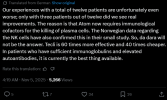
View attachment 29113

From Leo Habets. Translated from German.

Attempted to treat twelve patients already. Patients are so desperate so not going to pretend like this was not somewhat expected, but incredibly worrying.
Is he using the same dosing schedule as the trials? Has he at least checked NK numbers before dosing patients?

I don't approve of his methods but if what he's saying is true that is a bit worrying.
Isn't he using sub clinical doses of teclistamab when he prescribes that anyway?
 
I don't approve of his methods but if what he's saying is true that is a bit worrying.
I don't think so. There's a strong indication that he has no idea what he's doing or saying so I wouldn't put much value into his observations whether they are negative or positive.

Besides that we have no idea what condition the patients he treats have, maybe they have the spike protein disease he claims he's showed in his patients or the GPCR-aab disease he's claimed to shown to exist or is it the disease he's already cured so many times with Ronapreve? If he can't interpret tests but sees these tests as crucial part of diagnosis what do you end up with?
 
Back
Top Bottom