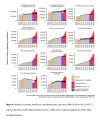
We are no longer encouraged to test at all.
Those changed long before the pandemic (in 2016), and can’t explain the post-pandemic changes in trends because they were already included in the baseline trend. It also only affects the ages 16-19.
Then you’d expect to see increases across all diagnostic groups, and you don’t. You only see increases in the covid-associated groups.
All of this was addressed in the publication. Looks like he either didn’t read it, or didn’t understand it. Concerning either way..
Based on the figure from the study, respiratory infections excluding covid were lower than expected in 2020 and 2021, and higher than the pre-pandemic baseline in 2023 and 2024. Overall, from 2020 to 2024, there were no excess consultations for respiratory infections. The study doesn't provide a breakdown of specific conditions, such as whooping cough and pneumonia, or individual symptoms, so I'm unsure if there was any excess for these. However, a similar trend is seen in other countries, as shown by this study (
https://www.sciencedirect.com/science/article/pii/S2667193X25000341) from Canada, which also reported increased hospitalizations for respiratory diseases in children in 2022. By 2024, they returned to pre-pandemic levels, and the average from 2020 to 2024 wasn't worse than 2015-2019 either. So, instead of speculating about undiagnosed covid infections or immune damage, it's much more likely that temporary measures simply delayed infections until they were lifted. The same situation is with conjunctivitis in the Norwegian study, and no, it didn't become more prevalent since 2023, no evidence of that.
The rise in fatigue diagnoses is actually the most compatible with post-covid conditions.
Females 15–29, children, adolescents, and young adults had disproportionately large relative excesses for consultations for memory disturbances.
However, if memory problems were more common in children and younger adults, long covid is likely not the reason, because it should affect middle-aged adults more frequently.
The rise in psychological complaints explains a large portion of the overall increase. The authors again suggested that some people with long covid were misdiagnosed, but there is not much evidence that it's caused by covid infections. For example, there is an interesting study (
https://jamanetwork.com/journals/jamanetworkopen/fullarticle/2817293) that compares the prevalence of symptoms in individuals who had a PCR-confirmed infection, those with no PCR-confirmed infections but a positive antibody test, and those with negative results for all PCR and antibody tests. I looked at the covid-specific symptoms like loss of taste or smell, 10-11% in people with a history of covid, 9-10% in people only with a positive antibody test, and 0,6% in people without any history of covid. It shows that infections in both groups are pretty similar in terms of severity, and there were a few undetected infections. Mental health symptoms were more prevalent in individuals with a history of COVID-19, but not in those with only a positive antibody test, so the awareness of infection may explain an increase, rather than the infection itself.
Another possible problem is an incorrect baseline. For example, abdominal pain and other infectious diseases showed a linear increase from roughly 2010 to 2015, followed by a plateau until 2019. So expected consultations were similar to those from 2015-2019, and any detected increase was considered an excess. However, a simple linear trend based on the 2010-2014 data wouldn't have shown any excess.
These findings align with broader population health deterioration observed both nationally andinternationally. In Norway, the period 2022–2024 with widespread SARS-CoV-2 transmissioncoincided with 13.0%, 8.4%, and 7.0% excess mortality respectively [87], representing anunprecedented level of excess mortality in Norway's modern public health history. This excessmortality, also affecting those under 65, is compatible with uncontrolled SARS-CoV-2 spreadincreasing deaths beyond acute SARS-CoV-2 infection [88].
Again, you need to be careful when making conclusions about excess deaths in 2023-2024 using pre-2020 data as a baseline. A linear trend may not necessarily apply for such a long period into the future.
There are also reports of larger shifts: In Spain, self-reported chronic health problems increased fromstable 30% (2012–2019) to 50% by late 2024 [91–94]. In the United States, disability numbersremained steady at 29–31 million until 2019, then rose continuously to nearly 35 million by end2024 [95].
The reason disability rates in Spain weren't mentioned is that there has been no increase there. The number of working-age individuals with disabilities has risen by 65,000 since 2019. However, there has been no increase since the end of 2020, and the rates were going up even before the pandemic (page 15). Unemployment rates are historically low as well.
https://sepe.es/SiteSepe/contenidos...capacidad.-Estatal-2024--Datos-2023--NIPO.pdf