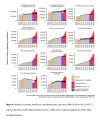
Excess primary healthcare consultations in Norway in 2024 compared to pre-COVID-19-pandemic baseline trends, White et al, 2026

We are no longer encouraged to test at all.
Yeah this one is a doozy alright. How would that even work? People were encouraged to test more during the pandemic, to control the spread when sick. And then? If it was back then, what? The habit remained, despite no longer happening? How does that translate into GP consults? Going to see a GP just to get tested even for mild illness? Which is about the only reasonable interpretation of this, but obviously it's false so this is just total bullshit.

The amount of lying, bullshit and deceit in medicine is completely out of control. This is no way to run a society, a government, even less so a health care system.
 
Last edited by a moderator:
Yeah this one is a doozy alright. How would that even work? People were encouraged to test more during the pandemic, to control the spread when sick. And then? If it was back then, what? The habit remained, despite no longer happening? How does that translate into GP consults? Going to see a GP just to get tested even for mild illness? Which is about the only reasonable interpretation of this, but obviously it's false so this is just total bullshit.

The amount of lying, bullshit and deceit in medicine is completely out of control. This is no way to run a society, a government, even less so a health care system.
I wonder if what was implied from the GP is that he believes people might have gotten more worried and fussy about their health because a big deal was made out of mild symptoms.
 
Last edited by a moderator:
We are no longer encouraged to test at all.

Those changed long before the pandemic (in 2016), and can’t explain the post-pandemic changes in trends because they were already included in the baseline trend. It also only affects the ages 16-19.

Then you’d expect to see increases across all diagnostic groups, and you don’t. You only see increases in the covid-associated groups.

All of this was addressed in the publication. Looks like he either didn’t read it, or didn’t understand it. Concerning either way..
Based on the figure from the study, respiratory infections excluding covid were lower than expected in 2020 and 2021, and higher than the pre-pandemic baseline in 2023 and 2024. Overall, from 2020 to 2024, there were no excess consultations for respiratory infections. The study doesn't provide a breakdown of specific conditions, such as whooping cough and pneumonia, or individual symptoms, so I'm unsure if there was any excess for these. However, a similar trend is seen in other countries, as shown by this study (https://www.sciencedirect.com/science/article/pii/S2667193X25000341) from Canada, which also reported increased hospitalizations for respiratory diseases in children in 2022. By 2024, they returned to pre-pandemic levels, and the average from 2020 to 2024 wasn't worse than 2015-2019 either. So, instead of speculating about undiagnosed covid infections or immune damage, it's much more likely that temporary measures simply delayed infections until they were lifted. The same situation is with conjunctivitis in the Norwegian study, and no, it didn't become more prevalent since 2023, no evidence of that.

The rise in fatigue diagnoses is actually the most compatible with post-covid conditions.
Females 15–29, children, adolescents, and young adults had disproportionately large relative excesses for consultations for memory disturbances.
However, if memory problems were more common in children and younger adults, long covid is likely not the reason, because it should affect middle-aged adults more frequently.

The rise in psychological complaints explains a large portion of the overall increase. The authors again suggested that some people with long covid were misdiagnosed, but there is not much evidence that it's caused by covid infections. For example, there is an interesting study (https://jamanetwork.com/journals/jamanetworkopen/fullarticle/2817293) that compares the prevalence of symptoms in individuals who had a PCR-confirmed infection, those with no PCR-confirmed infections but a positive antibody test, and those with negative results for all PCR and antibody tests. I looked at the covid-specific symptoms like loss of taste or smell, 10-11% in people with a history of covid, 9-10% in people only with a positive antibody test, and 0,6% in people without any history of covid. It shows that infections in both groups are pretty similar in terms of severity, and there were a few undetected infections. Mental health symptoms were more prevalent in individuals with a history of COVID-19, but not in those with only a positive antibody test, so the awareness of infection may explain an increase, rather than the infection itself.

Another possible problem is an incorrect baseline. For example, abdominal pain and other infectious diseases showed a linear increase from roughly 2010 to 2015, followed by a plateau until 2019. So expected consultations were similar to those from 2015-2019, and any detected increase was considered an excess. However, a simple linear trend based on the 2010-2014 data wouldn't have shown any excess.

These findings align with broader population health deterioration observed both nationally andinternationally. In Norway, the period 2022–2024 with widespread SARS-CoV-2 transmissioncoincided with 13.0%, 8.4%, and 7.0% excess mortality respectively [87], representing anunprecedented level of excess mortality in Norway's modern public health history. This excessmortality, also affecting those under 65, is compatible with uncontrolled SARS-CoV-2 spreadincreasing deaths beyond acute SARS-CoV-2 infection [88].
Again, you need to be careful when making conclusions about excess deaths in 2023-2024 using pre-2020 data as a baseline. A linear trend may not necessarily apply for such a long period into the future.
There are also reports of larger shifts: In Spain, self-reported chronic health problems increased fromstable 30% (2012–2019) to 50% by late 2024 [91–94]. In the United States, disability numbersremained steady at 29–31 million until 2019, then rose continuously to nearly 35 million by end2024 [95].
The reason disability rates in Spain weren't mentioned is that there has been no increase there. The number of working-age individuals with disabilities has risen by 65,000 since 2019. However, there has been no increase since the end of 2020, and the rates were going up even before the pandemic (page 15). Unemployment rates are historically low as well.

https://sepe.es/SiteSepe/contenidos...capacidad.-Estatal-2024--Datos-2023--NIPO.pdf
 
What is your evidence for long covid symptoms affecting middle aged adults more than young people/children?
The best evidence showing that long covid symptoms in general are significantly more common in middle-aged adults than in young adults or children is probably the ONS survey.


However, the risk factors for specific symptoms, like memory problems, might not be the same, so maybe I'm wrong here, but it would still be weird if covid is a greater risk factor for memory issues in younger adults and children, but not for fatigue.

I'm not trying to say that memory problems are definitely not caused by covid. Actually, memory problems are consistently associated with covid infection, even in the omicron period. But a 100+% increase in memory problems in children and young adults is highly unlikely to be exclusively due to covid, knowing the best estimates of long covid in children.

 
Last edited:
Considering that long covid (as broad as the definition may be) is now likely the most common chronic illness in children, surpassing asthma I wouldn't doubt research like this too much.

Also, disability estimates are woefully inadequate, especially in some countries - getting diagnosed with long covid or ME/CFS is pretty much impossible in Czechia. And getting disability for it if you manage that can easily be a 10 year battle, in person, in court. Therefore any such impact of covid is perfectly hidden in this statistic. I don't know what system Spain uses but something to keep in mind.

"Long covid is here to stay - even in children" (couldn't find if it was posted here already)
 
Considering that long covid (as broad as the definition may be) is now likely the most common chronic illness in children, surpassing asthma I wouldn't doubt research like this too much
But the broadness makes such statements meaningless doesn't it? If asthma following a Covid infection is considered Long-Covid which some consider it to be, then it can only be more common than asthma because everybody has gotten Covid. Others will tell you that FND is the most common condition in children because everything can be considered FND and of course Long-Covid is FND too. The prevalence estimates for Long-Covid deviate too much to tell you anything useful in that respect. Either one has to do more sophisticated stuff or just say it's a problem that's big but hard to quantify.
 
Also, disability estimates are woefully inadequate, especially in some countries - getting diagnosed with long covid or ME/CFS is pretty much impossible in Czechia. And getting disability for it if you manage that can easily be a 10 year battle, in person, in court. Therefore any such impact of covid is perfectly hidden in this statistic. I don't know what system Spain uses but something to keep in mind.
And we know for a fact the same thing is happening with LC, it's extremely rare to receive disability support outside of very specific diagnoses that are considered permanent. I am not recorded as being disabled, technically I'm just a loafer on welfare. I don't even mention my diagnosis when I interact with health care, even when asked directly. I only ever mention it on anonymous government surveys, but that seldom happens. Good numbers are very hard to come by on this front because they are not properly recorded. Just as we know how a huge % of "mental illness" diagnoses are actually made of people like us.

It takes a long time to understand this. It takes a significant understanding that the systems of health care are extremely flawed on this front, you have to know how this typically happens, and it's impossible to validate with certainty beyond the most generic data, such as GP consults. The details of what is recorded about the consults are inaccurate to the point of being very misleading for controversial diagnoses, and chronic illnesses have been the most controversial diagnoses for decades, we're talking literal generations of misleading data misrecorded intentionally.
 
Based on the figure from the study, respiratory infections excluding covid were lower than expected in 2020 and 2021, and higher than the pre-pandemic baseline in 2023 and 2024. Overall, from 2020 to 2024, there were no excess consultations for respiratory infections.
That’s an absurd time period to compare across because they are so different. It’s like saying that there was a drought for two years, and then floods for two years, but there is nothing abnormal because the average for all four years combined was normal.

In 2020 and 2021 there were strict restriction in place, which caused an overall decrease in the spread of respiratory infections.

After the restrictions were lifted in early 2022, there was an increase in respiratory infections beyond what would have been expected based on pre-pandemic trends.

During the first cycle post-restrictions you might have expected an increase in respiratory infection consultations due to the lowered immunity in the population due to the lower exposure to the infections in the preceeding years. But that would also mean that you’d expect a decrease again in the following years because of the increased immunity from higher amounts of infections.

But that’s not what we’re seeing. The numbers are staying higher than expected. So something else must also be going on, and it’s plausible that covid is affecting the immune system negatively.
The rise in psychological complaints explains a large portion of the overall increase. The authors again suggested that some people with long covid were misdiagnosed, but there is not much evidence that it's caused by covid infections.
It doesn’t seem like you’ve read the paper. They discuss this at length. E.g. that «slitenhet» which translates to «tiredness» is arbitrarily classified as psychological.
Another possible problem is an incorrect baseline. For example, abdominal pain and other infectious diseases showed a linear increase from roughly 2010 to 2015, followed by a plateau until 2019. So expected consultations were similar to those from 2015-2019, and any detected increase was considered an excess. However, a simple linear trend based on the 2010-2014 data wouldn't have shown any excess.
How is it incorrect to use the most recent baseline?

And excess means that there is a change in the trend, not that there is necessarily more or less in absolute terms. In maths terms (and slightly simplified), excess can be thought of as when the derivative of the derivative is positive.
Again, you need to be careful when making conclusions about excess deaths in 2023-2024 using pre-2020 data as a baseline. A linear trend may not necessarily apply for such a long period into the future.
Have you seen the flare on the trend line? This has already been accounted for in the model.
 
During the first cycle post-restrictions you might have expected an increase in respiratory infection consultations due to the lowered immunity in the population due to the lower exposure to the infections in the preceeding years. But that would also mean that you’d expect a decrease again in the following years because of the increased immunity from higher amounts of infections.

But that’s not what we’re seeing. The numbers are staying higher than expected. So something else must also be going on, and it’s plausible that covid is affecting the immune system negatively.
But that's exactly what happened with children's hospitalizations in Alberta, Canada, for example, where by the end of 2024, they returned to the expected levels. In Alberta, children's hospitalizations were already higher than expected in 2022, but in Norway, they were higher than in 2020 and 2021, but not above the pre-pandemic expected levels. The Mycoplasma pneumonia outbreak occurred almost a year later in Norway, so it's definitely possible that Norway will follow a similar pattern, just with a time delay. And Alberta isn't the exception. A study from the US shows that, by 2025, infections transmitted through the air had largely returned to pre-pandemic levels, and the cumulative rates in most states since 2020 remained at a net deficit, reflecting an overall reduction in the burden of disease.
It doesn’t seem like you’ve read the paper. They discuss this at length. E.g. that «slitenhet» which translates to «tiredness» is arbitrarily classified as psychological.
It's still not the evidence, even if some of the conditions of one of the multiple psychological symptom codes that showed an increase are connected to long covid. It clearly can't be the sole reason, although it's possible that long covid is partially responsible. The authors referenced a study showing some association between covid infection and some psychological conditions, but it's also possible that there won't be any association for those with no confirmed infections but a positive antibody test.
How is it incorrect to use the most recent baseline?
They didn't use the most recent baseline. They used 2010-19 data, but with a polynomial trend, which is easy to overfit. My point is that if there was no consistent trend for ten years before the pandemic, you should not expect a consistent trend afterwards.
Have you seen the flare on the trend line? This has already been accounted for in the model.
The farther an extrapolated trend goes beyond known data, the greater the uncertainty. But their confidence intervals stay the same.

https://www.rwhite.no/articles/2025-white-mortality.pdf

Because of that, normally, you use the data from the past five or ten years to calculate expected mortality rates for the following year, maybe for two years. This approach works well because significant changes tend to stand out quickly against any reasonable baseline. Trying to extend this approach can be quite tricky cause it's difficult to predict which factors might become more influential with enough time and to isolate the specific cause of any change.
 
Last edited:
Back
Top Bottom