Genetic variants associated with chronic fatigue syndrome predict population-level fatigue severity and actigraphic measurements, 2024, Liu et al.

Dolphin

Senior Member (Voting Rights)
Poster abstract, see post #4 for full paper.


https://www.neurology.org/doi/abs/10.1212/WNL.0000000000204829

SLEEP 3
April 9, 2024
Free Access

Actigraphic and Genetic Characterization of Myalgic Encephalomyelitis/Chronic Fatigue Syndrome Phenotypes in the UK Biobank (P10-9.007)

Patrick Liu, David Raizen, Carsten Skarke, Thomas Brooks, and Ron Anafi
AUTHORS INFO & AFFILIATIONS
April 9, 2024 issue
102 (17_supplement_1)
https://doi.org/10.1212/WNL.0000000000204829
Abstract

Objective:

Patients with myalgic encephalomyelitis/chronic fatigue syndrome (ME/CFS) often experience debilitating fatigue and autonomic dysregulation, yet objective measurements of these symptoms are limited. This study utilized actigraphic data from the United Kingdom Biobank (UKBB) to investigate (1) reduced activity in those with CFS, (2) decreased amplitudes of daily temperature rhythms as a potential indicator of autonomic dysregulation, and (3) the impact of specific single nucleotide polymorphisms (SNPs) associated with CFS on these actigraphic parameters.

Background:

ME/CFS is a complex and poorly understood condition characterized by profound fatigue, postural orthostasis, and temperature dysregulation. Objective metrics reflecting these fatigue-related symptoms are scarce. Previous research explored small-scale actigraphic analyses, shedding light on movement and temperature patterns in CFS, but large-scale investigations remain limited. Genetic factors have also emerged as potential contributors to CFS risk, although how they affect phenotypic manifestations remains unclear.

Design/Methods:

Actigraphic data from the UKBB were analyzed to compare those with CFS (n = 295) to controls (n = 63,133). Movement parameters, acceleration amplitudes, and temperature amplitudes were assessed. Additionally, the impact of specific SNPs associated with CFS on actigraphic measurements and subjective fatigue experiences was examined.

Results:

In addition to profound fatigue, those with CFS exhibited significantly reduced overall movement (Cohen’s d = −0.220, p-value = 2.42 × 10⁻¹⁵), lower acceleration amplitudes (Cohen’s d = −0.377, p-value = 1.74 × 10⁻⁶), and decreased temperature amplitudes (Cohen’s d = −0.173, p-value = 0.002) compared to controls. Furthermore, certain SNPs associated with CFS were found to significantly influence both actigraphic measurements and subjective fatigue experiences.

Conclusions:

This study provides valuable insights into the objective characterization of CFS using actigraphy, shedding light on the interaction between genetics and symptomatology in CFS. The findings offer avenues for further research into the pathophysiology of CFS and may contribute to a better understanding of fatigue-related conditions in general.


Disclosure: Dr. Liu has nothing to disclose. Dr. Raizen has nothing to disclose. Dr. Skarke has nothing to disclose. Dr. Brooks has nothing to disclose. Dr. Anafi has nothing to disclose.

 
Last edited by a moderator:
Well, if the findings are valid, it would be interesting to see what our good friend Professor Knoop has to say about this, given his insistence that there is zero relationship between reported fatigue and actual activity.
 
Genetic variants associated with chronic fatigue syndrome predict population-level fatigue severity and actigraphic measurements
Liu, Patrick Z; Raizen, David M; Skarke, Carsten; Brooks, Thomas G; Anafi, Ron C

STUDY OBJECTIVES
The diagnosis of myalgic encephalomyelitis/chronic fatigue syndrome (CFS) is based on a constellation of symptoms which center around fatigue. However, fatigue is commonly reported in the general population by people without CFS. Does the biology underlying fatigue in patients with CFS also drive fatigue experienced by individuals without CFS?

METHODS
We used UK Biobank actigraphy data to characterize differences in physical activity patterns and daily temperature rhythms between participants diagnosed with CFS compared to controls. We then tested if single nucleotide variants (SNVs) previously associated with CFS are also associated with the variation of these actigraphic CFS correlates and/or subjective fatigue symptoms in the general population.

RESULTS
Participants diagnosed with CFS (n = 295) had significantly decreased overall movement (Cohen’s d = 0.220, 95% CI of -0.335 to -0.106, p-value = 2.42x10⁻¹⁵ ), lower activity amplitudes (Cohen’s d = -0.377, 95% CI of -0.492 to -0.262, p-value = 1.74x10⁻⁶ ), and lower wrist temperature amplitudes (Cohen’s d = -0.173, 95% CI of -0.288 -0.059, p-value = 0.002) compared to controls (n = 63,133). Of 30 tested SNVs associated in the literature with CFS, one was associated in the control population with subjective fatigue and one with actigraphic measurements (FDR < 0.05).

CONCLUSIONS
The genetic overlap of CFS risk with actigraphy and subjective fatigue phenotypes suggests that some biological mechanisms underlying pathologic fatigue in CFS patients also underlie fatigue symptoms at a broader population level. Therefore, understanding the biology of fatigue in general may inform our understanding of CFS pathophysiology.

Link | PDF (Sleep) [Open Access]
 
Members of the CFS group must have met both of two criteria: 1) they must have answered “Yes” to the 2019 UKBB pain supplement questionnaire question “Have you ever been told by a doctor that you have had Chronic Fatigue Syndrome or Myalgic Encephalomyelitis (M.E.)?” and 2) they must have self-reported having CFS prior to 2013 during a verbal interview by a trained nurse on past and current medical conditions.
 
The two genes that may be affected by the genotype of SNVs associated with fatigue or with actigraphic measures deserve discussion. The SNV associated with subjective fatigue have previously been mapped to genes involved in immune modulation: rs2398428 may affect SLC15A4, which encodes solute carrier family member 15. SLC15A4 plays a role in interferon production and genetic variants in SLC15A4 are linked to systemic lupus erythematosus, an inflammatory disease. This is consistent with previous studies linking inflammation to fatigue.

The SNV associated with actigraphic metrics in the control population was previously mapped to a gene involved in the regulation of metabolism: rs2904106 may affect the gene ATP9A, which encodes an ATPase phospholipid transporter. ATP9A has been shown to be involved in glucose metabolism.
 
Last edited:
Regarding SLC15A4 and ATP9A, see also —

Genetic risk factors for severe and fatigue dominant long COVID and commonalities with ME/CFS identified by combinatorial analysis (2023, Journal of Translational Medicine) —

Of the remaining 4 genes common between long COVID and ME/CFS, we identified 3 common variants in the genes ATP9A, INSR and SLC15A4 in both Severe and Fatigue Dominant cohorts (Table 7).

SLC15A4 encodes a transmembrane transport that has previously been associated with inflammatory autoimmune diseases such as systemic lupus erythematosus from genome-wide association studies [84, 85]. However, SLC15A4 also plays a key role in mitochondrial function, with knock down of the gene resulting in impaired autophagy and mitochondrial membrane potential under cellular stress [86].

We also hypothesized that the genetic variants in ATP9A and INSR both contribute to dysregulated insulin signaling in subgroups of ME/CFS patients.

[86] is Human SLC15A4 is crucial for TLR-mediated type I interferon production and mitochondrial integrity (2021, International Immunology)
 

"Members of the CFS group must have met both of two criteria: 1) they must have answered “Yes” to the 2019 UKBB pain supplement questionnaire question “Have you ever been told by a doctor that you have had Chronic Fatigue Syndrome or Myalgic Encephalomyelitis (M.E.)?” and 2) they must have self-reported having CFS prior to 2013 during a verbal interview by a trained nurse on past and current medical conditions."

RESULTS
Participants diagnosed with CFS (n = 295) had significantly decreased overall movement (Cohen’s d = 0.220, 95% CI of -0.335 to -0.106, p-value = 2.42x10⁻¹⁵ ), lower activity amplitudes (Cohen’s d = -0.377, 95% CI of -0.492 to -0.262, p-value = 1.74x10⁻⁶ ), and lower wrist temperature amplitudes (Cohen’s d = -0.173, 95% CI of -0.288 -0.059, p-value = 0.002) compared to controls (n = 63,133). Of 30 tested SNVs associated in the literature with CFS, one was associated in the control population with subjective fatigue and one with actigraphic measurements (FDR < 0.05).
Hmm..

The findings are certainly interesting, and the overlap with findings from other studies.

But 295 is a tiny sample for a study like this when UKB has a few thousand cases. The recent blood biomarker study from Edinburgh also required CFS peeps to declare fair/poor health and HC to be average/good, which apparently made a big difference.

The small Cohen's d effect sizes for CFS vs actigraphy also casts doubt on the severity for this CFS cohort.
 
Last edited:
Statement of Significance

Objective metrics characterizing symptomatology in chronic fatigue syndrome are scarce and would provide insight into phenotypic presentation, pathophysiology, and fatigue in general. How genetic risk for chronic fatigue syndrome influences phenotypic manifestations of fatigue also remains uncharacterized. This study utilizes large-scale datasets to demonstrate that individuals with chronic fatigue syndrome exhibit reduced total physical activity, lower physical activity amplitudes, and altered wrist temperature rhythms. Moreover, genetic variants associated with CFS modulate these phenotypic manifestations in a control population. These findings suggest the potential of characterizing objective actigraphic parameters in chronic fatigue syndrome patient populations and of linking genetic risk to symptomology, providing insights for understanding chronic fatigue syndrome and fatigue in general and establishing potential mechanistic routes for further investigation.
 
The conclusion of the paper writes:
The genetic overlap of CFS risk with actigraphy and subjective fatigue phenotypes suggests that some biological mechanisms underlying pathologic fatigue in CFS patients also underlie fatigue symptoms at a broader population level.
Which I found rather confusing because the content of their paper suggest rather the opposite. Of 30 single nucleotide variants (SNVs) previously associated with CFS, only one was associated with subjective fatigue severity in the control group. The authors argue that this is unlikely to be due to lack of statistical power:
28 SNVs previously found to be associated with CFS do not predict subjective or actigraphic features in the control population. Again, this lack of association for the 28 SNVs is unlikely to be explained by insufficient statistical power within the UKBB control group since even with the far more inclusive FDR of < 0.4, we could identify no additional SNVs to be associated with subjective fatigue or with actigraphic correlates of CFS.

So where does this statement come from that "some biological mechanisms underlying pathologic fatigue in CFS patients also underlie fatigue symptoms at a broader population level". It is a plausible hypothesis but I don't see anything in this paper that provides evidence for it.
 
So where does this statement come from that "some biological mechanisms underlying pathologic fatigue in CFS patients also underlie fatigue symptoms at a broader population level". It is a plausible hypothesis but I don't see anything in this paper that provides evidence for it.
I assume the evidence is that one SNV that they found was associated with subjective fatigue severity in the control group? I haven't read the study, but I note that they didn't say anything about the SNV in their own CFS sample, only that it had been associated with CFS in the literature.

Interesting, but I think there would be so much noise around a reported subjective fatigue severity in the large control group. I mean, there are so many genetic and acquired health conditions and lifestyle factors that might be associated with subjective fatigue severity.
 
They say there were lower wrist temperature amplitudes in the CFS group. That's interesting.

But, wouldn't wrist temperature be highly susceptible to environmental conditions? As in the healthy controls going off to their squash games and spin classes and even their morning hot shower might have higher wrist temperature peaks because of those things?
 
They say there were lower wrist temperature amplitudes in the CFS group.
I found the following:
Most healthy humans have an inner body temperature that hovers around 98.6 degrees F. But a University of Utah study published in the journal Lancet found that women’s core body temperatures can actually run 0.4 degrees F higher than men’s on average. And women’s hands can be significantly colder — 82.7 degrees F on average, compared with 90 degrees F for men.
It motivated me to find out if the authors controlled for sex in the temperature studies.


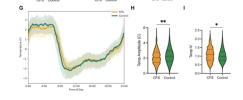
(G) Compiled wrist temperature traces for the CFS and control groups. Similar to (A), all 295 participants with CFS are represented in the graph, and 295 age and sex-matched controls were selected for the control graph. To generate this 24 hour graph, temperature traces for each individual participant were averaged across corresponding time points in the week’s worth of actigraphy data. 25th and 75th percentiles for the selected populations are shown in the shaded regions with considerable overlap between the two groups. Each individual’s temperature values were centered to have a mean of 0°C to account for inter-individual calibration differences.
(H) Temperature amplitude was significantly lower in the CFS group compared to the control group (Cohen’s d = −0.173, 95% CI of −0.288 to −0.059, p-value = .002, Welch’s two sample t-test).
Screenshot 2026-02-07 at 7.43.59 PM.png
It looks as though they matched the CFS group with the controls on age and sex before they did the analysis of activity levels and temperature. That's good.

Wrist temperature values were also calculated using this pipeline and were reported in 30-second intervals. Non-wear time, which was identified by accelerometry data, was treated as missing data. Temperature IV was calculated in the same manner as acceleration IV but using temperature values instead of acceleration. Since we did not have reliable absolute temperature measurements, we could not calculate a temperature RA similar to our calculation of acceleration RA. Instead, to calculate temperature amplitude, we performed cosinor fits of temperature for each participant, yielding diurnal rhythms from which temperature amplitude could be extracted. Temperature amplitude is defined as the difference between the mid-line and peak values of the cosinor fits, thereby making peak-to-trough values twice the calculated amplitude [14

What I realise now from reading the text above is they didn't have absolute temperatures. So, it's not that the peak wrist temperatures were lower in the CFS group. The temperature amplitude is the difference between some sort of mean for the person and the peak values of curves applied to the data. So, the wrist temperatures were more consistent in the CFS group. I think that is entirely to be expected in a group of people who were less likely to exercising, having hot showers and sitting outside in the cold.
 
Last edited:
Back
Top Bottom