Preprint Initial findings from the DecodeME genome-wide association study of myalgic encephalomyelitis/chronic fatigue syndrome, 2025, DecodeMe Collaboration

I would agree with @jnmaciuch that the specifics of our viral reservoirs are unlikely to be a key to any sort of solution or even understanding. If there was no speck of dirt we would have nothing to grow food in. A world devoid of background mess is not an option. I don't see any reason to even talk about pathogens or tandems. Nothing indicates any sort of specificity, except perhaps the global presence of EBV and its effects on B cells.
 
I don't see any reason to even talk about pathogens or tandems.
There are many highly regarded ME/CFS experts that would disagree with you. There are a lot of infectious disease specialists that would disagree with you.

I'm thinking the way to flesh out these ideas, and maybe even resolve these differences in beliefs, at the very least involves talking abut them.
 
Last edited:
'is a neuron ever infected with a virus' - what I'm also getting with that is whether during the infection that kicks off the illness there is virus getting into neurons or otherwise the CNS when it shouldn't be and if an event like that is necessary to develop ME/CFS. I think the implication in Jo's hypothesis is that it wouldn't be that but instead the IFNg response that kicks things off.
I think the circumstances under which that could happen are hard to argue for. A virus pretty much already has to be neurotropic in order to get into the CNS at all. Developing the capability to enter into a new cell type is an extraordinarily rare occurrence even for viruses that mutate extremely rapidly.

Perhaps there might be a difference in terms of how much actually gets to the brain, but in that case it would be an issue of severity rather than location specificity since viruses are detectable across the whole brain within 72 hours (at least all the ones I’m familiar with). Plus there are several cardiovascular and neurovascular disorders which seem to be associated with increased blood brain barrier permeability, but those conditions don’t seem to really predispose to ME/CFS or LC.

So that means that if this idea has any merit, it would have to be a neurotropic virus with latency capabilities that probably also enters the brain of people without ME/CFS, and the weird thing that they cause neurons to do in latency only becomes “activated” upon other infections, some of which don’t reach the brain themselves so it would have to be due to the global immune response. And it would have to be a “something weird” which only happens in ME/CFS, so that likely means an additional stochastic event of homeostatic dysregulation.

Maybe there’s something that fits that very specific bill, I can’t fully discount it. My sense is just that it’s a pretty unlikely possibility to begin with and there’s no mechanistic understanding of how any of that would actually lead to the symptoms of ME/CFS that would justify prioritizing it as a research avenue.
 
One argument against persistent virus is that MECFS seems to have one pattern of presentation (broadly) but the persistent viruses we know of all produce very different disease. MECFS could be due to one specific hidden virus despite being triggbred by lots but it gets a bit complicated.

Sorry to chime in with very pseudo-evolutionary biology science, but wouldn't at least in humans, from the virus perspective, triggering a latent virus infection that causes ME symptoms like being stuck in a dark room and not interacting be kind of counter productive to spreading?

Viruses want to spread their material from host to host, so like sneezing or respiratory fluids. But if a virus infects you and the end result is you reducing your social isolation (and not being contagious), wouldn't it kind of be quite a failure of a virus since it can't spread.

Sorry if this is really dumb (it probably is), but I am just thinking out loud.

A virus that infects the host and causes the host to not interact with anyone else kind of is a bad virus. So by this logic it might be some immune misfire rather than virus.

Imagine if acute covid caused you to not be able to leave your house or bed for a year. That would take care of infection rates real quick
 
Last edited:
Sorry to chime in with very pseudo-evolutionary biology science, but wouldn't at least in humans, from the virus perspective, triggering a latent virus infection that causes ME symptoms like being stuck in a dark room and not interacting be kind of counter productive to spreading?

Viruses want to spread their material from host to host, so like sneezing or respiratory fluids. But if a virus infects you and the end result is you reducing your social isolation (and not being contagious), wouldn't it kind of be quite a failure of a virus since it can't spread.

Sorry if this is really dumb (it probably is), but I am just thinking out loud.
But ME isn’t contagious. So if caused by a virus I can’t see it increasing selection for that virus since transmission doesn’t seem to happen in disease stage?

Edit: I realise my comment is basically repeating what you said LOL sorry. I misunderstood when I first read.
 
Hi @mariovitali ,

To me those responses are just a rehash of all the trendy stuff constantly recycled by people thinking inside a box with no real understanding of global biodynamics. There is no actual explanatory model, just buzzwords.

I think asking @jnmaciuch or @Snow Leopard and a few others here, some with little or no technical training in the field but a good dose of common sense, is likely to provide a more interesting answer.
I agree, I encounter this word salad when I ask ChatGPT for explanations as well. It does better when you feed it clinical trial papers rather than research papers.
 
Sorry to chime in with very pseudo-evolutionary biology science, but wouldn't at least in humans, from the virus perspective, triggering a latent virus infection that causes ME symptoms like being stuck in a dark room and not interacting be kind of counter productive to spreading?

Viruses want to spread their material from host to host, so like sneezing or respiratory fluids. But if a virus infects you and the end result is you reducing your social isolation (and not being contagious), wouldn't it kind of be quite a failure of a virus since it can't spread.

Sorry if this is really dumb (it probably is), but I am just thinking out loud.

A virus that infects the host and causes the host to not interact with anyone else kind of is a bad virus. So by this logic it might be some immune misfire rather than virus.

Imagine if acute covid caused you to not be able to leave your house or bed for a year. That would take care of infection rates real quick
Because it is our immune system causing the behaviour, not the virus.
 
A virus that infects the host and causes the host to not interact with anyone else kind of is a bad virus. So by this logic it might be some immune misfire rather than virus.
Read about sickness behaviour in response to infections. The behaviour of withdrawing and isolating oneself is caused by your own body and is likely an attempt to protect itself and reducing contact with others to limit the spread of the pathogen. It seems to be unspecific response to illness in general.
 
Last edited:
Why did decode focus on protein-coding genes only? Are dodgy miRNA pathways of no interest?
I'm not sure that is the case. The first thing they look for is the genetic signal, then they look to see what was captured by that genetic signal. I think that was mainly protein coding genes. I had a feeling there was at least one RNA species. I don't know if that showed up in the supplementary information?
 
I'm simply not sure this needs to be true.
All living things pretty much have to be genetically programmed to survive and to replicate because if not, they would not be around anymore.

The only way I can imagine that a virus might survive in a population if it causes people to essentially hibernate, is if it causes only some people to hibernate due to rare traits in those people.

Maybe others have some other ideas?
 
All living things pretty much have to be genetically programmed to survive and to replicate because if not, they would not be around anymore.
Fair. But it doesn't have to manifest in typical fashion, i.e. at the progressive expense of the infected. Take parasites, for example.

The only way I can imagine that a virus might survive in a population if it causes people to essentially hibernate, is if it causes only some people to hibernate due to rare traits in those people.

Maybe others have some other ideas?
Perhaps if it's not the virus that persists, or if it is, that it doesn't conform to usual characteristics. Similar to ME/CFS qualities. Of course, it doesn't have to be a virus.
 
On the topic of "what does DecodeME" show, my feeling is that it's really early for anyone to be saying with much confidence that the genes they found point to any specific pathway. From the DecodeME blog and paper respectively:
The signals discovered are involved in the immune and the nervous systems, indicating immunological and neurological causes to this poorly understood disease.
Overall, DecodeME shows that ME/CFS is partly caused by genes related to the immune and nervous systems.

Here are the candidate genes suggested by DecodeME:
chr1
RABGAP1L
DARS2
RC3H1
GPR52
ZBTB37
TNFSF4
ANKRD45
KLHL20
PRDX6
SERPINC1
SLC9C2

chr6q
FBXL4

chr6p
BTN2A2
TRIM38
ZNF322
ABT1
HFE
BTN3A3
HMGN4

chr12
SUDS3
PEBP1
VSIG10

chr13
OLFM4

chr15
CCPG1

chr17
CA10

chr20
CSE1L
ARFGEF2
DDX27
STAU1
ZNFX1
B4GALT5
PTGIS

Is it really possible to say that the above list of genes indicates "immunological causes"? Genuine question, since I don't know much about any of them. But my impression is that genes often have lots of unrelated functions. And the genes related to ME/CFS will likely be only a subset of genes from each locus above, if the right gene is even listed at all. So it feels like you could pretty much write any story you want based on the genes and gene functions you pick.

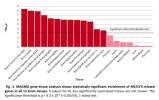
I'm more excited about the MAGMA analysis that found overexpression of ME/CFS-associated genes in the brain (though unfortunately not much more specific than that) as pointing to the nervous system since the technique is much less biased than trying to create a story from the literature.
 
Back
Top Bottom