Long COVID Recovery and Exercise Adherence: 32-Month Study, 2025, Rolo-Duarte

Dolphin

Senior Member (Voting Rights)

Ana Rolo-Duarte, Daniela Prada, Ana S. M. Carvalho, Ana Borges, Paulo J. G. Bettencourt​

ABSTRACT

Objective To evaluate symptom progression in COVID-19 survivors, adherence to prescribed exercise therapy, and its association with pre-infection physical activity at 21 days (T0), 6 months (T1), and 32 months (T2) post-discharge.

Design Retrospective longitudinal study in a hospital-based rehabilitation unit in Portugal. The cohort included 276 patients (mean age 56.6 ± 13.5 years) with confirmed SARS-CoV-2 infection.

Results Adherence was higher among patients reporting prior physical activity (48.8%; p = .003). Symptom prevalence declined over time: dyspnea (T0 = 22.4%, T2 = 7.3%), fatigue (T0 = 32.4%, T2 = 14.5%), and pain (T0 = 17.6%, T2 = 4.8%). Asymptomatic cases increased from 27.4% (T0) to 54.5% (T2). Early adherence, particularly by day 15, was associated with continued participation at day 21, and adherence at day 21 correlated with reduced dyspnea at follow-up (p = .02). Importantly, patients who remained symptomatic at day 21 took significantly longer to recover (t = –6.386; p < .001), indicating this time point as a prognostic marker of delayed resolution of exercise-modifiable symptoms.

Conclusion Early initiation of individualized, structured exercise proved safe, adaptable, and associated with reduced symptom burden, especially dyspnea. Persistence of symptoms at day 21 highlights the prognostic value of early follow-up and underscores the decisive role of timely rehabilitation engagement. Structured home-based and tele-rehabilitation programs supported adherence and accessibility, reinforcing exercise as a cornerstone of long COVID management and potentially applicable to other post-respiratory rehabilitation contexts.
 
For which patients? No stratification.

No mention of a control group.

Retrospective.

Impossible to determine causation. Patients who were going to improve/recover naturally probably did so anyway.

If anything what they measured was the natural recovery rate, independent of exercise.
 
The most common comorbidities were hypertension (58.3%), obesity (57.4%), dyslipidemia (41.1%), and diabetes mellitus (32.4%). Other relevant conditions included psychiatric disorders (10.2%), malignancy (7.0%), chronic pulmonary disease (6.6%), and asthma (6.1%). Notably, 45.5% of patients had no comorbidities.
Never impressive when errors like this show up.
There are different ways to interpret this, so perhaps my initial interpretation was incorrect.
 
Last edited:
Limitations

This study has several limitations. First, pre-existing symptomatology data were unavailable, potentially confounding persistent symptom interpretation. Second, symptom severity assessment was limited by data granularity constraints. Third, excluding patients without follow-up calls may have introduced selection bias. Additionally, this single-center study lacked a control group of patients discharged after non-COVID illnesses. Since prolonged symptoms may occur after community-acquired pneumonia, findings may have broader relevance beyond COVID-19

No mention that no "no treatment" control group
 
As always, they fail to see the most obvious explanation for the date they have: people were able to keep up with exercise because they were improving. The exercise didn’t cause the improvements.

They also had almost 100 % adherence to the exercise the first two weeks, so there is nothing to indicate that the people with symptoms after three weeks could have avoided having symptoms if they just exercised.

Rehab people seem to have been able to situate themselves in a unique temporal position: they meet the patients when they are expected to improve no matter what. So even a harmful rehab treatment might look like it’s «helping». But they are too blinded by their own hubris to see it.
 
As always, they fail to see the most obvious explanation for the date they have: people were able to keep up with exercise because they were improving. The exercise didn’t cause the improvements.

They also had almost 100 % adherence to the exercise the first two weeks, so there is nothing to indicate that the people with symptoms after three weeks could have avoided having symptoms if they just exercised.

Rehab people seem to have been able to situate themselves in a unique temporal position: they meet the patients when they are expected to improve no matter what. So even a harmful rehab treatment might look like it’s «helping». But they are too blinded by their own hubris to see it.
Especially here, it creates the complete illusion that early intervention helps, reinforced by the fact that early recovery is most common. It's really stunning seeing this after so many years knowing the natural progression of the illness.

Put a potato in socks. Wait two weeks. Illness gone. Potato-in-socks cured patient of illness. Exact same reasoning.
They also had almost 100 % adherence to the exercise the first two weeks, so there is nothing to indicate that the people with symptoms after three weeks could have avoided having symptoms if they just exercised.
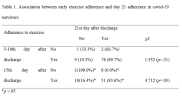
Where did you see this? Adherence appears sprinkled throughout the paper and the tables they show are very confusing, I have no idea what's going on here or their other tables:

1765655364513.png
 
Especially here, it creates the complete illusion that early intervention helps, reinforced by the fact that early recovery is most common. It's really stunning seeing this after so many years knowing the natural progression of the illness.

Put a potato in socks. Wait two weeks. Illness gone. Potato-in-socks cured patient of illness. Exact same reasoning.

Where did you see this? Adherence appears sprinkled throughout the paper and the tables they show are very confusing, I have no idea what's going on here or their other tables:

View attachment 29667
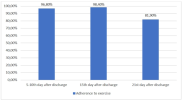
Figure 2
IMG_0527.png
 
How did they measure adherence?

As always, they fail to see the most obvious explanation for the date they have: people were able to keep up with exercise because they were improving. The exercise didn’t cause the improvements.
Indeed. They have not collected any data that reveals causation, and especially direction of any causation.

But the whole point of doing science is to determine causal relationships. If a study cannot contribute to that then it is not scientific in any meaningful sense.
 
So that's 80% after two weeks. Probably lower than your typical new year's day resolution. That's actually rather low considering it's supposed to be rehabilitative. You gotta laugh at the idea that adherence at day 15 'predicts' adherence at day 21. Good grief they are latching on anything they can find.
How did they measure adherence?
Appears to be self-reported, a simple yes/no. I have no idea how mediocre research like this is acceptable. Even amateurs can do far better than this and it's not even close.
 
Back
Top Bottom