Making Invisible Illnesses Visible: Recognizing and Responding to Infection Associated Chronic Conditions 2026 Iskander and Haridopolos

I personally believe my onset was triggered by an infection as I had no gap between my acute glandular fever (mono) episode with the EBV virus confirmed and the onset of my ME. This idea was reinforced by a major relapse triggered by seasonal flue (virus not confirmed). However in both my belief is based of proximity in time which is not proof of causation. Further most viral infections, except perhaps Covid, are not generally confirmed by formal testing.

It may be until we have an understanding of the underlying biology we will not be able say what triggers/causes ME/CFS.
 
I would be curious to know what percent of people who do not believe they had infectious onset have a theory about what their trigger was. It seems no known trigger is by far the most common, not any of the possible triggers you listed. A small percentage of people happening to have an infection correspond with another life event would be totally believable.
If you're on Twitter, you can ask Scott Daniska @scott_scientist (his ME/CFS was triggered by a hydrazine exposure in a chemistry lab) - he's conducted some polls on Facebook and he said that based on these ~60% of people with non-infectious onsets were "affirmative cases" as he calls them - i.e. identify a clear non-infectious trigger. (I think he makes a good point about some people with non-infectious onsets not identifying with the term ME/CFS and instead other terms due to the constant "post-infectious illness" messaging around ME/CFS, especially if they had gradual/insidious onsets and/or have hypermobility e.g - I've heard people say that PEM can be a feature of hEDS and therefore they have hEDS and not ME/CFS, e.g.)


This is the only paper I could find that reported on % of patients with different types of non-infectious triggers where CCC/ICC/IOM criteria were used rather than Fukuda/CDC (I'm guessing "ICM" is supposed to say ICC?) (again, perhaps there is some bias for patients with infectious onsets to join ME/CFS associations - rather than their EDS or fibromyalgia association, e.g.)
Myalgic encephalomyelitis/chronic fatigue syndrome (ME/CFS): A preliminary survey among patients in Switzerland
Participants were consenting ME/CFS patients aged 18 and older and recruited through the largest Swiss ME/CFS association, which counted over 320 members at the start of the study.

Patients who received an ME/CFS diagnosis from health personnel were included in the study. In addition, the study team conducted a quality control in order to ensure reported symptoms did fit the criteria of any of the three case-definitions (CCC, ICM or IOM). Patients not having been diagnosed for ME/CFS by physicians and/or not fulfilling either of the three case definitions for ME/CFS were not included into this study.
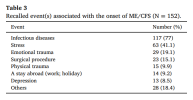
Hundred-fifty-two participants (90%) could recall an associative event with the start of their disease (Table 3). The majority of these patients (N = 117; 69.2%) recalled an infectious disease (i.e. febrile illness) as the most prevalent association prior the onset of ME/CFS.

Among the 117 patients stating infectious diseases as an onset for ME/CFS, 69 (59%) mentioned Epstein-Barr-virus (EBV). Of these, 46 had a confirmed clinical disease, whereas 23 had a sub-clinical infection (antibodies for EBV found during routine blood test; ME/CFS examination). Viral diseases were mentioned by the majority of participants (N = 91; 77.8%), followed by respiratory infections (N = 39; 33.3%), Gastro-intestinal infections including hepatitis (N = 18; 15.4%), tick-borne diseases (N = 19; 16.2%) and miscellaneous infections (N = 20; 17.1%). Table 4 shows the detailed diseases reported by the patients.
Fifty-nine patients (38.8%) recalled a single event as the start of ME/CFS, whereas a combination of events happening around the same time, was stated by 93 participants (61.2%). Among the single associative events, the majority reported infectious diseases (N = 43; 72.9%). Less often recalled were: an episode with perception of “extreme stress” (N = 5; 8.5%), a surgical procedure (N = 2; 3.4%), emotional trauma (N = 1; 1.7%) and a visit abroad (N = 1; 1.7%). Seven (11.9%) patients stated “other” causes as a single event (e.g. vaccination; cancer treatment). Depression and physical trauma were never stated as a single event.

Two, three and more than three coinciding events were reported by 56 (36.8%), 23 (15.1%) and 14 (9.2%) of the participants, respectively. Among this sub-group of multiple associative events, infectious diseases were reported by 75 (80.6%) of the patients. Other events (pooled into the category “other”) included three cancer (mamma carcinoma, intestinal cancer); 13 vaccinations; two drug induced (mephloquine, long term fluorchinolones); one acute urinary retention; one mitochondriopathy; three laboratory incidents (exposure to mercury and nitrous oxide); one surgical heart catheter implant with subsequent complications).

Sixteen patients mentioned vaccines to have been associated with the onset of ME/CFS. It included: six Hepatitis B (inoculation after year 2000); three pox; one tick-borne encephalitis; two influenza; one swine flu; one typhus; one tetanus; one Yellow fever given at the same time as meningococcus). Four patients stated vaccines as the perceived sole event linked to the onset of ME/CFS (three Hepatitis B, one simultaneous Yellow Fever and Meningococcus vaccination).

A trip abroad reported as association with the onset of ME/CFS included destinations to Africa, South-East Asia, Central Asia, South-America, and Northern Australia.
1776277238034.png
 
Last edited:
A small percentage of people happening to have an infection correspond with another life event would be totally believable.
We are culturally hell-bent on defining most infections as acute - boundaried by symptoms and timeframes and, whenever possible, defined by objectively measured biomarkers or lab results.
I would be much more likely to consider the plausibility of the "all these people who report clear non-infectious triggers may have actually had an (asymptomatic) infection at the same time" if there was some evidence that the pathophysiology of ME/CFS is in any way directly related to pathogens (e.g. strong evidence of viral/bacterial persistence driving symptoms e.g.) - although even with that, it would still seem more plausible to me to posit some sort of diverse triggers leading to pathogen reactivation type theory because the coincidental (asymptomatic) infection hypothesis still seems a bit too far-fetched to me. Anyways, without evidence that pathogens are directly implicated in the pathophysiology of ME/CFS, it seems like the much more logical interpretation that infection is the most common trigger for ME/CFS, but just one of many possible triggers.
 
I would be much more likely to consider the plausibility of the "all these people who report clear non-infectious triggers may have actually had an (asymptomatic) infection at the same time" if there was some evidence that the pathophysiology of ME/CFS is in any way directly related to pathogens (e.g. strong evidence of viral/bacterial persistence driving symptoms e.g.)

You'd need reliably accurate diagnostics to satisfy you, and not only do we not have them, not only have we not had them for the last half century since the advent of widespread ME/CFS and things like the half a dozen or so tick-borne diseases - we remain no closer to having them.

We are making no meaningful progress, and for some that means trying to fathom why not because that may have direct import not only on our diagnosis, but on our treatment.
 
If you're on Twitter, you can ask Scott Daniska @scott_scientist (his ME/CFS was triggered by a hydrazine exposure in a chemistry lab) - he's conducted some polls on Facebook and he said that based on these ~60% of people with non-infectious onsets were "affirmative cases" as he calls them - i.e. identify a clear non-infectious trigger.
A Facebook poll by someone who is known to claim a non-infectious trigger is unreliable. People who think they had a similar trigger are way more likely to engage with him.
I've heard people say that PEM can be a feature of hEDS and therefore they have hEDS and not ME/CFS, e.g.
I have a vague memory of someone claiming that COVID gave them hEDS or some such. People say all kinds of things. I don’t think we can assume people who claim to have hEDS with PEM don’t have infectious onset. hEDS is such a mess that I really don’t assume anything at all about what someone has if they claim they have it, including whether they even have hypermobility.
This is the only paper I could find that reported on % of patients with different types of non-infectious triggers where CCC/ICC/IOM criteria were used rather than Fukuda/CDC
The numbers of people in that study who claim a specific non-infectious trigger are quite small. Doesn’t look incompatible with chance or recall bias to me.

The largest group is perceived high stress, which is going to be unreliable because of the number of medical professionals who have publicly insisted ME is caused by stress or an over-activated nervous system or a burnt-out HPA axis or whatever other rebranding of that idea. People will look for a particular type of cause in their history if they think there’s supposed to be one.

You can of course argue the same thing for infectious onset. My point is just that none of this is incompatible with exclusively infectious onset, not that exclusively infectious onset is the only answer.
 
A Facebook poll by someone who is known to claim a non-infectious trigger is unreliable. People who think they had a similar trigger are way more likely to engage with him.
Saying things like "claim a non-infectious trigger" and "people who think they had a similar trigger" is exactly the kind of thing that pushes people with non-infectious triggers away from the ME/CFS community and the ME/CFS diagnosis, because many of these people know that a non-infectious trigger was the trigger for their illness to the same certainty that people with an infection know that it was the trigger. Scott literally had the same experience as many people with an infectious onset, just substitute hydrazine exposure: he was exposed to hydrazine, immediately felt sick, and has never felt well since and meets criteria for ME/CFS.

I suggest that people stop saying things like this to people with non-infectious onsets if they wouldn't say the same to people with infectious onsets.

You can of course argue the same thing for infectious onset. My point is just that none of this is incompatible with exclusively infectious onset, not that exclusively infectious onset is the only answer.
Again, if there was any evidence that the pathophysiology of ME/CFS was directly related to pathogens in any way I would be more inclined to get on board with the "none of this is incompatible with exclusively infectious onset," but as far as I know there isn't, so there's no good reason to believe that ME/CFS should be triggered exclusively by infectious onsets.
 
Saying things like "claim a non-infectious trigger" and "people who think they had a similar trigger" is exactly the kind of thing that pushes people with non-infectious triggers away from the ME/CFS community and the ME/CFS diagnosis, because many of these people know that a non-infectious trigger was the trigger for their illness to the same certainty that people with an infection know that it was the trigger. Scott literally had the same experience as many people with an infectious onset, just substitute hydrazine exposure: he was exposed to hydrazine, immediately felt sick, and has never felt well since and meets criteria for ME/CFS.

I suggest that people stop saying things like this to people with non-infectious onsets if they wouldn't say the same to people with infectious onsets.
Again, if there was any evidence that the pathophysiology of ME/CFS was directly related to pathogens in any way I would be more inclined to get on board with the "none of this is incompatible with exclusively infectious onset," but as far as I know there isn't, so there's no good reason to believe that ME/CFS should be triggered exclusively by infectious onsets.
Right.

An impasse.

But seriously. This isn't merely Stupid on one half's part. Or natural catch-22's.

Someone was/is lying somewhere along the continuum.
 
If we are the good guys, and we only want truth. who doesn't want to understand what motivates them? Avarice? Legacy? State agency? Prejudice? State/government history?

Or does it not matter? Does it all boil down to fixing our health?
 
Saying things like "claim a non-infectious trigger" and "people who think they had a similar trigger" is exactly the kind of thing that pushes people with non-infectious triggers away from the ME/CFS community and the ME/CFS diagnosis, because many of these people know that a non-infectious trigger was the trigger for their illness to the same certainty that people with an infection know that it was the trigger. Scott literally had the same experience as many people with an infectious onset, just substitute hydrazine exposure: he was exposed to hydrazine, immediately felt sick, and has never felt well since and meets criteria for ME/CFS.

I suggest that people stop saying things like this to people with non-infectious onsets if they wouldn't say the same to people with infectious onsets.


Again, if there was any evidence that the pathophysiology of ME/CFS was directly related to pathogens in any way I would be more inclined to get on board with the "none of this is incompatible with exclusively infectious onset," but as far as I know there isn't, so there's no good reason to believe that ME/CFS should be triggered exclusively by infectious onsets.
It is very well documented that EBV and COVID are associated with ME. It is not remotely well documented that miscarriage or travel abroad are. It is reasonable to have higher skepticism of things that are less well documented. Using more cautious language that intentionally doesn’t make any judgments about whether someone’s perception is correct is appropriate here.

I think you may be misinterpreting my claim. I’m not trying to convince you that ME is exclusively caused by infections. I’m just saying I don’t see anything in what you presented that is incompatible with that view. You’re wanting positive evidence, but that’s not really relevant to what I’m saying. My claim is much more limited than that.
 
It is very well documented that EBV and COVID are associated with ME. It is not remotely well documented that miscarriage or travel abroad are. It is reasonable to have higher skepticism of things that are less well documented. Using more cautious language that intentionally doesn’t make any judgments about whether someone’s perception is correct is appropriate here.

I think you may be misinterpreting my claim. I’m not trying to convince you that ME is exclusively caused by infections. I’m just saying I don’t see anything in what you presented that is incompatible with that view. You’re wanting positive evidence, but that’s not really relevant to what I’m saying. My claim is much more limited than that.
Remind me how long a half a century is? When should we start getting pissed and discard more cautious language on a wholesale basis? Can't we be circumspect but still say WTF, what we say matters??

Why do I feel like this is the true battleground, and most here would rather bathe on the beach?

Aside from we cannot prove one way or the other. That's the proving ground for Opinion.
 
Last edited:
Back
Top Bottom