Migraine prevalence by age and sex in the United States: A life-span study, 2010, Victor et al

forestglip

Moderator
Staff member
Migraine prevalence by age and sex in the United States: A life-span study

Victor, TW; Hu, X; Campbell, JC; Buse, DC; Lipton, RB

Abstract
The present study assessed age- and sex-specific patterns of migraine prevalence in a US population of 40,892 men, women, and children who participated in the 2003 National Health Interview Survey. Gaussian mixture models characterised the relationship between migraine, age, and sex.

Migraine prevalence was 8.6% (males), 17.5% (females), and 13.2% (overall) and showed a bimodal distribution in both sexes (peaking in the late teens and 20s and around 50 years of age). Rate of change in migraine prevalence for both sexes increased the fastest from age 3 years to the mid-20s.

Beyond the age of 10 years, females had a higher prevalence of migraine than males. The prevalence ratio for females versus males was highest during the female reproductive/child-bearing years, consistent with a relationship between menstruation and migraine. After age 42 years, the prevalence ratio was approximately 2-fold higher in women.

Web | DOI | PDF | Cephalalgia | Open Access

 
This study was found by Murph when discussing whether migraine and ME/CFS may be related:
The present study assessed age- and sex-specific patterns of migraine prevalence in a US population of 40,892 men, women, and children who participated in the 2003 National Health Interview Survey. Gaussian mixture models characterised the relationship between migraine, age, and sex. Migraine prevalence was 8.6% (males), 17.5% (females), and 13.2% (overall) and showed a bimodal distribution in both sexes (peaking in the late teens and 20s and around 50 years of age).

I posted so we could examine whether the bimodal distribution looks like it might be showing the same thing as in two ME/CFS papers:

Two age peaks in the incidence of chronic fatigue syndrome/myalgic encephalomyelitis: a population-based registry study from Norway 2008-2012, 2014, Bakken et al
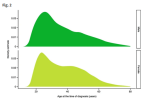
The incidence rate varied strongly with age for both sexes, with a first peak in the age group 10 to 19 years and a second peak in the age group 30 to 39 years.

Incidence age is bimodal for myalgic encephalomyelitis/chronic fatigue syndrome, with higher severity burden for early onset disease, 2026, McGrath et al
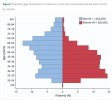
Our findings suggest that incidence of ME/CFS peaks in adolescence and in early middle-age
 
Last edited:
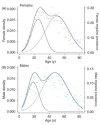
For women, the peak periods for migraine risk were at a mean ± SD age of 25 ± 8.6 years and 50 ± 15.8 years (Figure 3A). Approximately one-third of the total female migraineur population was contained within the first population, and there was an overall higher density probability for migraine risk than in the second population at its peak. For men, the peak risk periods (18.7 ± 7.4 years and 47.6 ± 16.8 years) were earlier than in women, and both peaks were approximately of the same magnitude (Figure 3B).

Figure 3. The probability density curves and migraine prevalence across the life span in (A) females and (B) males.

Speculating that hormonal changes might cause second peak in men.
The reasons for the second peak in prevalence in men is uncertain, though research in this area is evolving. Emerging data suggest that there are age-related hormonal changes in men, which might contribute to the second prevalence peak. Between the ages of 40–80 years, total testosterone (the major substrate for oestradiol production) decreases slightly (30). Changes in total oestradiol levels are complex and vary with body mass index. Free oestradiol levels have been shown to decrease with age in men in middle life (31). The decline in bioactive oestradiol might contribute to the second prevalence peak in middle-aged men, though this is highly speculative.

Previous studies had not seen this bimodal effect. They speculate that it is because other studies used 5 year age groups instead of 1 year, and because they used populations that didn't span as large of a range in ages as this study.
Previous studies of migraine prevalence have not shown the bimodality reported here (1,5,7,16,24). Methodological differences might account for the lack of correspondence. Many of the previous studies examined age in 5-year categories; here, we fit curves to each year of age. Perhaps the larger age groupings removed variability in the data, decreasing sensitivity to bimodality. Second, the NHIS included a broad age range (3–85 + years), which reduces the bias associated with estimating prevalence when the age range is more limited. Other epidemiology studies limited the age ranges to 16–65 years, ≥15 years, and ≥12 years (1,7,16,32). Some epidemiologists (33) and other methodologists (34,35) have suggested that truncation of age range, especially when the disease affects younger individuals, may introduce serious bias in risk estimates for that disease. Limiting the age range may have attenuated the bimodality of the distributions. Support for these effects comes from our group, which used the same NHIS data plotted to a curved-fitted function with a truncated age range (18–85 years). Using this methodology, migraine prevalence peaked at 34 years old for both sexes and only displayed a single peak across the life span (36). In contrast, in the current analysis, when the full NHIS age range was used, without a curved-fitted function, a bimodal distribution in prevalence was seen.

They went into the study testing the bimodal hypothesis, so maybe more biased to detect it:
Based on the suggestion that sex-specific age prevalence was bimodal in distribution, we applied Gaussian mixture modelling (GMM (27) to the prevalence curves. GMM allows for flexible estimation of the parameters that describe the densities of the populations, namely the mixture parameters (π) the mean distributions (µ), as well as the SD (σ).

I note that the question asked seems to be broader for children:
The Sample Adult Core contains health-related questions, including whether ‘a doctor has diagnosed migraine within the past 90 days’. For the Sample Child Core, the parent was asked: ‘During the past 12 months has the child had frequent or severe headaches, including migraine?’

They say this is unlikely to have been the reason for the bimodal distribution because the first peak was in adults:
As noted, the questions for migraine were different for children (i.e. migraine within 1 year) and adults (migraine within 3 months), raising the issue of whether it is valid to combine the data. Because of the shorter time interval for the adult query, migraine may have been under-reported more in adults in comparison with the responses for the children (i.e. in those aged >18 years vs <18 years). However, a large difference in under-reporting would have been expected to result in the initial peak prevalence occurring at age 18 years, but this was not observed; indeed, the first peak occurred after age 20 years in both sexes (Figure 2A). Thus, the differences in methodology for children and adults appear unlikely to have had a large affect on the validity of our results.
 
Ages for peaks from ME/CFS papers, to compare to this study:

StudyConditionFirst peak (SD)Second peak (SD)
Bakken 2024ME/CFS10-1930-39
McGrath 2026ME/CFS16 (4.3)36.6 (10.5)
Victor 2010Migraine (Women)25 (8.6)50 (15.8)
Victor 2010Migraine (Men)18.7 (7.4)47.6 (16.8)

The peaks seem to come later for migraine.

Edit: Realized this is comparing incidence peaks for ME/CFS to prevalence peaks for migraine, so not measuring the same thing.
 
Last edited:
Some other studies to potentially look at. I just quickly grabbed quotes about bimodal distributions, and haven't read the papers:

Trends in migraine incidence among women of childbearing age from 1990 to 2019 and the prediction for 2030: an analysis of national data in China (2023, J Headache Pain)
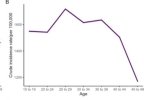
With period and cohort considered, the age-specific relative risks of migraine followed a bimodal pattern with peaks at the age-group of 25–29 years (CIR = 1718.27/100000; 95% CI: 1709.95/100000, 1726.63/100000) and 35–39 years (CIR = 1635.18/100000; 95% CI: 1626.83/100000, 1643.57/100000) (Fig. 1b).
iMarkup_20260416_213632.jpg

Migraine Disease Burden and Trends (1990-2021): A Multidimensional Comparative Analysis of China and Other G20 Countries (2025, Brain and Behavior)
[China] Regarding age‐specific prevalence patterns, females displayed a bimodal pattern, while males showed a more gradual increase peaking after age 50, possibly reflecting cumulative effects.
[G20 Countries] Within the G20, the fundamental characteristics of the migraine burden were consistent. Age distribution analysis revealed a bimodal pattern across all metrics, with the lowest burden in children under 5, a first peak in young adulthood (25–29 years), and the highest burden concentration at 50–54 years, before a gradual decline after age 75.

Migraine Without Aura and Migraine with Aura Are Distinct Clinical Entities: A Study of Four Hundred and Eighty-Four Male and Female Migraineurs From the General Population (1996, Cephalagia)
The age at onset of MO [migraine without aura] followed a normal distribution, whereas the age at onset of MA [migraine with aura] was bimodally distributed, which could be explained by a composition of two normal distributions.

Cluster headache in women (1982, Cephalagia)
75 patients with cluster headache (63 men and 12 women) and 939 with migraine headache were seen among 1260 new patients at the Princess Margaret Migraine Clinic of Charing Cross Hospital (London, England) over a 16-month period. [...] The age of onset in women, unlike the men, appeared to be bimodal. Approximately half of the women developed the condition in early adult life, and the remainder at about the time of the menopause.
 
Ages for peaks from ME/CFS papers, to compare to this study:

StudyConditionFirst peak (SD)Second peak (SD)
Bakken 2024ME/CFS10-1930-39
McGrath 2026ME/CFS16 (4.3)36.6 (10.5)
Victor 2010Migraine (Women)25 (8.6)50 (15.8)
Victor 2010Migraine (Men)18.7 (7.4)47.6 (16.8)

The peaks seem to come later for migraine.
Oh, actually, this is comparing incidence peaks in ME/CFS to prevalence peaks in migraine. I think prevalence would be expected to peak later, though I'm not sure how much later. So maybe the ages of the migraine peaks are closer to ME/CFS than it seems from this.
 
Back
Top Bottom