Moderate Exercise Increases Expression for Sensory, Adrenergic, and Immune Genes in CFS Patients But Not in Normal Subjects 2009 Light et al

Andy

Senior Member (Voting rights)
[A study from 2009.]

Abstract

Chronic fatigue syndrome (CFS) is characterized by debilitating fatigue, often accompanied by widespread muscle pain that meets criteria for fibromyalgia syndrome (FMS). Symptoms become markedly worse after exercise. Previous studies implicated dysregulation of the sympathetic nervous system (SNS), and immune system (IS) in CFS and FMS.

We recently demonstrated that acid sensing ion channel (probably ASIC3), purinergic type 2X receptors (probably P2X4 and P2X5) and the transient receptor potential vanilloid type 1 (TRPV1) are molecular receptors in mouse sensory neurons detecting metabolites that cause acute muscle pain and possibly muscle fatigue. These molecular receptors are found on human leukocytes along with SNS and IS genes.

Real-time, quantitative PCR showed that 19 CFS patients had lower expression of β-2 adrenergic receptors but otherwise did not differ from 16 control subjects before exercise. After a sustained moderate exercise test, CFS patients showed greater increases than control subjects in gene expression for metabolite detecting receptors ASIC3, P2X4, and P2X5, for SNS receptors α-2A, β-1, β-2, and COMT and IS genes for IL10 and TLR4 lasting from 0.5 to 48 hours (P < .05). These increases were also seen in the CFS subgroup with comorbid FMS and were highly correlated with symptoms of physical fatigue, mental fatigue, and pain. These new findings suggest dysregulation of metabolite detecting receptors as well as SNS and IS in CFS and CFS-FMS.

Perspective

Muscle fatigue and pain are major symptoms of CFS. After moderate exercise, CFS and CFS-FMS patients show enhanced gene expression for receptors detecting muscle metabolites and for SNS and IS, which correlate with these symptoms. These findings suggest possible new causes, points for intervention, and objective biomarkers for these disorders.

Open access, https://www.jpain.org/article/S1526-5900(09)00574-4/fulltext
 
Dr. Bateman talks about the findings of this 2009 study in a recent webinar:


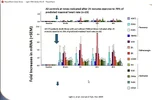
Couldn’t find the exact same graph, using a screenshot of her presentation instead:
Figure.webp
On failing reproducibility:
This just applies to the physical
activity but uh I I've never forgotten
it. it was not repeated.
It was repeated later without the same clarity and I think it's because there's so much
heterogeneity, right?
And it's hard to do these assays.
Uh but I have never forgotten it.

YouTube Transcript:
So, what is the kind of what is the
conventional understanding or theories
behind uh the pathophysiology of post
exertional malaise?
You know what I want to do is be institutional memory today and I want to just really show you um some early research that completely uh outlined my uh why the way I think about
PM.
>> If you'll just uh put up with me doing
this for a minute.
>> Um so this is a slide uh that just just
to quickly give you some background of
this.
Um we did this back in the 2000s.
Um our first paper was in 2009 so it's
been a long time. and I worked with
Allan and Kathy Light at the University
of Utah and we put people on an exercise
bike for 25 minutes and um measured uh
these cytoine these u uh messenger RNA
this mRNA uh in the blood and it's
[clears throat]
here's what's interesting about it is Al
was a physiologist a neurohysiologist
and he picked um pain and and fatigue
sensory receptors which are the first
group.
He picked adonergic receptors and
then he picked some immune molecules and
measured them.
And what we did just
really quickly um is we these are the controls. Uh we measured all of these items at baseline.
Then here's the exercise trigger right
there.
Then we drew people's blood 30
minutes later, 8 hours, 24, and 48 hours
later.
And you can see some elevations
uh from the exercise that relate.
But here's what happened when we did it in
the ME/CFS patients.
And this was a very small I want to just tell you that this was a handpicked group of 20 people that I knew very well and I knew had
postexertional malaise.
And these are fold increases immediately measurable 30 minutes after the exercise trigger. Wow.
>> And what really stood out to me about
this one is it's multi-system, right?
It's immune, it's autonomic, it's
neurologic.
Uh these are these receptors
uh the sensory receptors are in the
dorsal horn neurons and are related to
pain and fatigue transmission.
Um but uh what makes me feel confident about these is these are all separate blood draws and separate analyses.
Um and you can see that uh and these are not symptoms, right?
So most of these people did not
develop symptoms until later.
So the body is reacting immediately to the
exercise.
It's increasing at 8 hours and 24 hours. At 48 hours, it's still there, right?
It has not resolved.
So what I realized is if you exercise again at the beginning of 48 hours, right,
>> or the next day, you're stacking, this
is like rolling PEM, right?
You're stacking these chemical messengers that probably go on to create symptoms in
your autonomic nervous system and
inflammation uh and and these other
sensory markers. uh just to finish this
off um he did it we did it in I didn't
do it but Alan White did it in a group
of nine MS patients who and then when
you look here that purple thing is
probably a lab error this really
difficult assays to do uh and actually
they stopped doing this kind of uh tech
for for uh uh for these uh messenger
RNAs for these biomarkers um but you can
see the ones that are consistent right
and show a pattern uh and they also did
it in uh they had the controls exercise
at high intensity.
So you can see that at high intensity for 25 minutes you start to bump these markers right at 24 and 48 hours which is when you get sore after doing excessive exercise.
>> So the reason I wanted to share that is
it really shaped my uh my thinking.
>> Oh, you muted real quick.
>> You muted yourself. Didn't
mean to mute myself. I was trying to get
off my screen down
>> just when you said shaped my thinking.
>> Yep. It shaped and my video went off.
It shaped my thinking about how to counsel
people and basically I said don't and
I'd show them this and they say don't
raise your bars too high and wait till
they come down before you do exercise
again.
This just applies to the physical
activity but uh I I've never forgotten
it. it was not repeated.
It was repeated later without the same clarity and I think it's because there's so much
heterogeneity, right?
And it's hard to do these assays.
Uh but I have never forgotten it.
>> Wow. Yeah, that's an amazing graph.
I've never seen that. And that's
>> it was published on the cover of the
journal of pain.
>> Wow. Um love that. Um thank you for
sharing that. I really appreciate it.

More discussion about this webinar can be found here:
 
Last edited:
It was repeated later without the same clarity and I think it's because there's so much
heterogeneity, right?
This argument really doesn't seem convincing to me

And it's hard to do these assays.
This could be true though, does anyone with expertise here have idea whether it's credible that the failed replication could be down to researcher error?

these receptors
uh the sensory receptors are in the
dorsal horn neurons and are related to
pain and fatigue transmission.
This sounds interesting - same kind of receptors as the German antibody theories are based around.


Still, think if it didn't replicate that's not a very encouraging sign.
 
@Chandelier that graph you posted from the presentation seems to be from this 2012 publication on the same topic (link goes to S4ME thread)
Gene expression alterations at baseline and following moderate exercise in patients with CFS and Fibromyalgia Syndrome, 2011, Light et al
They found:
CFS patients showed greater post-exercise AUC increases than controls for P2X4, P2X5, TRPV1, α-2A, β-2, COMT, and IL10 (P <.05 to P<.001;see Table 2).

They seem to have done the same set up again also comparing to MS patients (link to publication):
Differences in metabolite-detecting, adrenergic, and immune gene expression following moderate exercise in chronic fatigue syndrome, multiple sclerosis and healthy controls, 2011, White et al
They report:
CFS patients had greater [...] mRNA increases in P2X4, TRPV1, CD14 and all adrenergic receptors than controls (1.3 ± .14 to 3.4 ± .90 fold increase above baseline, p=.04 – .005).
Though their cohort had some overlap with the 2009 publication (this thread's topic publication):
Twenty-two CFS patients (6 of these are the same patients from our previous publication (15)).

Trying to avoid falling into a rabbit hole with this because there were other things I meant to read today lol, but seems like it could be worth taking a look at.
 
@Chandelier that graph you posted from the presentation seems to be from this 2012 publication on the same topic (link goes to S4ME thread)
Interesting, thanks, ScoutB, there has happened some discussion on this already, good to know.

Just for the record, the graph from my screenshot of the presentation seems to be some sort of Frankenstein graph.
Obviously, to the left and right legends have been added to aid the understanding.

Moreover, above the bottom graph it says „All CFS patients…“, couldn’t find that on a graph in any of the papers.

Though their cohort had some overlap with the 2009 publication (this thread's topic publication):
Dr. Bateman explicitly mentions that it’s a study from 2009. That’s also what it says on the bottom of the screenshot.
Probably they used the same CFS cohort.
 
Back
Top Bottom