Nucleotide variations in genes encoding [CA8 and CA10] associated with femoral bone mineral density in Japanese female with osteoporosis, 2009, Mori+

forestglip

Moderator
Staff member
Nucleotide variations in genes encoding carbonic anhydrase 8 and 10 associated with femoral bone mineral density in Japanese female with osteoporosis

Mori, Seijiro; Kou, Ikuyo; Sato, Hidenori; Emi, Mitsuru; Ito, Hideki; Hosoi, Takayuki; Ikegawa, Shiro

Abstract
Osteoporosis is a multi-factorial common disease, which is caused by combination of genetic as well as environmental factors. Among several factors, osteoclast acidification pathways during bone resorption might play an important role. Carbonic anhydrases, consisting of a gene family, are essential for pH regulation by the osteoclast. Clinically, use of carbonic anhydrase inhibitors has been known to be associated with a bone-sparing effect as judged by spine bone mineral density (BMD).

Here, we investigated single nucleotide polymorphisms (SNPs) in carbonic anhydrase genes that are expressed in bone tissues, i.e., CA8 and CA10, for possible association with femoral and lumbar BMD among 337 Japanese women with osteoporosis participated in BioBank Japan project.

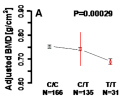
Significant correlation was observed between CA8 SNP, rs6984526, and femoral BMD (P = 0.00029); homozygous carriers of the major (C) allele (n = 166) had the highest BMD (0.754 ± 0.006 g/cm2, mean ± SD), while heterozygous carriers (n = 135) were intermediate (0.741 ± 0.07 g/cm2) and homozygous T-allele carriers (n = 31) had the lowest BMD (0.691 ± 0.012 g/cm2). CA8 SNP as well displayed significant association with lumbar BMD in recessive model (P = 0.00017). In addition, CA10 SNP, rs2106329, also displayed strong association with femoral BMD (P = 0.00002).

The results suggest that the variations of CA8 and CA10 loci may be important determinants of osteoporosis in Japanese women.

Web | DOI | PDF | Journal of Bone and Mineral Metabolism | Paywall
 
I'm currently reading papers about CA10, and came across this one that seems kind of odd. I thought it was worth checking if there are real issues here, as findings related to CA10 could be important, considering CA10 was a DecodeME gene.

In 337 participants with osteoporosis, they tested for association of two types of bone mineral density (BMD) measures, lumbar spine BMD and femoral BMD, with two SNPs, one in the CA8 gene and one in the CA10 gene.
Carbonic anhydrases form a family of enzymes that catalyze the rapid conversion of carbon dioxide to bicarbonate and protons. It has been reported that continuous subcutaneous infusion of a carbonic anhydrase inhibitor acetazolamide partially prevented denervation-induced bone loss in a rat model of disuse osteoporosis [6]. In fact, it was further confirmed in postmenopausal white female with glaucoma that long-term use of carbonic anhydrase inhibitors, acetazolamide or methazolamide, was associated with a bone-sparing effect as judged by spinal BMD [7].

These reports suggested a role for the carbonic anhydrases in human bone resorption and, thus, prompted us to undertake genetic association study between single nucleotide polymorphisms (SNPs) on carbonic anhydrase genes. We focused on carbonic anhydrase 8 and 10 genes (CA8 and CA10) that are expressed in bone tissues. We chose representative intronic SNPs on each gene, i.e., rs6984526 (in CA8) and rs2106329 (in CA10) with minor allele frequencies above 0.1 in Japanese, and, examined correlation with femoral BMD as well as lumbar BMD among 337 Japanese women with osteoporosis participated in BioBank Japan project.
They give some rationale about looking at carbonic anhydrases in the first paragraph above, and describe carbonic anhydrases as enzymes that "catalyze the rapid conversion of carbon dioxide to bicarbonate and protons". It's unclear to me why they chose two members of the carbonic anhydrase family which do not catalyze this reaction. [1]

They also say they specifically chose CA8 and CA10 because they are expressed in bone, though they don't cite a source for this. I wasn't able to find evidence of bone expression of these genes from a quick search, except a paper that says CA8 is expressed in bone but just cites the present paper. [2] [Edit: I did find one study that found expression of CA8 in mouse bones during embryonic development. [3]]


In terms of the results, they seem to have been lucky with getting very low p-values for both of the genes they tested. From abstract:
Significant correlation was observed between CA8 SNP, rs6984526, and femoral BMD (P = 0.00029)
In addition, CA10 SNP, rs2106329, also displayed strong association with femoral BMD (P = 0.00002).

The stats for femoral BMD from the abstract and text (mean, with standard deviation (SD) in parentheses, units in g/cm^2):
CC: 0.754 (0.006)​
CT: 0.741 (0.07)​
TT: 0.691 (0.012)​
The SD for CT in the text doesn't seem to align with the SD in the plot. I added red bars for how wide each of the SDs would be if they matched the text:

They also looked at CC and CT combined into one group:
When the subjects were separated into two groups, the T homozygote (n = 31) and those who bear at least one C-allele (C/T and C/C), the former subjects had significantly lower femoral BMD than the latter (BMD; 0.691 ± 0.012 g/cm2 versus 0.748 ± 0.005 g/cm2, P = 0.00017; Fig. 1b).
Mean (SD) g/cm^2
CC + CT: 0.748 (0.005)​
TT : 0.691 (0.012)​
The SD (0.005) for the combined group is even smaller than for either of the original groups (0.006 and 0.07). As far as I'm aware, the SD for combined groups can only be at least as large as the SD of the smaller group.

So this seems like it could be caused by writing the wrong value in the text for the SD for the CT genotype, where it should be a value smaller than 0.005, not 0.07.


Mainly, it seems unlikely to me to get p-values so small based on a hypothesis which doesn't seem to entirely make sense. Though it's not impossible, I suppose.

1. Nishimori, Isao, et al. “Restoring Catalytic Activity to the Human Carbonic Anhydrase (CA) Related Proteins VIII, X and XI Affords Isoforms with High Catalytic Efficiency and Susceptibility to Anion Inhibition.” Bioorganic & Medicinal Chemistry Letters, vol. 23, no. 1, Jan. 2013, pp. 256–260, https://doi.org/10.1016/j.bmcl.2012.10.103.

2. Ashok Aspatwar, et al. “Carbonic Anhydrase Related Protein VIII and Its Role in Neurodegeneration and Cancer.” Current Pharmaceutical Design, vol. 16, no. 29, 1 Oct. 2010, pp. 3264–3276, https://doi.org/10.2174/138161210793429823.

3. Lakkis, Maha M., et al. “Expression of the Acatalytic Carbonic Anhydrase VIII Gene, Car8, during Mouse Embryonic Development.” The Histochemical Journal, vol. 29, no. 2, Feb. 1997, pp. 135–141, https://doi.org/10.1023/a:1026433321974.
 
Last edited:
Back
Top Bottom