Obstructive sleep apnoea and quality of life in Ehlers-Danlos syndrome: A parallel cohort study, 2017, Gaisl et al.

nataliezzz

Senior Member (Voting Rights)
Obstructive sleep apnoea and quality of life in Ehlers-Danlos syndrome: A parallel cohort study
Thomas Gaisl, Cecilia Giunta, Daniel J Bratton, Kate Sutherland, Christian Schlatzer, Noriane Sievi, Daniel Franzen, Peter A Cistulli, Marianne Rohrbach, Malcolm Kohler
https://www.researchgate.net/publication/312232373_Obstructive_sleep_apnoea_and_quality_of_life_in_Ehlers-Danlos_syndrome_A_parallel_cohort_study (PDF available)

Abstract

Background:
Patients with the connective tissue disorder Ehlers-Danlos syndrome (EDS) often suffer from fatigue, excessive daytime sleepiness and impaired quality of life. Obstructive sleep apnoea (OSA) may be an underlying cause for these symptoms but its prevalence in this population is unclear.

Methods: In this prospective parallel-cohort study, we included 100 adult patients with EDS (46% hypermobile-type, 35% classical-type and 19% other), which were one-to-one matched to 100 healthy adult controls according to sex, age, weight and height. Participants underwent structured interviews (including short-form 36) and level-3 respiratory polygraphy. OSA was defined as apnoea-hypopnea index ≥5/hour. Photographic craniofacial phenotyping was conducted in a subgroup. Conditional logistic regression was used to compare the prevalence of OSA.

Results: In patients with EDS, OSA prevalence was 32% versus 6% in the matched control group (OR 5.3 (95% CI 2.5 to 11.2); p<0.001). The EDS group reported impaired quality of life in all dimensions (p<0.05) and significantly higher excessive daytime sleepiness measured by the Epworth Sleepiness Scale (median (quartiles) 11 (7-14) vs 7 (5-10); p<0.001). OSA severity was positively associated with daytime sleepiness and lower quality of life in the EDS group. There was no evidence of a difference between the two study groups in terms of craniofacial phenotypes.

Conclusions: The prevalence of OSA is higher in patients with EDS than in a matched control group. This is of clinical relevance as it is associated with fatigue, excessive daytime sleepiness and impaired quality of life. Further studies are needed to assess the clinical benefit of OSA treatment in patients with EDS.
 
This study was about the rare, 1 in 5000, monogenic form of EDS. I don't think there would be any surprise that this genetic condition which is known to affect connective tissue in other organs besides joints, might lead to OSA.

There is nothing here as far as I can see that has any specific relevance to either the much more common joint hypermobility that is not monogenic, or to ME/CFS.
 
This study was about the rare, 1 in 5000, monogenic form of EDS. I don't think there would be any surprise that this genetic condition which is known to affect connective tissue in other organs besides joints, might lead to OSA.

There is nothing here as far as I can see that has any specific relevance to either the much more common joint hypermobility that is not monogenic, or to ME/CFS.

I may well be missing something, but I am not sure this is the case.

In the abstract (emphasis mine):

Methods In this prospective parallel-cohort study, we included 100 adult patients with EDS (46% hypermobile-type, 35% classical-type and 19% other), which were one-to-one matched to 100 healthy adult controls according to sex, age, weight and height. Participants underwent structured interviews (including short-form 36) and level-3 respiratory polygraphy. OSA was defined as apnoea–hypopnea index ≥5/hour. Photographic craniofacial phenotyping was conducted in a subgroup. Conditional logistic regression was used to compare the prevalence of OSA.

Later, the paper states:

EDS was diagnosed and categorised into subtypes according to the Villefranche diagnostic criteria 1 and hypermobility was assessed
according to the Beighton score. 23

1 is a book to which I do not presently have access ( Steinmann B. The Ehlers-Danlos syndrom. Connective tissue and its heritable disorders. Vol 2. New York: Wiley-Liss, 2002:431–523.), but versions of the Villefranche diagnostic criteria online (admittedly older) do not appear to require genetic testing and do include hypermobility as part of the diagnostic criteria, with Type III (hypermobility) identified as a subtype.

But again, perhaps I have misunderstood?
 
Last edited:
1 is a book to which I do not presently have access ( Steinmann B. The Ehlers-Danlos syndrom. Connective tissue and its heritable disorders. Vol 2. New York: Wiley-Liss, 2002:431–523.), but versions of the Villefranche diagnostic criteria online (admittedly older) do not appear to require genetic testing and do include hypermobility as part of the diagnostic criteria. But again, perhaps I have misunderstood?
If this is the right book, then it talks about the genetic ones. One of those is classified as «hypermobile», but is distinct from hEDS if I’ve understood things corectly.
 
If this is the right book, then it talks about the genetic ones. One of those is classified as «hypermobile», but is distinct from hEDS if I’ve understood things corectly.
Trying to disentangle this is proving quite frustrating. Most of what I am finding seems to indicate that hEDS and EDS Type III are one and the same.

https://www.ncbi.nlm.nih.gov/books/NBK1279/

Nomenclature​

The 1997 Villefranche criteria [Beighton et al 1998] broadened the classification and nomenclature of the Ehlers-Danlos syndromes based on phenotypic and genetic characteristics. The former EDS type III was renamed the hypermobile type. In 2017, the International Consortium on the Ehlers-Danlos Syndromes and Hypermobility Spectrum Disorders published revised diagnostic criteria, and the name was modified slightly to hypermobile EDS (hEDS) [Malfait et al 2017].

The terms "benign familial articular hypermobility syndrome" and "joint hypermobility syndrome" are no longer used [Grahame et al 2000]. Individuals with hypermobility-related musculoskeletal concerns who do not fulfill the hEDS criteria and are not syndromic in any other way (which would suggest another underlying disorder) are diagnosed with hypermobility spectrum disorders (HSD) [Castori et al 2017, Castori & Hakim 2017].

The 2017 criteria were constructed with adults in mind. Many of these features arise over time and may not be present in childhood and adolescence. In addition, many of the clinical manifestations are common in younger individuals. A framework for the diagnosis in younger people was developed by Tofts et al [2023]. In this framework most individuals with symptomatic joint hypermobility are classified as having HSD, with the guidance that younger individuals should be monitored and that their diagnosis can change as concerns arise or resolve.
 
The introduction clearly states they are talking about the rare, 1 in 5000, monogenic type EDS, which includes different forms including hypermobile and vascular.
I saw that they cite the 1 in 5000 estimate. My confusion arises from the fact that the criteria for diagnosis and the terminology associated with the diagnosis appear to be the same as what I am seeing for hEDS, which leads to some additional confusion about who was or was not included in the study. It is quite possible I am just being exceptionally daft.

To be clear, I have no stake in this and no fixed position regarding either the validity or the utility of these labels - I am simply hoping to understand. I greatly appreciate your responses.
 
If this is the right book, then it talks about the genetic ones. One of those is classified as «hypermobile», but is distinct from hEDS if I’ve understood things corectly.
Thanks, @Utsikt. Reading through the relevant section (pp.451-3) I clearly see the discussion concerning EDS III/hEDS as being inherited as an autosomnal dominant trait. It seems then that part of the issue is that the term hEDS is being used to describe different patient groups by different people. Perhaps that was obvious, but I was unaware.
 
Trying to disentangle this is proving quite frustrating. Most of what I am finding seems to indicate that hEDS and EDS Type III are one and the same.

https://www.ncbi.nlm.nih.gov/books/NBK1279/
I agree that it’s messy.

The book says the following:
The hypermobile type of EDS (EDS III) is characterized by marked joint hypermobility, moderate skin involvement, and an absence of tissue fragility. It is inherited as an autosomal dominant trait; the underlying defect is unknown.
If it’s autosomal dominant, each child will have a 50 % chance of inheriting the condition from the carrying parent.

The 2017 criteria does not require a family history for hEDS:

Criterion 2​

At least two of Features A, B, and C must be present.
Feature B. Positive family history, with at least one first-degree relative independently meeting the current diagnostic criteria for hEDS.
The 1997 criteria seem to require it to be autosomal dominant (it’s number 2).

It seems to me like the 2017 criteria further widened the criteria for type III EDS to the point that it can no longer be characterised as primarily autosomal dominant.
 
I have been exploring a bit on the EDS society website.
According to them classical, vascular and other rare types of monogenic autosomal dominant EDS have a prevalence of around 1 in 20,000, and known connective tissue proteins affected.

hEDS they reckon at around 1 in 5000, with an autosomal dominant inheritance pattern but unknown genes and unknown proteins affected.

They also describe HSD, hypermobility spectrum disorders diagnosed by the Beignton scale with unknown inheritance pattern, and prevalence much much higher.

They seem to admit that the can't tell the difference between HSD and hEDS.
So it all seems an almighty muddle.
 
Trying to disentangle this is proving quite frustrating. Most of what I am finding seems to indicate that hEDS and EDS Type III are one and the same.

Join the club.
The problem is very complicated but 'hEDS' as now popularly defined is not hypermobility type EDS as originally conceived at all. Ehlers and Danlos probably thought they were describing one syndrome but with a tight family pedigree indicating a monogenic problem. It became clear that there were several syndromes - the 'types' of EDS, which we can now split further according to at least a dozen gene defects.

The problem with the hypermobile type is that hardly any specific gene defects were identified. If there was a tight family pedigree presumably they were there and a few have now been found but for most patients the categorisation had to continue by the clinical pattern. People with problems limited to hypermobile joints were Type III. In the 1970s 'benign hypermobility syndrome' (BHS) became popular and usage of terms got sloppy so that BHS was said to be Type III EDS but of course it was not because BHS is not monogenic and does not have a tight Mendelian pedigree.

So hEDS is not hypermobile EDS proper.

If this paper is written by geneticists who insist on either knowing the gene or a clear Mendelian pedigree then the patients will be hypermobile EDS. IF they are hEDS enthusiasts then the patients will be largely hEDS. Since the genes are not known for most and pedigrees are not always clear I thin there may be considerable doubt which it is.
 
So it all seems an almighty muddle.

Which it is. And if the authors have not spelled that out very clearly, indicating they themselves know what a muddle it is, then I wouldn't take much notice of the findings. They are likely to reflect enthusiasm for memes rather than any useful biology.
 
It is a long time ago but when I wrote a paper claiming to find internal organ involvement in BHS aka EDS III (mitral valve prolapse) this was supposed to be an entirely new finding because BHS/EDSIII was supposed to be defined as not having visceral involvement. The paper's claim was invalid but even at the time I was puzzled how we could write a paper on a condition defined as without X that found X.
 
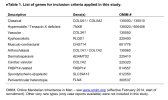
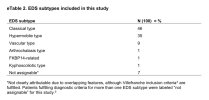
@Trish @DHagen @Utsikt @Jonathan Edwards I'll look into this more in depth when I have time, but here is the online supplement for this paper that may help clarify things:

https://www.researchgate.net/publication/313634042_Online_supplement

And here is the link to paper they cited for the Villefranche criteria they used:

https://www.researchgate.net/public...dation_USA_and_Ehlers-Danlos_Support_Group_UK

From the original paper:

"In a post hoc analysis of the patients with EDS only, no difference in AHI was found between solely clinically diagnosed EDS (n=17) and objectively confirmed EDS (n=83) participants (2.7/hour (1.3–8.7) vs 2.9/hour (1.2–7.2); p=0.55)."

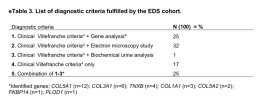
"Of those diagnosed by the ‘clinical’ Villefranche criteria (n=17; see online supplementary eTable 3), the majority of 12 patients was suspected to have EDS hypermobile type at the time of this study. First, this EDS type is known to be prone to subjective tests, such as the Beighton score and skin assessment, as often no molecular diagnostic tests are available to confirm the clinical diagnosis (ie, presence of both major criteria). To date, there is no consensus on the minimum criteria for the diagnosis of EDS hypermobile type. Second, EDS hypermobile type shares many overlapping phenotypic features with the joint hypermobility syndrome and the boundaries between the two entities are somewhat blurred. Recently, experts suggested that EDS hypermobile type and the joint hypermobility syndrome represent the same phenotypic group of patients. It is expected that the diagnostic criteria might shift for these 12 candidates but to date there is no molecular evidence to clarify their relationship. Because of this classification problem, in the current study, the most recent diagnostic criteria for the joint hypermobility syndrome (Beighton criteria) and the EDS (Villefranche criteria) for differential diagnosis were applied. Skin involvement was the major discriminative symptom in this study for these two conditions, excluding 92 subjects during the recruitment process (see flow chart). We acknowledge that diagnostic accuracy in this ‘clinical’ subgroup suffers from subjective judgement. However, post hoc subgroup analysis (see online supplementary eTable 10) suggested no difference in the primary outcome for the EDS hypermobile type and thus this group is unlikely to affect the overall results of this study. Whether OSA is also highly prevalent in joint hypermobility syndrome remains to be established."
 
Last edited:
OK, so it looks as if they do not understand the depth of the problem. I cannot get interested in this if so.

But if they are observing that the hypermobile group and the remainder of the EDS cohort differ from healthy controls in the same way with no significant between group differences, isn't that potentially significant, regardless of whether the former should best be classed as BHS, HSD, hEDS, or EDS-III?
 
Back
Top Bottom