
jnmaciuch
Senior Member (Voting Rights)
I'll have to go back and see the discussion--I also didn't know about this transcriptional mechanism thenThat sounds like the suggestion I made that you neatly annihilated months back.

I'll have to go back and see the discussion--I also didn't know about this transcriptional mechanism thenThat sounds like the suggestion I made that you neatly annihilated months back.

I suppose a mouse could be jumpy and non-mobile but that seems a bit weird.
The people I’ve talked to that do mouse models of Covid say it’s pretty distinctive. They call it “loafing” or “ragdolling.” Apparently theyre the easiest mice to handle by far.But admittedly that isn't 'lethargy'.
I might be misremembering something read a long time ago, but I’m pretty sure that ACTH is increased in prolonged sepsis. Plus cortisol spikes alongside the first burst of cytokines as a negative feedback mechanism during regular infection. So it doesn’t seem surprising that CRH activation happens in infection, just that the connection to sickness behavior is surprising.And maybe the local adrenergic signals are nothing to do with a systemic adrenergic response. I do think it is becoming complicated though! Not that that is a bad thing. I suspect we need to discover in what way we have been oversimplifying things, in order to see the wood for the trees.
So it doesn’t seem surprising that CRH activation happens in infection, just that the connection to sickness behavior is surprising.

Could you explain this part for the more brain fogged among us (i.e. me!)if the CRH depletion in ME/CFS is real, and CRH is potentially relevant to sickness behavior-like symptoms in ME/CFS, is it possible that in the severe ppts who donated their brains we are just seeing the effects of initially overactive CRH?
Oh sure, it’s just spitballing to find a way to reconcile the mouse studies and the human autopsy study. If CRH upregulation is necessary for people to feel sick during infection, and pwME feel sick in similar ways, you would expect that there’s more CRH activity in ME/CFS.Could you explain this part for the more brain fogged among us (i.e. me!)
This discussion is really interesting but I dont quite follow this bit.
But surely in that model if the neurons burnt out people would stop having the sickness behavior symptoms. Even if they had other horrible symptoms from having no CRH neurons?So one possibility is that the autopsy study is showing the late stage consequences of having CRH neurons be active long term from an immune response.
There are definitely some outstanding mysteries, and a lot of unknowns. First, it's not a complete lack of CRH neurons, but a substantial depletion. A few functioning CRH neurons might be enough for some of the fundamental functioning, in both ME/CFS and type I narcolepsy. The fact that cortisol levels were a little lower but not completely depleted in the autopsy study seems to support this (though there's also the possibility that something downstream of CRH compensates specifically for cortisol production).But surely in that model if the neurons burnt out people would stop having the sickness behavior symptoms. Even if they had other horrible symptoms from having no CRH neurons?

Sounds like you are making an assumption that ME/CFS is a form of sickness behavior. Another possibility is a non-response, rather than hyper-response, to environmental demand, thus producing the sensation of fatigue and other maladies, stemming from overactive default mode network (courtesy of another article from our favorite blogger, Cort). Anecdotes of stimulants or dopamine making some difference could be tied to this. And the depletion of CRH neurons could be a contributing factor to overactive DMN, if not the cause.If CRH upregulation is necessary for people to feel sick during infection, and pwME feel sick in similar ways, you would expect that there’s more CRH activity in ME/CFS.
But we have one study showing the opposite in ME/CFS, a stark depletion.

Are you talking about the same study as CRH findings? I think there was a huge difference in cortisol too.The fact that cortisol levels were a little lower but not completely depleted in the autopsy study seems to support this
The plot for cortisol levels in cerebrospinal fluid looks similarly striking to the CRH finding. I would think that this would have already been tested in people who are alive, though I can't immediately find a study looking at CSF cortisol in ME/CFS. I don't see any mentions of CSF on the cortisol thread.
If it hasn't been tested before, it seems this should be a priority to replicate.

Edit: This is from the YouTube video at 8:26.

Not my favourite blogger. @ME/CFS Science Blog , @Simon M and @Grigor are all far better bloggers than Cort.
Given several past discussions with other grad students, I'm not sure I could get a roomful of neuroscience experts to even agree whether the DMN is a real or useful concept. It's been tied to everything under the sun with poorly done research.overactive default mode network
Maybe I remembered it as less striking because the y axis range spans less here than the CRH one? In narcolepsy the evidence is better since we can assume that the narcolepsy autopsy cases were more representative of an average T1N case, whereas there's a big chance the ME/CFS autopsy is skewed towards very severe.Are you talking about the same study as CRH findings? I think there was a huge difference in cortisol too.
Another possibility is a non-response, rather than hyper-response, to environmental demand, thus producing the sensation of fatigue and other maladies, stemming from overactive default mode network (courtesy of another article from our favorite blogger, Cort).

[...] But here is the cortisol CSF data from the deep phenotyping study. There appears to be virtually no difference between the groups. [...]
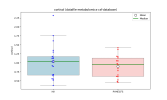
That might be it, thanks for bailing me out hahaMaybe @jnmaciuch you remembered the cortisol as less striking because of the other CSF cortisol data @forestglip was able to share that came from the deep phenotyping study.
View attachment 31091
Duly noted. I'll try to make my sarcasm a bit more clear next time.Not my favourite blogger. @ME/CFS Science Blog , @Simon M and @Grigor are all far better bloggers than Cort.
Just from that, we can conclude that either sickness behavior in humans isn’t completely dependent on a robust CRH response, or that a CRH-dependent sickness pathway can still be triggered even with 10% of the CRH production of a non-narcoleptic healthy human.