Phosphoproteomic analysis reveals differential associations between liver-spleen disharmony and qi-blood deficiency syndromes in [CFS] 2026 Zhang+

Andy

Senior Member (Voting rights)

Abstract​

Background​

Chronic fatigue syndrome (CFS) is a debilitating disorder characterized by persistent fatigue that is not alleviated by rest and is often accompanied by multiple somatic symptoms. The etiology of CFS remains poorly understood, and conventional Western medicine offers limited effective targeted therapies. In contrast, Traditional Chinese Medicine (TCM), which utilizes pattern differentiation—particularly the Liver-Spleen Disharmony Pattern (LSDP) and the Qi-Blood Deficiency Pattern (QBDP)—has demonstrated clinical efficacy in managing CFS. However, the molecular mechanisms underpinning TCM pattern classification in CFS remain largely unexplored.

Methods​

A total of 30 participants were enrolled in this study, including 10 CFS patients with LSDP, 10 CFS patients with QBDP, and 10 age- and sex-matched healthy controls (HC). Serum phosphoproteomic profiling was conducted using liquid chromatography-tandem mass spectrometry (LC-MS/MS), which incorporated data-dependent acquisition (DDA) for spectral library construction and data-independent acquisition (DIA) for label-free quantification. Differentially phosphorylated sites (DPSs) and proteins (DPPs) were identified with thresholds of absolute fold change (|FC|) ≥ 1.2 and a Benjamini-Hochberg (BH)-corrected false discovery rate (FDR) < 0.05. Principal component analysis (PCA) was employed to assess global differences in phosphorylation profiles across groups, and functional enrichment analyses were performed to elucidate the biological functions of differential molecules.

Results​

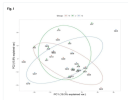
PCA revealed distinct clustering of phosphoproteomic profiles among the three groups, with high consistency across biological replicates (PC1 explained 19.3% of the total variance, and PC2 explained 15.9%). A total of 849 non-redundant DPSs and 586 non-redundant DPPs were identified across the three pairwise comparisons. The HC vs. LSDP comparison yielded the highest number of differential molecules (406 DPSs and 351 DPPs), with a balanced distribution of upregulated and downregulated events. In contrast, the HC vs. QBDP comparison was dominated by phosphorylation upregulation (61.2% of DPSs), while the QBDP vs. LSDP comparison showed a higher proportion of downregulated DPSs (56.7%). Functional enrichment analysis indicated that upregulated DPPs in the HC vs. LSDP comparison were primarily involved in MAPK signaling and cytoskeletal remodeling, while downregulated DPPs were enriched in pathways associated with neurodegenerative diseases and nucleocytoplasmic transport. Notably, we identified a candidate differential phosphorylation site, DENND3 S472 (S472@DENND3_HUMAN), with moderate discriminatory power (raw p = 0.042, BH-corrected FDR < 0.05, AUC = 0.72).

Conclusion​

This exploratory study identified significant differences in serum phosphoproteomic profiles between CFS patients with LSDP and QBDP. The distinct phosphoproteomic signatures observed in LSDP and QBDP provide preliminary molecular evidence supporting TCM pattern differentiation in CFS. These findings enhance the understanding of CFS pathogenesis and lay the groundwork for precision-based TCM diagnosis and individualized therapeutic strategies for CFS.

Open access
 
LSDP: The diagnosis of LSDP was based on the《Expert Consensus on TCM Diagnosis and Treatment of Liver-Spleen Disharmony Syndrome (2023)》 The main symptoms include chest and hypochondriac distension, emotional depression, poor appetite, and loose stools. Secondary symptoms include frequent sighing, chest or hypochondriac pain, abdominal pain with a tendency toward diarrhea, abdominal distension, borborygmus, or diarrhea that relieves pain. The tongue typically has a white coating, and the pulse is wiry or weak. A diagnosis of LSDP was made if at least two main symptoms and two or more secondary symptoms were present.
QBDP: The diagnosis of QBDP was based on the《Guidelines for Clinical Research of New Chinese Medicines (Trial)》The main symptoms include fatigue, shortness of breath, reluctance to speak, and a pale or sallow complexion. Secondary symptoms include dizziness, spontaneous sweating, poor appetite, and insomnia. The tongue appears pale with a thin white coating,and the pulse is thin and weak. A diagnosis of QBDP was made if at least two main symptoms and two or more secondary symptoms were present.
I thought a different cultural view of ME/CFS could be interesting - I'm quite willing to believe that there are actually two sorts of ME/CFS.

I think there is a problem with the translation there, I don't think 'hypochondriac' means what the authors think it means. I think with 'chest and hypochondriac distension' and 'chest and hypochondriac pain', maybe they were thinking of something like 'below the ribs' when they wrote 'hypochondriac'?

Anyway, I don't recognise ME/CFS in either of those definitions. (Although I did catch myself sighing as I read the first definition, which was a bit funny, but I reckon it was due to disappointment, not due to sighing being a symptom of my disease. (Perhaps sighing and eye-rolling are symptoms of reading too many ME/CFS research papers.)

I'm surprised there isn't a TCM diagnosis that fits better.
 
Core variation of PC1: The primary source of variation in PC1 originated from differences in phosphorylation modifications related to energy metabolism, immune regulation, and oxidative stress pathways between healthy individuals and CFS patients. This is highly consistent with the core TCM pathogenesis of CFS, often described as the “consumption of healthy qi” and “disharmony of qi and blood.”
Core variation of PC2: The core variation in PC2 stemmed from differences in phosphorylation modifications within neuromuscular regulation and vascular function pathways between the two syndromes. In the LSDP group, phosphorylation levels of MAPK pathway-related sites were significantly upregulated, which corresponds to the TCM syndrome features of “liver qi stagnation” and “qi movement disorder.” Conversely, the phosphorylation levels of VEGF/eNOS pathway-related sites in the QBDP group were significantly downregulated, aligning with TCM characteristics of “qi and blood deficiency” and “malnutrition of collaterals.”

I was reading the description of the PCA, thinking 'gosh, this might be good'. They don't seem to have made the error that we have seen some other teams do, of selecting, from thousands of features, only the ones that are significantly different between the groups, doing a PCA just on those features for each participant, and then claiming 'wow, the groups are distinguished!'. The discussion of the PCA in this paper suggests that the x axis separates the CFS groups from the healthy controls, while the y axis separates the two CFS groups from each other.

But, then, here's the PCA:

Screenshot 2026-05-16 at 12.42.29 AM.png

Green is the healthy controls, the red and blue are the CFS groups. I really cannot see how the authors can claim that the x axis separates the disease groups from the healthy groups, when the healthy group could not be more in the middle, and enormously overlapping.

It's hard to believe that the authors and I are looking at the same PCA. I guess that's why the other research teams resort to cherry picking the features that separate the groups. I mean, they absolutely shouldn't do it and then make claims about it being proof of group separation, but when you have thousands of features, there's just so much noise that nothing much shows up.

I guess the authors of this paper still may have found some interesting differences, but the PCA certainly is not illustrating them. The factors explaining the variance in the PC1 and PC2 axes don't seem to have much to do with group separation at all. The authors' claims about the PCA reduces their credibility, in my eyes anyway.
 
Do they mean costochondrial pain perhaps @Hutan
Yes, maybe, I wondered about that. But the 'chest and hypochondriac distension' made me wonder if they muddled up 'hypo' with 'below', as in 'below the chest' and so were thinking about bloating.

I've looked up Liver-Spleen disharmony syndrome. The Tallahassee Chinese Medicine website seems to equate Liver-Spleen Disharmony Syndrome with IBS:

In Traditional Chinese Medicine (TCM), health is seen as a dynamic balance among the organ systems, each with specific functions and interrelationships. One important interaction is the controlling (ke) cycle in the Five Element Theory, where each element keeps another in check to maintain harmony. Within this framework, the Liver (Wood element) naturally controls the Spleen (Earth element). However, when the Liver becomes excessive or imbalanced, it can "overact" on the Spleen, disrupting digestion and leading to a range of symptoms. This is known as Liver Overacting on the Spleen (肝乘脾).

The Liver’s primary role in TCM is to ensure the smooth flow of Qi (vital energy) throughout the body and support emotional balance. The Spleen governs digestion and the transformation and transportation of food into Qi and Blood.

When the Liver becomes stagnant—due to emotional stress, anger, frustration, or lack of physical movement—it can generate excessive Qi that disrupts the Spleen's function. The overactive Liver "attacks" the Spleen, impairing its ability to digest food and produce energy, leading to digestive and emotional symptoms.

Common causes include:
  • Emotional stress (especially frustration, resentment, and anger)
  • Irregular eating habits or overeating
  • Overwork and lack of rest
  • Sedentary lifestyle
  • Chronic Liver Qi Stagnation
  • Overuse of antibiotics
Symptoms reflect the interaction of Liver Qi Stagnation with Spleen Qi Deficiency or dysfunction. Common clinical manifestations include:
  • Digestive issues: Bloating, loose stools or diarrhea, abdominal pain relieved by bowel movement, flatulence, poor appetite.
  • Emotional signs: Irritability, mood swings, depression, stress-induced digestive upset.
  • Energy disturbances: Fatigue, especially after eating; heaviness in limbs.
  • Menstrual irregularities (in women): PMS, breast tenderness, irregular cycles.
  • Tongue: Pale or normal color with teeth marks, and possibly a thin white or greasy coating.
  • Pulse: Wiry on the left (Liver side) and weak or soft on the right (Spleen side).

Bloating is definitely a symptom, so I think they were trying to talk about bloating when they wrote hypochondriac distension. I'm not sure what they mean by 'chest or hypochondriac pain' though, when they mention abdominal pain separately. They could easily mean 'pain caused by emotions' - but then they seemed to be talking about parts of the body. Perhaps it all doesn't bear too much analysis.

The causes seem quite compatible with a BPS view. i.e. bad management of emotions, stress, poor life habits and a sedentary lifestyle
 
Last edited:
Biological Interpretation of Variation Sources: Combined with the functional annotation of core variation sites, the biological nature of the variation sources of the major components was further clarified: Core variation of PC1: The primary source of variation in PC1 originated from differences in phosphorylation modifications related to energy metabolism, immune regulation, and oxidative stress pathways between healthy individuals and CFS patients. This is highly consistent with the core TCM pathogenesis of CFS, often described as the “consumption of healthy qi” and “disharmony of qi and blood.”
There's a lot of analysis of the biological drivers of the principal component axes, with the suggestion that that tells us something useful about CFS. But, that's just ridiculous when the PCA does not in fact separate out the disease groups.

In fact, the analysis basically suggests the opposite, that the identified sources of variance have little bearing on the disease or healthy state. Because the variation attributed to, for example, energy metabolism is not actually separating out the trial participants according to the presence of CFS or not.

(Gosh, I sighed again. It just feels as though there is way too much research dross about. I don't understand how anyone who understands anything about PCA could write this paper - it's not difficult. I mean, anyone should be able to look at that PCA chart and acknowledge that it does not distinguish the CFS and healthy groups.

I guess we could just say 'oh well, it doesn't matter'. But, in China alone, there will be lots of people with ME/CFS being subject to these sorts of ideas. And, to be fair, these authors won't be among the worst of the people spreading misinformation, because at least they are taking the time to look for biological causes.)
 
Probably at this point, I should be giving up on this paper, given the characterisation of the CFS groups is suspect, the sample size is small and the authors have misrepresented the PCA.

But the actual differentially phosphorylated proteins (DPP) between the healthy controls and the disease groups will be a bit interesting to see - maybe they overlap with proteins others have identified.

Figure 6 groups the DPP according to function, for each of the three comparisons (healthy to the liver spleen group; healthy (J) to the Qi-blood deficiency group; liver spleen group to Qi-blood deficiency group. Unfortunately, it is a bit too small for me to easily read what functions are listed. If anyone can easily see it, it might be worth looking at.

The paper itself often just talks about the DPPs that came up in any of the comparisons, which is a bit useless, as the comparisons between healthy and CFS groups, and between the CFS groups are quite different, and should come up with different proteins.

KEGG Pathway analysis
HC Group vs. LSDP comparison: DPPs in this comparison were significantly enriched in neurodegenerative disease-related pathways, as well as immune and signal transduction pathways. The prion disease pathway exhibited the highest proportion of differential genes, suggesting that molecular differences in this group predominantly involve neuronal dysfunction and immune response activation.
HC Group vs. QBDP comparison: DPPs were enriched in neurodegenerative disease pathways and uniquely enriched in pathways associated with virus-induced carcinogenesis, cell cycle regulation, and focal adhesion. This pattern indicates a stronger focus on cellular proliferation control and alterations in cell adhesion functions in this group.

DENND3
There is focus on one phosphorylation site on a particular protein as having discriminatory power between the liver spleen group and the healthy controls
Among all identified DPSs, the serine 472 site of the DENND3 protein (S472@DENND3_HUMAN) exhibited significant differential expression between the LSDP and the HC group (raw p = 0.042, BH-corrected FDR < 0.05). ROC curve analysis revealed an area under the curve (AUC) value of 0.72, indicating moderate discriminatory power for this site between LSDP patients and healthy controls.
The distribution of the S472@DENND3_HUMAN site abundance between the two groups is shown in the violin plot integrated with a box plot (Fig. 14). The HC Group exhibited a significantly higher median abundance of this site compared to the LSDP, with distinct distribution characteristics observed between the two groups. DENND3 is a classical guanine nucleotide exchange factor, and phosphorylation at serine 472 has been shown to directly regulate its activation of Rab12, thereby influencing cellular autophagy and transferrin receptor degradation. This site was preliminarily identified as a potential candidate biomarker for LSDP in CFS [10,11,12]. Its diagnostic efficacy and functional role warrant further validation through larger independent cohorts and functional experiments.
But, Figure 14 is a bit underwhelming, there is overlap in the expressions of this in each group. It could easily just be a random result. But, I think it is worth looking a bit closer at the impact of that gene. It looks as though it might be switched when a cell is under stress, it also looks to be implicated in hepcidin expression and iron management, which has come up a bit.
 
Back
Top Bottom