

Psychometric evaluation of The Index of Myalgic Encephalomyelitis Symptoms TIMES. Part II: Criterion-related and discriminant validity, test-retest reliability and minimal detectable difference.
OBJECTIVE
To evaluate the criterion-related and discriminant validity, test-retest reliability and minimal detectable difference of The Index of ME Symptoms (TIMES) in myalgic encephalomyelitis/chronic fatigue syndrome (ME/CFS)
METHODS
People with ME/CFS in the UK completed the TIMES online (n=1055). Rasch-transformed interval data and parametric statistics were used: Pearson correlations (with the ME severity scale); analysis of variance; intra-class correlations (ICC) and standard error of measurement of ICC measured criterion-related and discriminant validity, test-retest reliability and minimal detectable difference respectively.
RESULTS
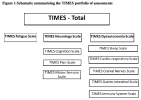
Highly significant (P<0.001) moderate (r=0.400- 0.528) correlations were seen between the TIMES scales and severity of ME/CFS except the gastro-intestinal and immune systems scales (r= 0.315 and 0.302 P<0.001 respectively). Discriminant validity was demonstrated with significant differences in TIMES scores between all five levels of ME severity, except between levels 4 and 5 in some cases, which were underpowered due to the small group numbers. Test-retest reliability was excellent (ICC>0.7, p<0.001) except the cranial nerves and immune system scales which were good (ICC = 0.681 and 0.669, p<0.001) and minimal detectable difference was excellent (3.95-17.45%).
CONCLUSIONS
The Index of ME Symptoms (TIMES) scales are valid, reliable, sensitive assessments of symptoms in ME/CFS. They are freely available for use.
Web | DOI | PDF | Preprint: MedRxiv | Open Access
Sarah F Tyson; Mike C Horton; Russell Fleming
OBJECTIVE
To evaluate the criterion-related and discriminant validity, test-retest reliability and minimal detectable difference of The Index of ME Symptoms (TIMES) in myalgic encephalomyelitis/chronic fatigue syndrome (ME/CFS)
METHODS
People with ME/CFS in the UK completed the TIMES online (n=1055). Rasch-transformed interval data and parametric statistics were used: Pearson correlations (with the ME severity scale); analysis of variance; intra-class correlations (ICC) and standard error of measurement of ICC measured criterion-related and discriminant validity, test-retest reliability and minimal detectable difference respectively.
RESULTS
Highly significant (P<0.001) moderate (r=0.400- 0.528) correlations were seen between the TIMES scales and severity of ME/CFS except the gastro-intestinal and immune systems scales (r= 0.315 and 0.302 P<0.001 respectively). Discriminant validity was demonstrated with significant differences in TIMES scores between all five levels of ME severity, except between levels 4 and 5 in some cases, which were underpowered due to the small group numbers. Test-retest reliability was excellent (ICC>0.7, p<0.001) except the cranial nerves and immune system scales which were good (ICC = 0.681 and 0.669, p<0.001) and minimal detectable difference was excellent (3.95-17.45%).
CONCLUSIONS
The Index of ME Symptoms (TIMES) scales are valid, reliable, sensitive assessments of symptoms in ME/CFS. They are freely available for use.
Web | DOI | PDF | Preprint: MedRxiv | Open Access

 you've got to laugh....