Open Research study on ME/CFS and rest

Dolphin

Senior Member (Voting Rights)
V, Ph.D, MSWV, Ph.D, MSW • Research & Policy Research & Policy • Edited • 2 days ago • Edited • Visible to anyone on or off LinkedIn
Follow

Hi, my name is Victoria and I am a researcher and person with ME/CFS! I am sharing an opportunity to participate in a research study on ME/CFS and rest.

The study is open to people with ME/CFS and medical or healthcare providers who are currently practicing or conducting research, and have had at least one patient or participant with ME/CFS.

Here is a flyer for more information, and you can find the short survey at https://restandmecfs.com

For any questions, please reach out to empwrtc@protonmail.com.
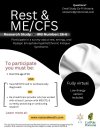
1770188488740.jpg
alt text:

This is a flyer for the Rest & ME/CFS research study, IRB number 26-6. It says "participate in a survey about rest, energy, and Myalgic Encephalomyelitis/Chronic Fatigue Syndrome". In the upper right corner it says Questions? Email Study Co-PI Victoria:
empwrtc@protonmail.com. Below the header is interwoven circles, one is black with text that says Fully Virtual, low-
 
Also highlighted here:
 
My mind's still trying (and failing) to get around the idea of finding a medical practitioner who'd be interested enough in the place of rest in disease management to take part.

In ME/CFS, at least. In other chronic illnesses with a fatigue or fatiguability component, it seems to be regarded as common sense.
 
Last edited:
The survey is quite short and mostly boxes to fill in in your own words. It starts with some demographic questions - ethnicity, age, gender, how long ill.

The rest are mostly boxes to fill in if you want to.

People with Myalgic Encephalomyelitis may hear the word “rest” from peers, medical providers, and family members.
When you think of the word rest, what comes to mind as a person with ME/CFS? This can be emotions, your definition of rest, or a memory.

Can you describe what rest feels like to you? Whether it is during a “crash” or period of time in which your symptoms are worse, or not during a “crash” — when your symptoms may be more stable.

What supports if any, are needed for you to rest and why?

If you would like, please describe what Post-Exertional Malaise (PEM), or, Post-Exertional Neuroimmune Exhaustion (PENE) feels like to you.

What supports, if any, help to prevent Post-Exertional Malaise or "PEM"? (Please explain if these are different from the supports needed to rest, and why).

What barriers if any prevent you from resting and why?

When you cannot rest, what happens?
(Physically, mentally, or in other aspects of your life)

Do you feel like your friends or family understand rest and energy limitations, as it relates to ME/CFS?
Yes
No
Sometimes
Other

Is there anything else you’d like to share about your demographic information or identity, ME/CFS, and/or rest? If so please include it here.
___________________
 
Clinicians survey

Starts with some demographics, then these questions, some with open boxes to fill in:

People with Myalgic Encephalomyelitis may frequently hear the word “rest” from peers, medical providers, and family members.
How does rest show up in your work with people who have ME/CFS? This can include your observations or thoughts about rest, a definition or conceptualization of rest, or how you use or think about "rest" in your practice or research.

What barriers prevent you from adequately accommodating or providing care for patients with ME/CFS in your clinical setting?

If you're a researcher, what barriers exist that prevent you from adequately accommodating, recruiting, or retaining research participants with ME/CFS?

Select all that apply.
What barriers prevent you from adequately accommodating or providing care for patients with ME/CFS in your clinical setting? If you're a researcher, what barriers exist that prevent you from adequately accommodating, recruiting, or retaining research participants with ME/CFS? Press next to skip. Select all that apply.
No substantial professional education or training on ME/CFS
Lack of funding
Lack of adequate staff
Lack of communication with people who have ME/CFS
Lack of adequate facilities or tools (buildings, rooms, equipment)
I have no issues accommodating, researching, or otherwise professionally caring for people with ME/CFS
Other

What type of accommodations do you offer in your clinic, business, or place of research to support or assist people with ME/CFS?

Have you heard of the "Pacing" framework?
Yes
No

Are you familiar with the term PEM (Post-Exertional Malaise) and/or PENE (Post Exertional Neuroimmune Exhaustion)?
Yes
No

What barriers prevent you from adequately accommodating patients or research participants who experience PEM? Check all that apply.
Lack of education or training on PEM
Lack of funding or institutional support
Lack of adequate staff
Lack of communication with people who have ME/CFS
Lack of adequate facilities or tools (buildings, rooms, equipment)
I have no issues accommodating people experiencing PEM
Other

Are you familiar with the use of Graded Exercise Therapy (GET), Graded Activity Management (GAM), or Graded Activity Therapy (GAT) for ME/CFS?
Yes
No
Prefer not to disclose

Please add anything here you wish to add, that wasn't covered in the survey. Press "submit" to end the survey.
 
I attempted to fill in the patients' survey. I found it accessible in the sense of being short and free to skip questions, and not too much to read, but I found it hard to think what they were getting at in some of the questions, so I would do one, then realise my answer was actually more relevant for another.

I find questions about my emotions intrusive and not relevant to my illness, so I focused on symptoms and practical difficulties.

Also we have seen from some other survey based studies with open ended questions by social scientists that they manipulate what people write to fit with preconceived theoretical constructs, which I think is abuse of patients' trust. I hope that won't happen in this case.

I have no idea what useful information they can get from this study. I can't see any practical use for it.

I'm interested to hear what others think.
 
I deactivated my Linkedin profile, so I can't see it there but I saw it advertised on Patient-Led Research Collaborative Fb page. The page description says:
We are a group of Long COVID patients & patients of associated illnesses researching #LongCOVID.
and the post for this project starts with "PLRC member Victoria...".

I don't follow PLRC closely but I didn't think they were into BPS, so I hope the data won't be interpreted in that framework.

I can't get excited about a survey study, though.

I don't see what we can learn from this project that we don't know already. Maybe she writes it up nicely, so it could be used for advocacy or sharing with people who'd like to know how the illness affects us.
 
Last edited:
Here's the information sheet with more info, linked from the restandmecfs.com website: https://drive.proton.me/urls/RE5AGP2W3W#ghfXfevCCoou
As a sidenote appreciate them using proton which actually has decent privacy.
I hate having to basically hand over my data to google to see stuff on google drive. So cool to see researcher taking that issue seriously.
I don't see what we can learn from this project that we don't know already. Maybe she writes it up nicely, so it could be used for advocacy or sharing with people who'd like to know how the illness affects us.
Agreed
I don't follow PLRC closely but I didn't think they were into BPS, so I hope the data won't be interpreted in that framework.
Generally they have been quite good in my view. But that doesn’t guarantee this project will be.
 
Also we have seen from some other survey based studies with open ended questions by social scientists that they manipulate what people write to fit with preconceived theoretical constructs, which I think is abuse of patients' trust.
They can also manipulate the interpretation of open ended questions, possibly opposite of what the subject was trying to communicate.
 

"Hi everyone. Last week I opened this survey in hopes of getting at least 50 responses. In the first week there have been over 150, including people who identify as having extremely severe ME/CFS. I am incredibly grateful for all those who spent their precious energy on this survey.

If you are a person with ME/CFS or a provider working with or researching people with ME/CFS, this survey is open to you. Visit restandmecfs.com for more information.

I will also be presenting preliminary findings at the Symposium for Disability and Accessibility at Yale University in April. More info here: https://lnkd.in/gdNUH2zR"
 
Last edited by a moderator:
They can also manipulate the interpretation of open ended questions, possibly opposite of what the subject was trying to communicate.

Research is funny-peculiar about what it does with personal data-input.

Some of it is like the news media when it does not check its re-presentation at source, but at least there may be some right to reply once the final product is published. In a survey there is no knowing which re-presentation came from which source.

It was an education for me when I heard that research data had been obtained and exposed as misleading by the ME / CFS community

I also think that there must be a way to return individual results to people being biologically tested by research.

That said, old-style convalescence was said to be the missing link, and plainly people are desperate for representation to signify, as offered by ME/CFS surveys

Here we have several students making academic presentations in a seminar. Some have not yet produced a description of their presentation.

Vicotria Copleand can describe hers in advance, and it will be a 20 minute presentation:

I will also be presenting preliminary findings at the Symposium for Disability and Accessibility at Yale University in April. More info here: https://lnkd.in/gdNUH2zR

This one-day presentation is entitled: "Self Care, Rest, and Care Work"

1. Starting with a 20 minute pre-recorded presentation by Victoria Copeland

"When Rest isn't Resistance: Lessons about Rest and Self-Care from People with ME"

This is planned to "share results from a study on ME/CFS to: "problematise the concept of 'rest', emphasise inter-dependence and cross-disability solidarity, and expand ideas about accessibility and care"

2, Then 20 minutes with Evan Wicklund on:

"The Ethics of Care: Theorising Vulnerability, Interdependence and Discontinuity as Insurgent Politics"

Introducing the new theorisation of disability in post-humanist scholarship, prioritising unavoidable interconnectivity between humans and other actants - with inevitable discontinuity, so disabled bodies exemplify the extent of human interdependence

mmmmm I would say that turning on the tap exemplifies the army of people everyone round here depends on for water however they may pride themselves on their "independence"
 
That said, old-style convalescence was said to be the missing link,
Convalescence is a concept and term that could be useful for us.

Good chance, I think, that a lot more patients would do considerably better in the long term, even if not actually fully recovering, if they were both diagnosed early, and allowed to convalesce adequately in the early stages.
 
Last edited:
Yes, I've been saying for ages that the switch from convalescence to rehabilitation for people post infection was a major misstep we are all paying for. I think it happened in the 1980's. Before that my observation was that if you felt ill you were taken seriously and advised to rest as much as you needed to until you felt better.

I think it was a toxic consequence of psychiatrists deciding we were their domain, and government disability benefits departments deliberately misreading data about working people being healthier and happier than people on sick leave, and using that to say therefore work leads to better health.
 
Back
Top Bottom