Somatic arousal and sleepiness/fatigue among patients with sleep-disordered breathing, 2016, Gold et al.

nataliezzz

Senior Member (Voting Rights)
Somatic arousal and sleepiness/fatigue among patients with sleep-disordered breathing
Morris S. Gold, Tshering Amdo, Nadia Hasaneen and Avram R. Gold
https://www.researchgate.net/publication/289535169_Somatic_arousal_and_sleepinessfatigue_among_patients_with_sleep-disordered_breathing
Sci-Hub link to full paper: https://sci-hub.st/10.1007/s11325-015-1294-8

Abstract

Objectives: In a large clinical sample, we tested the hypothesis that levels of sleepiness and fatigue among upper airway resistance syndrome (UARS) patients are correlated with levels of somatic arousal (SA; reflecting the sympathetic nervous system component of the stress response). We also tested the correlations of post-treatment change in these three parameters, and we extended the investigation to obstructive sleep apnea/hypopnea (OSA/H) patients.

Methods: From 5 years of patient data, we obtained scores on the body sensation questionnaire (BSQ), measuring the level of SA, the fatigue severity scale (FSS), and Epworth sleepiness scale (ESS) for 152 consecutive UARS patients and 150 consecutive OSA/H patients. For each group, we correlated the FSS and ESS scores with the BSQ scores. Among the 45 UARS patients and 49 OSA/H patients treated with nasal CPAP who provided post-treatment data, we correlated change in FSS and ESS scores with change in BSQ scores.

Results: Scores on the BSQ, FSS, and ESS for UARS patients and OSA/H patients were comparable. In both UARS and OSA/H patients, both the FSS and ESS scores were positively correlated with the BSQ score. Nasal CPAP use decreased all three questionnaire scores in both patient groups. In the pooled data, changes in FSS were significantly correlated with changes in BSQ.

Conclusions: Our findings confirm our preliminary observations that sleepiness and fatigue among UARS patients are correlated with their level of SA and suggest that the same is true for OSA/H patients. The decrease of SA following treatment suggests that SDB is a cause of SA among patients with UARS and OSA/H.
 
Links to the UARS thread and the AI Summary

Re: the question What is causing the fatigue/sleepiness in UARS/OSAS patients? considering that a high % of sleep-disordered breathing patients are asymptomatic, this paper provides perhaps the strongest support for the theory that it is a stress response to inspiratory flow limitation (IFL) and not sleep fragmentation by (apnea/hypopnea-related) arousals or hypoxemia that is the primary factor driving fatigue and sleepiness in UARS/OSAS patients.

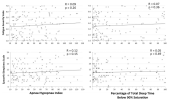
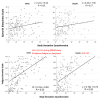
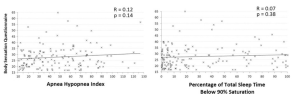
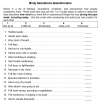
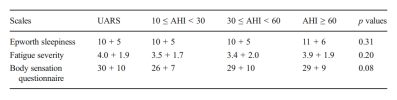
There was no significant correlation between the apnea-hypopnea index (AHI - the majority of apneas and hypopneas terminate in an arousal, by the way) or % sleep time below 90% oxygen saturation (SpO2 - and % sleep time <90% SpO2 correlated with time spent in more severe hypoxemia) and Fatigue Severity Scale (FSS) or Epworth Sleepiness Scale (ESS) scores. Scores on the Body Sensation Questionnaire (BSQ - a measure of "somatic arousal" - I've included the BSQ below) correlated with ESS scores and even more strongly with FSS scores. The regression equations were the same in the UARS and OSA patients, indicating that "somatic arousal" (hypothesized to be caused by the stress response to IFL) correlates with sleepiness and fatigue in the same way in UARS and OSA patients. There was no significant correlation between AHI or % sleep time <90% SpO2 and BSQ scores.

Nasal CPAP treatment results:
45 UARS patients: BSQ score decreased by 43 % (p < 0.0001), ESS score decreased by 18 %, (< 0.0001), and FSS score decreased by 29 % (p < 0.0001)
49 OSA patients: BSQ score decreased by 42 % (p < 0.0001), ESS score decreased by 36 % (p < 0.0001), and FSS score decreased by 29 % (p = 0.0002)
Pooled analysis of the UARS and OSA populations: Change in FSS was positively correlated with change in BSQ (R = 0.32; p = 0.002). There was a non-significant trend toward a positive correlation between the changes in BSQ and ESS (R = 0.17; p = 0.10)

1765429155775.png
1765431621071.png

1765427093299.png

1765427791343.png

1765427997462.png
 
Last edited:
To me it seems like the idea of the stress response has been added in post hoc as an explanation because all of the objective ways to measure sleep issues were not correlated with fatigue. Like what the hell is a somatic arousal? You can't just throw together a questionnaire, give it a name and say that is some process in the body causing symptoms.

Imagine if I took someone with the flu and ran a study to determine if their fatigue was correlated with their other symptoms (to which I gave a fancy name like Virillium Symptomatus). Of course you will find a correlation! That doesn't mean that Virillium Symptomatus is causing fatigue.

The findings from this study should be that we managed to select a group of people that report symptoms and are also have 'inspiratory flow limitation'. But how do we know that inspiratory flow limitation is actually causing any problems and not just some random thing that we decided to measure? Maybe lots of people have this measurement and it causes no issues. Or that there is some other reason why people who are fatigued are more likely to have this measurement. Or perhaps the way it is measured is questionable and prone to bias.

The treatment results could be some evidence for this hypothesis, but given the issues with unblinded small trials that isn't good enough for me. If this is the strongest evidence we aren't in good shape.
 
The findings from this study should be that we managed to select a group of people that report symptoms and are also have 'inspiratory flow limitation'. But how do we know that inspiratory flow limitation is actually causing any problems and not just some random thing that we decided to measure? Maybe lots of people have this measurement and it causes no issues. Or that there is some other reason why people who are fatigued are more likely to have this measurement. Or perhaps the way it is measured is questionable and prone to bias.
Yes, many people have inspiratory flow limitation (IFL) and are asymptomatic. That's where Dr. Gold's theory (stress response to IFL) comes in, attempting to provide an explanation for the sleepiness/fatigue in sleep-disordered breathing patients which has been shown (in the cases of sleepiness) in multiple studies to be objectively alleviated by CPAP as measured by multiple sleep latency testing (I didn't go looking for every study out there; I'm sure there are more).
the first study where UARS was formally described (see below) by Dr. Christian Guilleminault and colleagues at Stanford was in a group of hypersomnolent patients with mild sleep-disordered breathing not meeting criteria for obstructive sleep apnea (OSA) whose hypersomnolence was objectively improved by CPAP based on multiple sleep latency testing (MSLT). In addition, here is another study where sleepiness was objectively reduced (as measured by MSLT) in patients with "obstructive snoring": Multiple sleep latency test in patients with obstructive snoring (I'm sure you can find more studies like these out there)

Here are some additional sources supporting the importance of IFL:

A larger study: in 998 suspected OSA patients referred for polysomnography, increased flow limitation frequency was associated with increased psychomotor vigilance task (PVT) lapses; AHI was not.

Increased Flow Limitation During Sleep Is Associated With Increased Psychomotor Vigilance Task Lapses in Individuals With Suspected OSA

"Increased flow limitation frequency was associated with decreased vigilance: a 1-SD (35.3%) increase was associated with 2.1 additional PVT lapses (95% CI, 0.7-3.7; P = .003). This magnitude was similar to that for age, where a 1-SD increase (13.5 years) was associated with 1.9 additional lapses. Results were similar after adjusting for AHI, hypoxemia severity, and arousal severity. The AHI was not associated with PVT lapses (P = .20)"

The referenced studies below: 1, 2
A controlled study provides the strongest direct evidence for this theory:
  • Objective Sleep Findings: 18 veterans with GWI were compared to 11 asymptomatic, age- and BMI-matched Gulf War veterans. The GWI group experienced IFL during 96% ± 5% of their sleep, whereas the control group experienced it only 36% ± 25% of the time. This difference was highly statistically significant (p<0.0001).
  • Treatment Efficacy: When treated with therapeutic CPAP, the GWI patients experienced significant improvements in fatigue, pain, and cognitive function. This subjective improvement was directly correlated with an objective finding: a decrease in sleep stage shifts. The control group, which received sham CPAP, did not improve and in fact worsened slightly.

And this sleep doctor's clinical experience:
In addition, this from Dr. Denise Dewald (another sleep doctor not affiliated with Dr. Gold):

"I think of flow limitation as a really important thing to look at when you're looking at a PSG [polysomnogram] and deciding is this a normal study, or is it not? Spoiler alert: just about everyone who's referred for a sleep complaint does not have a normal study. After thousands of sleep studies, I have yet to see an actual normal study* in someone who was symptomatic. The only normal studies I've seen have been in people who are referred because they needed a sleep study for bariatric surgery or because they work in transportation. Oh, and there was one guy who was sent by his cardiologist because he developed atrial fibrillation, and so of course he needed a sleep study, but he had rheumatic valvular disease."

*i.e. no flow limitation during non-REM sleep; most people have some flow limitation during REM due to loss of muscle tone
 
Last edited:
Imagine if I took someone with the flu and ran a study to determine if their fatigue was correlated with their other symptoms (to which I gave a fancy name like Virillium Symptomatus). Of course you will find a correlation! That doesn't mean that Virillium Symptomatus is causing fatigue.
Yes, thanks, I edited it to say "somatic arousal" correlates with instead of "accounts for" sleepiness and fatigue in the same way in UARS and OSA patients.

To me it seems like the idea of the stress response has been added in post hoc as an explanation because all of the objective ways to measure sleep issues were not correlated with fatigue.
It definitely wasn't added in post-hoc. The whole thing evolved out of Dr. Gold's clinical experience noticing many of his UARS patients complaining of symptoms like IBS, body pain, etc. as well as many of them having alpha-delta sleep (an objective finding associated with fibromyalgia). His theory that the stress response was specifically to inspiratory flow limitation developed over time; if you read some of his earlier papers he proposes a sensitization/stress response process to "pharyngeal collapse" but doesn't discuss the concept of it being to inspiratory flow limitation specifically.

He did say this about what he believed prior to this study though: "I believed at the time we set up this study that patients with UARS are sleepy because they are stressed and that patients with sleep apnea are sleepy because of sleep fragmentation by apneas and hypopneas."

The treatment results could be some evidence for this hypothesis, but given the issues with unblinded small trials that isn't good enough for me. If this is the strongest evidence we aren't in good shape.
It was a start though. Dr. Gold recognized that the sleepiness/fatigue (and clinical picture in general) of UARS patients wasn't well explained by a traditional sleep fragmentation paradigm, so this was his attempt to test his theory (he's primarily a clinician, not a researcher; he doesn't have huge grant $ coming in; this was all just using his data from the clinic). Since sleep medicine has failed to come up with good evidence supporting the traditional sleep fragmentation paradigm, they should probably be pursuing this line of inquiry further, carrying out similar studies with objective outcome measures, perhaps ones where they actually attempt to measure the proposed stress response (e.g. fMRI/EEG of sleeping patients), but they are very hostile to the notion that their sleep fragmentation paradigm was wrong.

Like what the hell is a somatic arousal? You can't just throw together a questionnaire, give it a name and say that is some process in the body causing symptoms.
This is what Dr. Gold had to say about how they developed the Body Sensation Questionnaire (from this talk); it was based on Hans Selye's work:

"The Body Sensation Questionnaire is Selye's... (Selye put this together in 1950 before there were functional somatic syndromes), it was Selye's 31 symptoms of chronic stress... this was the sympathetic nervous system symptom piece of it. It's my marker for chronic stress. It doesn't have to be the best one; in fact, I will tell you, I suspect it's not good at picking up low levels of chronic stress."

1765438835981.png
 
Last edited:
To me it seems like the idea of the stress response has been added in post hoc as an explanation because all of the objective ways to measure sleep issues were not correlated with fatigue. Like what the hell is a somatic arousal? You can't just throw together a questionnaire, give it a name and say that is some process in the body causing symptoms.
Yeah equating the sympathetic nervous system with being only about the "stress response" is just as much nonsense as calling cortisol the stress hormone or all the cringe nonsense about "dopamine hits" people keep going on about in recent years. The entire nervous system does slightly more things than "dealing with stress". It's just tacked on reflexively because medicine has a deep-seated need for this to be true and fixable with thoughts and behaviour.

It's obvious that there is a lot to work out from the nervous system but they really have to let go of this damn obsession with psychosocial everything, at this point it's as if astronomy and physics were held back because of beliefs in astrology or whatever local religion is dominant. Medicine still lives half-way in Sagan's Demon-haunted world.
 
Yeah equating the sympathetic nervous system with being only about the "stress response" is just as much nonsense as calling cortisol the stress hormone or all the cringe nonsense about "dopamine hits" people keep going on about in recent years. The entire nervous system does slightly more things than "dealing with stress". It's just tacked on reflexively because medicine has a deep-seated need for this to be true and fixable with thoughts and behaviour.
Actually, Dr. Gold has proposed treating "functional somatic syndromes" and (many cases of) anxiety disorders with CPAP, not suggesting that they are "fixable with thoughts and behavior."

It's obvious that there is a lot to work out from the nervous system but they really have to let go of this damn obsession with psychosocial everything, at this point it's as if astronomy and physics were held back because of beliefs in astrology or whatever local religion is dominant. Medicine still lives half-way in Sagan's Demon-haunted world.
What is "psychosocial" about this theorized mechanism? A physiological stress response to inspiratory flow limitation while people are unconscious is not "psychosocial." See screenshot below of excerpts from Dr. Gold's thesis in Sleep Medicine Reviews; the word "stress" is probably too associated with the emotional/psychological for people.

And yes, UARS/OSAS can cause what are viewed as traditional "psychological" anxiety disorders too (I know the idea that something like panic disorder and fibromyalgia could in many cases, share a common underlying cause really makes people mad, but that's what the evidence supports)
People would say that the idea of UARS/OSAS causing panic disorder is ridiculous because panic disorder is clearly a psychological disorder, and yet, there is population-level data supporting a connection between OSA and panic disorder (independent of comorbidities), a small sham-controlled CPAP study showing improvement in panic disorder symptoms on therapeutic over sham CPAP, and multiple case reports of panic disorder cures with CPAP treatment for OSA.

Did you read my reply to @Eddie above about how Dr. Gold's clinical experience informed this whole process, how his theory developed over time, and how the Body Sensation Questionnaire was developed based on the work of Hans Selye? He didn't come into this with some preconceived notion that a stress response is causing fatigue/sleepiness (and other symptoms) in sleep-disordered breathing patients; he believed in the traditional sleep fragmentation paradigm of sleep-disordered breathing too.

To give you a better idea of how this evolved over time based on Dr. Gold's clinical experience:

He didn't even believe in UARS at first:
"I was one of the non-believers in UARS...Dr. Guillleminault's paper introducing UARS, 5 months after the Wisconsin Sleep Cohort study showed us that habitual snorers could be sleepy even if their AHI was <5, when Guilleminault and Stoohs came out with their information, we told them they were crazy, even though the Wisconsin Group showed the same thing. And I was one person who told them they were crazy, but within the next 2-3 years in my sleep lab that I'd started at the VA, I began to see snorers [with AHI <5] who were sleepy. And I began to treat them with nasal CPAP, because I didn't have to justify treating them to their insurance companies, and I began to see that even people who didn't snore audibly had inspiratory airflow limitation, because I was putting down esophageal catheters to measure inspiratory effort, as part of my nasal CPAP titration, because that's the way I was taught to do it at Hopkins."

Then later:
"So I was a big believer in UARS. And in the late 1990s, I was brought over to Stony Brook University hospital to begin seeing non-veterans there. And I began seeing a lot of women, and I began to notice symptoms of functional somatic syndromes in patients with UARS. What did I see? I saw alpha-delta sleep...Alpha-delta sleep was well known to be associated with both fibromyalgia and chronic fatigue syndrome, and I was seeing it in UARS patients who didn't have either diagnosis. So I went through and took 25 consecutive patients with 3 levels of sleep-disordered breathing: UARS, which for me was an AHI <10, mild/moderate sleep apnea (which I defined as AHI 10-40), and moderate to severe sleep apnea (any AHI >40)...and I showed a very high prevalence of sleep-onset insomnia (35% of UARS patients), headaches (in 50% of UARS patients), IBS (in ~45% of UARS patients), alpha-delta sleep in ~1/4 of them, bruxism in 50% (that's associated with TMJ)...I showed that there was a connection, a link, between the functional somatic syndromes and UARS. And if the functional somatic syndrome patients could be sleepy, maybe that explains the sleepiness of UARS patients. Maybe the mechanism was the same."

Which then lead him to do his studies of fibromyalgia and Gulf War illness patients, and later this study. He developed the BSQ as an attempt to capture the contribution of the theorized stress response, but acknowledges that there are probably better ways:
"I would view the BSQ as this: the BSQ is better than nothing, and the BSQ is what has enabled to me to seek scientifically about stress as an important marker for hypersomnolence in sleep-disordered breathing... Now everybody's gotta climb in, each with his own expertise, and start fleshing this out. There are loads of people out there who know cytokines, a hell of a lot better than I do. My job was to point everybody in the right direction, but I'm not the one who's going to do this by myself. And it would be fine with me if somebody comes along with a much better marker for stress."

SDB = sleep-disordered breathing FSS = functional somatic syndromes
1765485877671.png
 
Last edited:
You can in psychosomatics, they do it all the time. Construct validity and relevance are not important. Just ask them.
Perhaps, but I don't think that's what was happening here. Like I said, the BSQ was adapted from Hans Selye's work on chronic stress/general adaptation syndrome, which Dr. Gold only arrived at from his clinical/research observations. Once again, I'll quote him (re: his observation in his GWI study that changes in sleep stage shifts on CPAP were correlated with changes in severity of symptoms, in both directions, for both improvement in symptoms on therapeutic CPAP and worsening on sham CPAP):
"But my brother who works for the pharmaceutical industry, he says "When the change in the severity of symptoms is associated with a change in a physiological parameter, now you're talking cause and effect. So you gotta tell me why these sleep stage shifts have this relationship to symptom severity." And I had no idea. But ultimately, after reading a review paper by Ursula Voss...Functions of sleep architecture and the concept of protective fields...Basically, she's explaining how sleep stage shifts are essentially an adaptive mechanism for conditions of stress; it's a survival mechanism. By shifting from deeper to lighter sleep frequently, a person in danger will not die while they're unconscious...and she takes you through not only humans, but predators and prey, and the sleep of whales who are at risk of drowning, she takes you through everything, and shows you that increased sleep stage shifts is an increased manifestation of stress. Now I read this, and said "OK, I'm a pulmonologist. What's stress?" and I had no idea, so I Googled stress, and I found a book The Stress of Life written by Dr. Hans Selye; he's an endocrinologist from the first half of the 20th century who discovered the HPA axis and its role in preparing humans for life-threatening conditions. And the book The Stress of Life opened my eyes to sleep-disordered breathing."

Is the BSQ perfect? No, and as I discussed above, Dr. Gold acknowledged this (and stated that there's probably better ways of trying to assess the theorized sleep-disordered breathing [SDB] stress response). But it's not like he started with this idea that fatigue/sleepiness in SDB patients is caused by "psychosocial/psychosomatic stress" and came up with a measure to try to prove it (he was originally a believer in the traditional sleep fragmentation paradigm); his clinical/research observations lead him to the work of others which ultimately lead to the inference of a physiological stress response to SDB driving not only fatigue/sleepiness but symptoms like body pain/IBS/etc. in SDB patients.
 
Last edited:
Back
Top Bottom