

Manuel
Established Member (Voting Rights)
Much attention has focused on patients with HPA-axis dysfunction (cortisol).
But a large subgroup can look clinically identical — with a different mechanism:
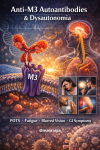
 Autoimmune dysautonomia driven by anti-M3 (muscarinic) autoantibodies
The M3 receptor regulates key parasympathetic functions:
• orthostatic regulation
• gland secretion (tears, saliva, sweat)
• GI motility
• ocular accommodation
When altered, patients may develop:
POTS, severe fatigue crashes, dry eyes/mouth, heat intolerance, slow digestion and visual fatigue.
Notably, visual symptoms are often not just “dry eye”: impaired ciliary muscle accommodation forces the eye to overwork.
Some patients improve with pyridostigmine (Mestinon), which enhances cholinergic signaling, and with volume expansion — treating physiology but not the immune driver.
-Immunogenetic context
Multiple chronic immune conditions share predisposition via ancestral HLA-II haplotypes:
DR2-DQ6, DR3-DQ2, DR4-DQ8
Immune reactivity against M3 presented through HLA-II has been described in small cohorts (including DR2-DQ6 carriers):
https://pmc.ncbi.nlm.nih.gov/articles/PMC7455086/
DR2-DQ6 is also linked to myasthenia gravis:
https://pmc.ncbi.nlm.nih.gov/articles/PMC3348874/
This supports a shared framework:
genetic predisposition + persistent trigger → loss of tolerance → different autoantibody targets → different phenotypes
Practical implication:
In dysautonomic Long COVID / ME-CFS, consider testing anti-M3 and myasthenia antibodies — mechanism matters.
Not one disease, but overlapping pathways.
Full explanation in the thread:
But a large subgroup can look clinically identical — with a different mechanism:
Autoimmune dysautonomia driven by anti-M3 (muscarinic) autoantibodiesThe M3 receptor regulates key parasympathetic functions:
• orthostatic regulation
• gland secretion (tears, saliva, sweat)
• GI motility
• ocular accommodation
When altered, patients may develop:
POTS, severe fatigue crashes, dry eyes/mouth, heat intolerance, slow digestion and visual fatigue.
Notably, visual symptoms are often not just “dry eye”: impaired ciliary muscle accommodation forces the eye to overwork.
Some patients improve with pyridostigmine (Mestinon), which enhances cholinergic signaling, and with volume expansion — treating physiology but not the immune driver.
-Immunogenetic context
Multiple chronic immune conditions share predisposition via ancestral HLA-II haplotypes:
DR2-DQ6, DR3-DQ2, DR4-DQ8
Immune reactivity against M3 presented through HLA-II has been described in small cohorts (including DR2-DQ6 carriers):
https://pmc.ncbi.nlm.nih.gov/articles/PMC7455086/
DR2-DQ6 is also linked to myasthenia gravis:
https://pmc.ncbi.nlm.nih.gov/articles/PMC3348874/
This supports a shared framework:
genetic predisposition + persistent trigger → loss of tolerance → different autoantibody targets → different phenotypes
Practical implication:
In dysautonomic Long COVID / ME-CFS, consider testing anti-M3 and myasthenia antibodies — mechanism matters.
Not one disease, but overlapping pathways.
Full explanation in the thread:
Last edited by a moderator:

