The causal status of pain catastrophizing: an experimental test with healthy participants
Severeijns, Rudy; van den Hout, Marcel A.; Vlaeyen, Johan W.S.
Abstract
In the current study we report findings on the effects of experimentally induced catastrophizing about pain on expected pain, experienced pain and escape/avoidance behavior during a cold pressor task in a sample of healthy participants.
It was hypothesized that increasing the level of catastrophizing would result in a higher level of expected pain, a higher level of experienced pain, and a shorter duration of ice‐water immersion. Also, it was hypothesized that these relations might be stronger for participants who already catastrophized about pain prior to the experiment.
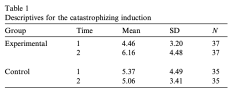
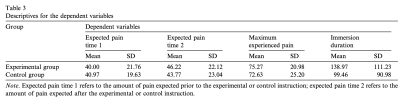
The results demonstrated that despite the successful attempt to induce catastrophizing, this neither significantly affected expected pain, experienced pain, and duration of ice‐water immersion, nor were these relations moderated by the pre‐experimental level of catastrophizing.
Although the level of catastrophizing was successfully manipulated, more similar experiments are necessary in order to give a more definite answer on the possible causal status of pain catastrophizing.
Web |
DOI | European Journal of Pain
Stupid test just showing lack of understanding in both the concept and basic observation of humans
And of research basics.
For a start they are just doing a childish poorly designed game on expectations with added play acting to pretend it’s a concept they are testing
And even if expectations worked the way they assume they haven’t done good null and main hypotheses to make it any worthwhile output to ‘contribute to any literature’ as literature is sold to supposedly build knowledge instead of attention seeking to get name heard politics type feel.
Most would know that higher expectation = mismatch when experience doesn’t meet it. And if you think something might be painful eg an injection and it’s not that bad you get relief. So this isn’t catastrophisatoon at all.
Except for some illogical reason they’ve picked a non-novel scenario and not just that but one of the most common day to day scenarios people have of this kind. You can’t wipe out decades of cumulated personal feedback on those when they wash their hands under cold water in winter not waiting for the boiled if mixing taps and so on with what they did once. It’s like telling someone a staircase will exhaust them then showing them the same height and steepness stairs they walk several times a day and expecting that little story meant they’ll suddenly ‘wonder if they can manage them’
And catastrophisation is specific and only generalised in a gradual related feature way eg ‘that alarm’ to ‘all alarms’ causing fear and maybe a specific reaction, not someone being told they’ve failed their maths test suddenly finding water colder . Even when someone might ‘catastrophise in a lot of different things’ there is a logical thread of event—> concern being in same area hence the term in its meaning before bps distorted it as a label used wrongly outside those properly sssessed serious clinical cases instead using generalised ideas of it ‘for the masses’ to use ‘on the mssses’
So I don’t get how anyone yet - and certainly not here- have not just skipped over the part where even if they caused catastrophisation (which I don’t think they are assessing and certainly would be nothing like the way the concept would then be used or measured ‘in real situations’) to what they said how that should or could bear relation to the water task or what it would mean if it did. Catastrophisers as they’ve labelled them here dont care about leaving their hands in cold water any differently to others, but would it have meant a thing if they did! ??? Where’s their link?
And yes finally they seem to have allowed themselves, in a way their students submitting assessed work probably wouldn’t have been without it being in limitations to control better in future, how obviously artificial the circumstances were allowed to be. And they let them get weird by the sounds of some of this. So no one was taking what they were suggesting seriously anyway I’d bet by the end. Just wondering what they thought they were achieving etc.
And yes catastrophisation talks of something very specific in only certain types and care of eg clinical depression and involves eg the implications of failing a maths test then leading to thinking that means they now can’t do maths and will never get a job etc.
But how it’s been bas****used means it’s something used in the bps and allied and medical too much as only an assessment made by externals on ‘others’ not subjective of oneself. Those people often don’t know what someone is saying about ‘this will happen if I’m not home on time’ is exaggeration of anxiety at all if they don’t know and live their situation anyway.
So it’s a flawed concept. Full stop. Outside very limited circumstances that are not the moss-Morris dream of generalizing it in a lay way as if there is a not severe illness ‘version’. Peoples lives, situations and individual reactions all come on normal distribution but only someone not doing scientific psychology would decide the other two are not just not key but irrelevant etc.
I really don’t get this bs with catastropgisatikn and pain other than it being sophism made so impenetrable osnd circular those not understanding it due to it not adding up assume it must be because it’s above them rather than nonsense.
If someone has extreme pain and extreme injury telling them they’ll survive it will perhaps take away any added terror associated with that but are they disappointed or assuming it likely wont change the pain. Somehow it’s more moral and ok to suggest with chronic - which just means someone has been enduring that grinding away at them for longer (not that it’s less pain and of course endurance should go down to that level as it drones on longer) - that telling someone they’ll survive aren’t going to die , or ‘it shouldn’t be that much pain’ as if you both should know believe that means it isn’t that much pain now, often without checking much (so not telling them more than they know already from still being alive x months later) , woukd somehow reduce pain in a way it doesn’t for acute pain either. And that ‘not fixing it’ becomes due to the bps propaganda or dissatisfaction with chronic pain existing etc ‘it shouldn’t still hurt’ responses from some hcps becomes the basis on which they mean ‘catastrophisation’ ie if they are the type saying those things not in genuine curiosity of ‘so maybe it’s not that broken toenail that was causing it but something else’ and that thinks the only differential to be quickly reached is catastrophisation,
So it’s not to me an externally valid concept as it is used. It describes other people’s behaviour thinking situation that are choosing to label the person more than the one being labelled
It’s really worrying someone is doing this for pain as we know even when the ‘treatment’ both harms and works less well than other treatments that do work but they don’t want to use (eg painkillers or more investigation to get to bottom of it) then it not working doesn’t stop the switch and bait being pulled to recategorise pain to psych or mental health simply to take advantage of the powers of removal of rights /belief of testimony involved with that etc
I’m hoping this was about trying to test the null in order to further literature and if so obviously improving design from trial and error of ‘well that didn’t really measure that’ and ‘that sssbtvreally convincing so..’
Because if it’s not it sounds like something along these types of lines that becomes used as a slowly perfected in descriptions physical ‘demonstration performance’ to those who ‘want to believe this for others because it is convenient for them’ to pretend ‘look see the water experiment’ type thing ‘if it does this to well students then imagine what your aunt either x would be like’ type non sequitur (particularly given the DSM getting SSD somatic symptom disorder added so having an illness that explains the ‘distress’ or symptoms now no longer excludes someone from having that label saying it’s ‘distress’ that’s the cause instead)