The Comorbidity of Self-Reported Chronic Fatigue Syndrome, Posttraumatic Stress Disorder, and Traumatic Symptoms, Dansie et al. 2013

Evergreen

Senior Member (Voting Rights)
The Comorbidity of Self-Reported Chronic Fatigue Syndrome, Posttraumatic Stress Disorder, and Traumatic Symptoms
Elizabeth Dansie 1, Pia Heppner 2, Helena Furberg 3, Jack Goldberg 4, Dedra Buchwald 5, Niloofar Afari 6,2

1Center for Clinical and Epidemiological Research, University of Washington, Seattle, WA; Department of Psychiatry and Behavioral Sciences, University of Washington, Seattle, WA
2Department of Psychiatry, University of California, San Diego, CA; San Diego VA Healthcare System, San Diego, CA
3Department of Epidemiology and Biostatistics, Memorial Sloan-Kettering Cancer Center, NY
4Department of Epidemiology, University of Washington & Vietnam Era Twin Registry, Seattle, WA
5Department of Medicine, University of Washington, Seattle, WA
6VA Center of Excellence for Stress and Mental Health, San Diego, CA

Abstract​

Background​

Data from primary care and community samples suggest higher rates of posttraumatic stress disorder (PTSD) among individuals with chronic fatigue syndrome (CFS).

Objective​

This study investigated the co-occurrence of CFS, PTSD, and trauma symptoms and assessed the contribution of familial factors to the association of CFS with lifetime PTSD and current traumatic symptoms.

Method​

Data on lifetime CFS and PTSD, as measured by self report of a doctor’s diagnosis of the disorder, and standardized questionnaire data on traumatic symptoms, using the Impact of Events Scale (IES), were obtained from 8,544 female and male twins from the community-based University of Washington Twin Registry.

Results​

Lifetime prevalence of CFS was 2% and lifetime prevalence of PTSD was 4%. Participants who reported a history of PTSD were over 8 times more likely to report a history of CFS. Participants with scores ≥ 26 on the IES were over 4 times more likely to report CFS than those who had scores ≤ 25. These associations were attenuated but remained significant after adjusting for familial factors through within-twin pair analyses.

Conclusion​

These results support similar findings that a lifetime diagnosis of CFS is strongly associated with both lifetime PTSD and current traumatic symptoms, although familial factors such as shared genetic and environmental contributions played a limited role in the relationship between CFS, PTSD, and traumatic symptoms. These findings suggest that future research should investigate both the familial and the unique environmental factors that may give rise to both CFS and PTSD.

Keywords: twins, chronic fatigue, posttraumatic stress disorder, trauma, traumatic symptoms, Impact of Events Scale, comorbidity

Link
 
Given the brain retraining focus on fear as the purported root of ME/CFS, I thought it would be good to have a thread on this oft-cited study.

The first thing to note is that "CFS" here is a self-reported diagnosis of CFS:
Twins were given a list of conditions including CFS and PTSD and asked: “Has your doctor ever told you that you have any of the following conditions?”
My concern there is that I think
(a) a doctor could say "chronic fatigue" and the patient could make the leap to "chronic fatigue syndrome" themselves, thinking they are the same thing
(b) some doctors would use the term "chronic fatigue syndrome" when really all they mean is that the person has fatigue that is chronic, and could be due to any other condition

From the limitations section:
First, the use of self-reported physician diagnoses could have resulted in misclassification of both CFS and PTSD, and it excludes individuals whose symptoms have not been formally diagnosed or who have limited access to health care. Because of the large-scale epidemiological nature of this study, we did not conduct clinical assessments and cannot be certain how self-reported diagnoses would compare to such assessments.
 
Last edited:
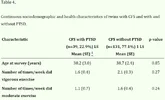
Regarding exercise, this is an excerpt from table 4:
1787738564010.webp
Both groups seem to be doing a lot of exercise for people with a diagnosis of CFS.

Editing to add: ah, it's a self-reported lifetime diagnosis of CFS, so in theory some could be recovered.
 
Last edited:
The lifetime prevalence of self-reported diagnosis of CFS in the sample is 2.1%.

2% of the population does not have ME/CFS at any given time. It's more like:
ME/CFS has a high prevalence of 0.4%–0.6% [1, 2] reaching as high as 0.75% in paediatric populations [3].
according to @Simon M's recent paper on age peaks.

I don't know if we have good data on lifetime prevalence. They do argue in their limitations section that:
Of note, however, the 2% lifetime rate of CFS in our sample is similar to that observed in the Swedish Twin Registry (4) and other prevalence studies that used medically-confirmed diagnoses of CFS (2), as is our observation that the prevalence of CFS was higher for females than for males (4).
1787738786380.webp

From the limitations section:
Second, we may have underestimated the prevalence of these disorders in our population because of undiagnosed conditions, or overestimated because of misdiagnosis or misperception of a physician’s diagnosis.
 
Last edited:
The main finding is this:
Twins who reported a lifetime physician diagnosis of PTSD were over 8 times more likely to report a diagnosis of CFS than those without PTSD (95% CI: 6.0–12.6). After adjusting for age, sex, and race, twins with PTSD were 7.5 times more likely to report CFS than those without PTSD (95% CI: 5.0–11.0).

Given that fatigue is a symptom of PTSD, I'm not sure how meaningful this is.
 
Indeed. Since people who doctor shop (maybe most of us) are quite likely to get two different doctors telling them the same symptoms are 'chronic fatigue' or 'post-traumatic stress disorder' this seems meaningless.
Agree, though I'd change "doctor shop" to just going to more than one doctor, which is pretty much inevitable if you have a significant health problem. Y'all refer us on!

people who doctor shop (maybe most of us)
That reminds me of the Occupational Health doctor who said angrily in my first visit after my relapse that we couldn't just accept that I had post-viral fatigue (syndrome), I had to see a specialist. I'd only been well for 5 months, but I thought, fair enough, best not to assume. They had no ideas about who I should see. I suggested that I could go back to the neurologist who I had seen first time around, and they said yes, do that.

Went to the neurologist, who said it looked like I had chronic fatigue syndrome, and sent me to an immunologist, given family history.

Went back to the Occ Health doctor, told them that I had seen the neurologist who thinks I have chronic fatigue syndrome and sent me to an immunologist. They Occ Health doctor said angrily that I couldn't just go from doctor to doctor...[tirade about doctor shopping].

My conclusion? This Occ Health doctor is angry.
 
This is an evaluation of clinical suggestion (not even coding, just suggestion) practices, it has no relevant bearing on the actual experiences of patients, no relevance in a demographic context in which it's long been known that clinical mishandling is the standard. Exact same false association with depression and anxiety, both of which are usually a reframing of the illness as either/or those concepts because of overlapping questions and blatant over-fitting.

Somehow I have to believe that other fields of social sciences do better at dealing with correlations because this is too crude and blatant. There is a current hot topic issue of "race science" and the dynamics look the same, it's pure abuse of statistics and intentionally awful record-keeping.

It gets lost in this but this is all extremely unhelpful to people with actual PTSD as well. Not a single life is improved from doing this, this ideology has all the public benefits of a bribe large enough to buy a mansion.

It's so absurd that all of this is happening in the background of AI development, where all the flaws that underpin psychosomatic ideology are topics of heavy discussion, mostly about ways to avoid them, whereas here they are explicitly abused to achieve the aims. It would be like training an AI on 4chan and current Xitter, then using its own output to train it further. Except even worse.
 
Back
Top Bottom