Virus-Induced Endothelial Senescence as a Cause and Driving Factor for ME/CFS and Long COVID: Mediated by a Dysfunctional Immune System, 2026, Nunes +

hotblack

Senior Member (Voting Rights)
See post #8 for peer-reviewed version
------------------------------------------------


Virus-Induced Endothelial Senescence as a Cause and Driving Factor for ME/CFS and Long COVID: Mediated by a Dysfunctional Immune System


Massimo Nunes, Loren Kell, Anouk Slaghekke, Rob Wüst, Burtram Fielding, Douglas Kell, Etheresia Pretorius

Abstract
Myalgic encephalomyelitis/chronic fatigue syndrome (ME/CFS) and long COVID are two post-viral diseases, which share many common symptoms and pathophysiological alterations. Yet a mechanistic explanation of disease induction and maintenance is lacking. This hinders the discovery and implementation of biomarkers and treatment options, and ultimately the establishment of effective clinical resolution.

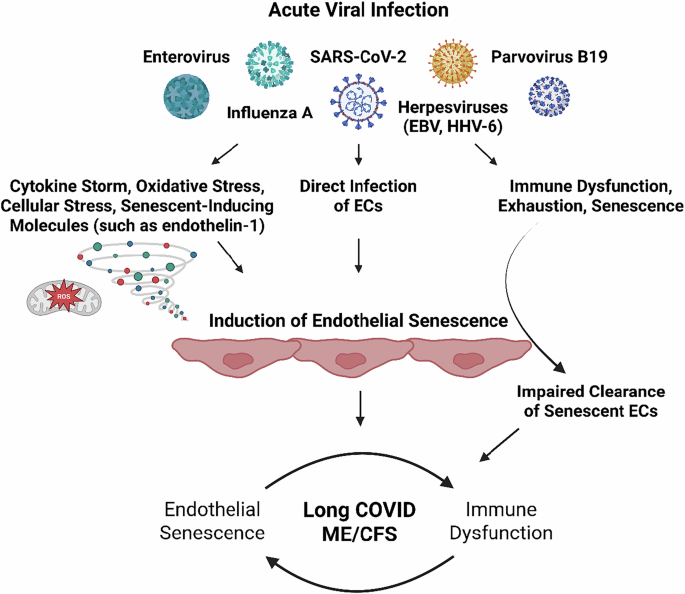
Here, we propose that acute viral infection results in (in)direct endothelial dysfunction and senescence, which at the blood-brain barrier, cerebral arteries, gastrointestinal tract, and skeletal muscle can explain symptoms. The endothelial senescence-associated secretory phenotype (SASP) is proinflammatory, pro-oxidative, procoagulant, primed for vasoconstriction, and characterized by impaired regulation of tissue repair, but also leads to dysregulated inflammatory processes. Immune abnormalities in ME/CFS and long COVID can account for the persistence of endothelial senescence long past the acute infection by preventing their clearance, thereby providing a mechanism for the chronic nature of ME/CFS and long COVID.

The systemic and tissue-specific effects of endothelial senescence can thus explain the multisystem involvement in and subtypes of ME/CFS and long COVID, including dysregulated blood flow and perfusion deficits. This can occur in all tissues, but especially the brain as evidenced by findings of reduced cerebral blood flow and impaired perfusion of various brain regions, post-exertional malaise (PEM), gastrointestinal disturbances, and fatigue. Paramount to this theory is the affected endothelium, and the bidirectional sustainment of immune abnormalities and endothelial senescence.

The recognition of endothelial cell dysfunction and senescence as a core element in the aetiology of both ME/CFS and Long COVID should aid in the establishment of effective biomarkers and treatment regimens.

Link (preprints.org) [not peer reviewed]

https://doi.org/10.20944/preprints202505.1875.v1
 
Last edited by a moderator:
I think this theory fails due to PWME reporting developing the disease without having an acute viral infection.

I don't know how rapidly the proposed mechanism acts. Could it explain the abrupt switching of state (full ME to full not-ME within minutes)?

It seems testable by measuring cerebral blood flow in patients with different severities, and PEM vs not-PEM.
 
As members of the subset of ME patients with sudden viral onset, many of us could benefit from research that focuses on postviral ME and Long COVID.

I do wonder about this research being "pre-publication" for a couple of months now, and not being peer reviewed.
 
Millions of people who recover from infections like COVID-19, influenza and glandular fever are affected by long-lasting symptoms. These include chronic fatigue, brain fog, exercise intolerance, dizziness, muscle or joint pain and gut problems. And many of these symptoms worsen after exercise, a phenomenon known as post-exertional malaise.
Medically the symptoms are known as myalgic encephalomyelitis or chronic fatigue syndrome (ME/CFS). The World Health Organization classifies this as a post viral fatigue syndrome, and it is recognised by both the WHO and the United States Centers for Disease Control and Prevention as a brain disorder.

Experiencing illness long after contracting an infection is not new, as patients have reported these symptoms for decades. But COVID-19 has amplified the problem worldwide. Nearly half of people with ongoing post-COVID symptoms – a condition known as long-COVID – now meet the criteria for ME/CFS. Since the start of the pandemic in 2020, it is estimated that more than 400 million people have developed long-COVID.


To date, no widely accepted and testable mechanism has fully explained the biological processes underlying long-COVID and ME/CFS. Our work offers a new perspective that may help close this gap.
Our research group studies blood and the cardiovascular system in inflammatory diseases, as well as post-viral conditions. We focus on coagulation, inflammation and endothelial cells. Endothelial cells make up the inner layer of blood vessels and serve many important functions, like regulating blood clotting, blood vessel dilation and constriction, and inflammation.

Our latest review aims to explain how ME/CFS and long-COVID start and progress, and how symptoms show up in the body and its systems. By pinpointing and explaining the underlying disease mechanisms, we can pave the way for better clinical tools to diagnose and treat people living with ME/CFS and long-COVID.

What is endothelial senescence?​

In our review, our international team proposes that certain viruses drive endothelial cells into a half-alive, “zombie-like” state called cellular senescence. Senescent endothelial cells stop dividing, but continue to release molecules that awaken and confuse the immune system. This prompts the blood to form clots and, at the same time, prevent clot breakdown, which could lead to the constriction of blood vessels and limited blood flow.
By placing “zombie” blood-vessel cells at the centre of these post-viral diseases, our hypothesis weaves together microclots, oxygen debt (the extra oxygen your body needs after strenuous exercise to restore balance), brain-fog, dizziness, gut leakiness (a digestive condition where the intestinal lining allows toxins into the bloodstream) and immune dysfunction into a single, testable narrative.

From acute viral infection to ‘zombie’ vessels​

Viruses like SARS-CoV-2, Epstein–Barr virus, HHV-6, influenza A, and enteroviruses (a group of viruses that cause a number of infectious illnesses which are usually mild) can all infect endothelial cells. They enable a direct attack on the cells that line the inside of blood vessels. Some of these viruses have been shown to trigger endothelial senescence.


Multiple studies show that SARS-CoV-2 (the virus which causes COVID-19 disease) has the ability to induce senescence in a variety of cell types, including endothelial cells. Viral proteins from SARS-CoV-2, for example, sabotage DNA-repair pathways and push the host cell towards a senescent state, while senescent cells in turn become even more susceptible to viral entry. This reciprocity helps explain why different pathogens can result in the same chronic illness. Influenza A, too, has shown the ability to drive endothelial cells into a senescent, zombie-like state.

What we think is happening​

We propose that when blood-vessel cells turn into “zombies”, they pump out substances that make blood thicker and prone to forming tiny clots. These clots slow down circulation, so less oxygen reaches muscles and organs. This is one reason people feel drained.

During exercise, the problem worsens. Instead of the vessels relaxing to allow adequate bloodflow, they tighten further. This means that muscles are starved of oxygen and patients experience a crash the day after exercise. In the brain, the same faulty cells let blood flow drop and leak, bringing on brain fog and dizziness.


In the gut, they weaken the lining, allowing bits of bacteria to slip into the bloodstream and trigger more inflammation. Because blood vessels reach every corner of the body, even scattered patches of these “zombie” cells found in the blood vessels can create the mix of symptoms seen in long-COVID and ME/CFS.
This article is republished from The Conversation under a Creative Commons license. Read the original article.
 
The SASP is associated with an increased expression of ET-1, and reduced eNOS and NO expression. ET-1 is indeed significantly higher in ME/CFS [40,58,59,192] and long COVID [40,42,45,59,192,193] patients, along with some initial evidence of decreased NO expression and eNOS function in ME/CFS [56,286,290].

I can see the attraction of a theory focussed on the endothelium. Increased ET-1 seems to be a core part of this theory. The authors claim there is evidence of higher levels in ME/CFS and Long Covid. I can't recall what we have concluded about ET-1.

Here are the papers for the ME/CFS refs.

40. Haffke, M. , et al., Endothelial dysfunction and altered endothelial biomarkers in patients with post-COVID-19 syndrome and chronic fatigue syndrome (ME/CFS). Journal of Translational Medicine, 2022. 20(1): p. 138. forum link

58. Cambras, T. , et al., Skin Temperature Circadian Rhythms and Dysautonomia in Myalgic Encephalomyelitis/Chronic Fatigue Syndrome: The Role of Endothelin-1 in the Vascular Tone Dysregulation. International Journal of Molecular Sciences, 2023. 24(5): p. 4835. forum link

59. Domingo, J.C. , et al., Association of circulating biomarkers with illness severity measures differentiates myalgic encephalomyelitis/chronic fatigue syndrome and post-COVID-19 condition: a prospective pilot cohort study. Journal of Translational Medicine, 2024. 22(1): p. 343. forum link

192. Zerón-Rugerio, M.F. , et al., Sleep and circadian rhythm alterations in myalgic encephalomyelitis/chronic fatigue syndrome and post-COVID fatigue syndrome and its association with cardiovascular risk factors: A prospective cohort study. Chronobiology International, 2024. 41(8): p. 1104-1115. forum link
 
ABSTRACT, with added spacing.

Myalgic encephalomyelitis/chronic fatigue syndrome (ME/CFS) and long COVID are two post-viral diseases, which share many common symptoms and pathophysiological alterations. Yet a mechanistic explanation of disease induction and maintenance is lacking. This hinders the discovery and implementation of biomarkers and treatment options, and ultimately the establishment of effective clinical resolution.

Here, we propose that acute viral infection results in (in)direct endothelial dysfunction and senescence, which at the blood-brain barrier, cerebral arteries, gastrointestinal tract, and skeletal muscle can explain symptoms.

The endothelial senescence-associated secretory phenotype (SASP) is proinflammatory, pro-oxidative, procoagulant, primed for vasoconstriction, and characterized by impaired regulation of tissue repair, but also leads to dysregulated inflammatory processes.

Immune abnormalities in ME/CFS and long COVID can account for the persistence of endothelial senescence long past the acute infection by preventing their clearance, thereby providing a mechanism for the chronic nature of ME/CFS and long COVID.

The systemic and tissue-specific effects of endothelial senescence can thus explain the multisystem involvement in and subtypes of ME/CFS and long COVID, including dysregulated blood flow and perfusion deficits. This can occur in all tissues, but especially the brain as evidenced by findings of reduced cerebral blood flow and impaired perfusion of various brain regions, post-exertional malaise (PEM), gastrointestinal disturbances, and fatigue.

Paramount to this theory is the affected endothelium, and the bidirectional sustainment of immune abnormalities and endothelial senescence. The recognition of endothelial cell dysfunction and senescence as a core element in the aetiology of both ME/CFS and Long COVID should aid in the establishment of effective biomarkers and treatment regimens.

FACTS

Evidence of endothelial dysfunction and perfusion deficits in ME/CFS and Long COVID suggests a central role for vascular abnormalities in pathology and symptom manifestation, bringing into question the long-term effects of acute viral infections on the vasculature.​

Several of the viruses implicated, including SARS-CoV-2, influenza A, enteroviruses, and herpesviruses, can directly infect endothelial cells, and SARS-CoV-2 and influenza A have even been shown to induce endothelial senescence.​

The senescence-associated secretory phenotype of endothelial cells can lead to enhanced vasoconstriction and blood flow abnormalities, immune dysregulation, impaired tissue repair, elevations in oxidative stress, and coagulation abnormalities, and has the potential to account for various symptoms observed in ME/CFS and Long COVID, especially at tissue-specific sites.​

Persistent immune dysregulation in ME/CFS and Long COVID can account for the perpetuation of senescent endothelial cells by disenabling their clearance, and thus warrants the experimentation into the ability of patient leukocytes to eliminate senescent (endothelial) cells.​

Virus-induced endothelial senescence, potentially in genetically-susceptible individuals, has the potential to explain the symptoms and chronicity of ME/CFS and Long COVID, and hence warrants further investigation of vascular senescence in animal and human studies, as well as the advancement of cell-specific senescent biomarkers for clinical application.​
 
Confirming the details of the mechanisms proposed here in vivo will require the detection and quantification of cell-specific senescence (e.g., endothelial senescence) in patients, and these are still being developed. There are currently no established biomarkers that are specific to virus-induced endothelial senescence, and the measurement of senescence-associated biomarkers in biological samples (e.g., urine, plasma, etc.) is likely insufficient to corroborate—specifically—endothelial senescence as a cause and driving factor of ME/CFS and long COVID

What might offer valuable information are biopsies of both small and large vessels and subsequent immunohistochemistry and imaging processing of tissues.
 
Would premature endothelial senescence increase risk of cardiovascular events, particularly long-term?

The endothelial senescence-associated secretory phenotype (SASP) is proinflammatory, pro-oxidative, procoagulant, primed for vasoconstriction, and characterized by impaired regulation of tissue repair, but also leads to dysregulated inflammatory processes.

Well, it's not sounding good. But, I don't know, how much evidence do we have of higher rates of mortality from cardiovascular disease in people with ME/CFS compared to people without ME/CFS?
 
Has some treatment suggestions:

“Senotherapeutics are a new class of drugs and natural products that consist of two classes: senomorphics and senolytics [222]. Senolytics selectively clear senescent cells, while senomorphics are compounds that modulate their behaviour. If, as we argue here, endothelial senescence is central to ME/CFS and Long COVID, then it is reasonable that senotherapeutics and related treatments [220] might offer therapeutic benefit to ME/CFS and long COVID patients. Indeed, some have been shown to aid in COVID-19 disease severity and ameliorate neuropathology associated with SARS-CoV-2 infection [76, 77, 223]. Given the more general value of carefully chosen combinations of natural products in these diseases, it seems that a trawl among relevant natural products acting as senolytics or senomorphics might be worthwhile.”
 
Back
Top Bottom