A crumb of a clue on epidemiology

Well! its a delight to come back here and see the thing I offered as "a feint, an opening gambit, a prompt" be taken with such goodwill! A wonderful contrast to the reddit crowd.

Here's the summary as i see it:
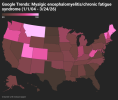
1. I looked at the map of google searches for me/cfs (strong in UK and Norway) and asked a question: what if there was signal on prevalence mixed in with signal on awareness. For a long time, I couldn't figure out any way to untangle the two.

2. I wondered using variation in English heritage within the US could help answer the question. If the pattern in England and Norway was just awareness you'd have no obvious reason to find any correlation within the USA.

3. I found a clue that correlation was not zero within the USA the case of England. I emphasised this is not proof of anything, but it perhaps introduces a teeny tiny wobble to the null case of equal prevalence worldwide.

4. @forestglip took the ball and ran with it, further and far more rigorously than I had. Honestly, further and far more rigorously than I dared hope. Their work successfully reduced two of the kinds of uncertainty: there really does seem to be a correlation between English heritage and searches for the illness, and income or English-speaking is not the confounder.


5. Three types of uncertainty remain reasons why this is probably still nothing.

5.1 English, in the UK context, is a diluted category (Saxons, Normans, Celts). Let alone in the USA where English migration was some time ago!

First thought is, does 'English' really exist?

5.2 Google trends data certainly doesn't only capture what it intends to capture, nor can we be sure it deals with foreign languages as well as it claims.

Edit: Oh ha. Mississippi's searches for MS are extremely high because the state abbreviation for Mississippi is MS.

5.3 We have no certainty searches correlate with prevalence - although it obviously can, it's not prima facie ridiculous - and forestglip has done some work to prune off some of the most obvious other explanations.

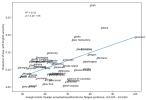
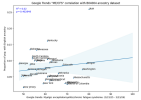
There isn't a very strong correlation between the ME/CFS search trends and speaking English at home:

6. So there *seems* to be a peculiar thing going on here, and one explanation *could* be that British/Celtic heritage correlates with MECFS. I'd say my confidence in the conclusion of Son et al has gone from maybe 55% before I did this analysis to maybe 50%.

"The total prevalence reported for Western and Asian populations were comparable."

Not a big shift, still lots of uncertainty. But in the research void we inhabit, getting even tiny probabilistic clues for free from existing public datatsets is worth something. As me/cfs science blog did with their immune work this week, emphasising what we don't know is important, and I don't think we know for sure that me/cfs hits all people equally.

Perhaps other clues will come forth and show all this to be a red herring. Perhaps other clues (HLA?) will suggest there's something going on.
 
Last edited:
I think it’s an interesting side quest to think about.

According to my Ancestry data I’m hardly English though, very Celtic but then again I am a little bit Norwegian, so that must be who is to blame! I can’t remember which parent that came from, I must check.

I thought DecodeME selected people of a particular background, I know my data was used despite being mixed race African.
 
5.1 English, in the UK context, is a diluted category (Saxons, Normans, Celts).

Yep. When you've added in the descendants of incoming medieval Scandinavians, 19th / 20th century eastern European Jews, etc, it becomes clear the category 'white English' includes most of northern Europe.

I agree there could be something in this, but we need to remember it's not really feasible to draw clear genetic boundaries on maps or in time. Too many people have been annoyingly resistant to staying put for too long.
 
I think this is interesting also because it’s got a lot of possible cultural bias such as certain groups having preference for using ME/CFS as the search term, or increased media and campaigning in the UK and USA.

One interesting comparison might be Australia - a lot of UK and Irish ancestry, majority English speaking population, I wonder what their results are like?
 
I think this is interesting also because it’s got a lot of possible cultural bias such as certain groups having preference for using ME/CFS as the search term, or increased media and campaigning in the UK and USA.

One interesting comparison might be Australia - a lot of UK and Irish ancestry, majority English speaking population, I wonder what their results are like?
  • Australia has many fewer states with quite uneven populations; only five states have more than a million people. the chance of getting signal in such a small sample is less. I've obviously shown willingness to listen out for signal amid noise, but I have my limits!
  • Also there's perhaps less diversity than in the US, and the heritage mix is, historically, more evenly distributed. There's lots of English heritage people everywhere!
  • And lastly the bushfire response service in South Australia gets a lot of searches each summer and it is known as the Country Fire Service (CFS), which rather ruins the results for that state. Perhaps you could get the data over winter in SA and normalise but I'd be nervous.

But I bet tehre's other ways we could slice the onion .Going back to @jmaciuch's observation about people guessing their heritgae based on their last name, I wonder if that could offer another low-cost approach using exitsing data.

Anyone with access to a public list of pwme coudl run a quick analysis of surnames. You might expect Smith to be ahead of Ferrero and Kowalski ... but then you could perhaps compare to population rates. Just an idea!
 
Also, just for context I should share a quote form the paper - Systematic review and meta-analysis of the prevalence of chronic fatigue syndrome/myalgic encephalomyelitis (CFS/ME) - I have been referencing.

They characterise an idea related to the one I'm wondering about as an outdated one.

It is well-known genetic background and living environment are important factors in the development or progression of diseases [48]. CFS/ME was once considered a disease of the middle to upper classes that was mostly prevalent in the Caucasian population [49], although other studies have suggested that members of minority groups and lower economic classes are more prone to CFS/ME due to psychosocial and environmental risk factors such as lack of adequate nutrition, limited access to healthcare, and work-related stressors [16, 5052]. In this respect, it is of interest that some studies from different countries showed similar prevalence rates in similar settings; i.e., when the CDC-1994 was used with a medical test for a community-based general population, similar results were found for Nigeria (0.28% for CFS, or 0.68% of CFS-like), the U.S. (0.60% and 0.42%), and Korea (0.61%) [50, 5355] (Table 2).

It's appropriate to be cautious about reviving old ideas. But we should absolutely get the defibrillators out if those ideas are true!

On my list of disclosures should perhaps also be my own heritage, most of my ancestors apparently grew up between Devon and Penwith (England), or near Cork (Ireland)! Perhaps it easy to look around, see all the British people in these forums and jump to conclusions.
 
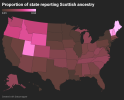
I previously tested the correlation of searching for ME/CFS with all the ancestries available in the US census data, to see which others may be as correlated to ME/CFS searches as English ancestry.

The first time, I used the past 1 year of Google Trends data and the 2024 5-year census data for 108 ancestries, using the data where each person could report up to two ancestries. Many ancestries relating to British regions, along with "Northern European", were most correlated with search trends:
Data I used:
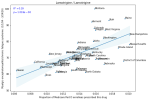
This is looking at the association between the Google Trends value for ME/CFS as an indicator of search popularity in a state, and the proportion of the state's population reporting English ancestry.

You got R^2=0.52. I got R^2=0.31. It looks like the difference may be due to me using newer Google Trends data or a slightly different search term. Vermont is #1 in mine, but #4 in your analysis. But it's still very significant.

1774240337097.png

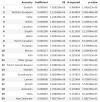
The census data includes 108 ancestries. I ran the regression on all of them against the same Google Trends values. Here are the top 20 highest R^2 values:
1774240791839.png

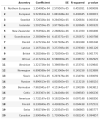
The second time, I used another census dataset which only included data for people who reported a single ancestry. I also notice now that I accidentally used the 2024 1-year census data instead of the 2024 5-year census data like the other test, so this may have led to it being less accurate. And this still used 1 year of Google search data.

In this case, none of the specific British regions like English or Scottish were near the top anymore:
I (and I think Murph) used B04006, which counts up to two ancestries per person. So, for example, the correlations for Scottish and English might both be high because the same people reported both ancestries.

I tried again with B04004, which only includes people who reported one ancestry, to avoid double counting and allow better comparison between ancestries.

In this case, the correlation with English is pretty much gone (the sample size is also much smaller for this dataset, so the ancestry values may be less precise):
1774308417525.png

There are still some large correlations in this analysis, and British is still near the top at #9, though less significant, with an R^2=0.26 and p=0.0018.
Screenshot from 2026-03-23 18-24-19.png

The top 5 correlations with Google Searches for ME/CFS are Northern European, European, Swedish, Icelander, and New Zealander.

As I've now realized that Murph got a much larger correlation when using the maximum available time span for Google Trends (~22 years instead of 1), I decided to redo testing many ancestries with the full Trends data.

I'm again doing it both with the census data where people could report up to two ancestries (B04006), and with the data where only people who reported one ancestry were counted (B04004). (Though I'm using the 2024 5-year version of the census data for both analyses this time.)

And I'm also doing both sets of correlations both with and without the covariates I used previously:

So that's four sets of correlations. (The term I'll refer to each by is in parentheses.)
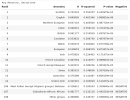
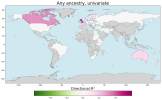
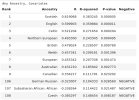
  1. Proportion of people reporting an ancestry where they could report up to 2 ancestries, without covariates. (Any ancestry, univariate)
  2. Proportion of people reporting an ancestry where they could report up to 2 ancestries, with covariates. (Any ancestry, covariates)
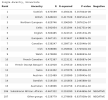
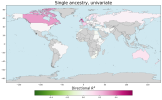
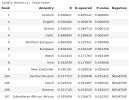
  3. Proportion of people reporting an ancestry where they could only report 1 ancestry, without covariates. (Single ancestry, univariate)
  4. Proportion of people reporting an ancestry where they could only report 1 ancestry, with covariates. (Single ancestry, covariates)
For R/R-squared values, I am reporting partial correlations and p-values tested using the Pingouin library. (Partial correlations allow one to determine a value for a correlation between two variables while controlling for all covariates.)

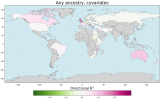
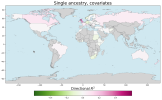
I figured out how to plot data onto a map, so along with each set of results, I'll add a map colored by the strength of the association between the country that aligns with the given ancestry, and searches for ME/CFS in US states. The color is based on R-squared, but where R-squared is negative if the association is negative.

Note that only 76 out of 108 ancestries could be cleanly mapped to a country, so the other 32 were not included in the maps. For example, "Eastern European" and "Yugoslavian" can't be mapped to a specific country. I also only used ancestries relating to specific regions of Britain, and not the more general "British" ancestry, in the map. The mapping of ancestries to countries (or lack thereof) is in this spoiler:
AncestryRegion on map
AfghanAfghanistan
AlbanianAlbania
ArmenianArmenia
AustralianAustralia
AustrianAustria
West Indian (except Hispanic groups): BarbadianBarbados
West Indian (except Hispanic groups): BelizeanBelize
West Indian (except Hispanic groups): BermudanBermuda
BrazilianBrazil
BulgarianBulgaria
CanadianCanada
Subsaharan African: Cape VerdeanCape Verde
CroatianCroatia
CypriotCyprus
CzechCzech Republic
DanishDenmark
Arab: EgyptianEgypt
EnglishEngland
EstonianEstonia
Subsaharan African: EthiopianEthiopia
FinnishFinland
BelgianFlemish Brabant,Walloon Brabant,Brussels Capital Region
French (except Basque)France
GermanGermany
Subsaharan African: GhanaianGhana
GreekGreece
GuyaneseGuyana
West Indian (except Hispanic groups): HaitianHaiti
HungarianHungary
IcelanderIceland
IranianIran
Arab: IraqiIraq
IrishIreland
IsraeliIsrael
ItalianItaly
West Indian (except Hispanic groups): JamaicanJamaica
Arab: JordanianJordan
Subsaharan African: KenyanKenya
LatvianLatvia
Arab: LebaneseLebanon
Subsaharan African: LiberianLiberia
Subsaharan African: NigerianLiberia
LithuanianLithuania
LuxembourgerLuxembourg
MalteseMalta
Arab: MoroccanMorocco
DutchNetherlands
New ZealanderNew Zealand
MacedonianNorth Macedonia
NorwegianNorway
PolishPoland
PortuguesePortugal
RomanianRomania
RussianRussia
ScottishScotland
Subsaharan African: SenegaleseSenegal
SerbianSerbia
Subsaharan African: Sierra LeoneanSierra Leone
SlovakSlovakia
SloveneSlovenia
Subsaharan African: SomaliSomalia
Subsaharan African: South AfricanSouth Africa
Subsaharan African: SudaneseSudan
SwedishSweden
SwissSwitzerland
Arab: SyrianSyria
West Indian (except Hispanic groups): BahamianThe Bahamas
West Indian (except Hispanic groups): Trinidadian and TobagonianTrinidad and Tobago
TurkishTurkey
Subsaharan African: UgandanUganda
UkrainianUkraine
AmericanUnited States of America
West Indian (except Hispanic groups): U.S. Virgin IslanderUnited States Virgin Islands
WelshWales
Arab: PalestinianWest Bank
Subsaharan African: ZimbabweanZimbabwe
Alsatian
Arab
Arab: Arab
Arab: Other Arab
Assyrian/Chaldean/Syriac
Basque
British
Cajun
Carpatho Rusyn
Celtic
Czechoslovakian
Eastern European
European
French Canadian
German Russian
Northern European
Other groups
Pennsylvania German
Scandinavian
Scotch-Irish
Slavic
Soviet Union
Subsaharan African
Subsaharan African: African
Subsaharan African: Other Subsaharan African
Unclassified or not reported
West Indian (except Hispanic groups)
West Indian (except Hispanic groups): British West Indian
West Indian (except Hispanic groups): Dutch West Indian
West Indian (except Hispanic groups): Other West Indian
West Indian (except Hispanic groups): West Indian
Yugoslavian

Grey regions in the map are missing/not-shown data. Green is negative correlation, white is no correlation, and pink is positive correlation.

To restate what is being tested: For each ancestry or ethnic origin, what is the correlation between

1. the proportion of a US state which identifies as that ancestry and,
2. the proportion of Google searches from that state which relate to ME/CFS.

[Edit: The tables are only showing rows with R-squared greater than 0.1]

Results

Univariate


Any ancestry, univariate​
Screenshot from 2026-03-27 16-49-30.pngScreenshot from 2026-03-28 10-41-56.png
Single ancestry, univariate​
Screenshot from 2026-03-27 16-49-11.pngScreenshot from 2026-03-28 10-42-12.png

Controlling for covariates

Any ancestry, covariates​
Screenshot from 2026-03-27 16-49-41.pngScreenshot from 2026-03-28 10-42-06.png
Single ancestry, covariates​
Screenshot from 2026-03-27 16-49-19.pngScreenshot from 2026-03-28 10-42-20.png


So when we use the maximum Google Trends data available and the 5-year version of the most recent census data, ancestries related to the British Isles (Scottish, British, English, Irish, Welsh), as well as European and Northern European, are consistently most correlated with ME/CFS searches, whether or not including people who reported more than one ancestry, and whether or not controlling for various potential confounders.

Note that an ancestry not being significant does not necessarily mean there is not a correlation. The sample sizes in the census data for some ancestries are far smaller than others, so the state-level ancestry data may be less precise for these, which could prevent identifying a significant relationship.

Edit: I just noticed I accidentally mapped the "German Russian" correlation, instead of the "German" correlation, to Germany on the map.

Edit: I updated the maps and the mapping table to use the "German" correlation for Germany. The change in color of Germany is virtually imperceptible though, because the correlation is very similar to "German Russian".
 
Last edited:
The number of people that responded for any given ancestry will affect how strong the correlation can be with Google Trends, both because of less precision due to lower sample size and because an ancestry with a small population will likely explain only a small part of the variance in search trends.

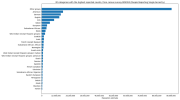
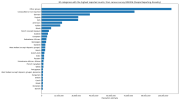
Therefore, I plotted the counts of the top 30 ancestries/categories in each of the two census surveys I used to see whether the highest raw count ancestries are significant or non-significant.

B04004 (People Reporting Single Ancestry)
1774650744688.png

B04006 (People Reporting Ancestry)
Screenshot from 2026-03-27 18-29-27.png


"Scottish" was consistently most significantly correlated with ME/CFS searches in all versions of the above analyses, and has the 8th highest total estimate in the USA (out of 106 ancestries, not including "Other" or "Unclassified").

"American" had a very high count, but was not significantly correlated to ME/CFS searches.

So while raw count could play some part in which ancestries were significant, it wouldn't fully explain why British regions are most significant. Similarly, it is possible that ancestries with relatively low counts could be correlated to ME/CFS searches, but the low counts may have prevented those ancestries from being significant in the above analyses.
 
Last edited:
I've been having some more fun with the search trends data trying to find what else it correlates to.

Medicare is the health insurance provided by the US government. They provide state-level data for "The total number of unique Medicare Part D beneficiaries with at least one claim for the drug" for hundreds of drugs for the year 2023 here. They also provide the number of total Medicare Part D enrollees in every state here.

For each drug in each state, I calculated the proportion of total enrollees in the state who had at least one claim for the drug, as a rough measure to be able to compare use of any given drug among states.

Many drugs didn't have info for every state, mostly because of low numbers of people being prescribed that drug, so I only included those where every state had data. This resulted in data for 789 drugs. (The drugs are categorized by brand name of drug, so there may be some duplicates in terms of the same chemical.)

For each drug, I correlated these prescribing values with the ~22 year span for Google Trends ME/CFS data for each state.

Since there are some large outliers for many drugs, I focused on the statistics of the non-parametric Spearman correlation. I did Bonferroni correction on the Spearman p-values.

The resulting drugs which are significantly correlated with state-level search trends for ME/CFS are below:

Prescription (Generic name / Brand name)Pearson RPearson P-valueSpearman RSpearman P-valueSpearman P-value (Bonferroni adjusted)
Lamotrigine / Lamotrigine0.6235781902479361.02E-060.6802398738478984.00E-083.16E-05
Prazosin Hcl / Prazosin Hcl0.5835421605777566.98E-060.6434689255248533.53E-070.000278214572358373
Disulfiram / Disulfiram0.5289918325500036.59E-050.6407031698556724.11E-070.00032388690956068
Lithium Carbonate / Lithium Carbonate Er0.6359755759011785.30E-070.6377560531590044.82E-070.00038020312342398
Finerenone / Kerendia-0.5147271888573130.000111370265018976-0.6136803767600681.68E-060.00132540310771482
Sitagliptin Phos/Metformin Hcl / Janumet-0.4259460617215480.00183097470025415-0.6121841482832981.81E-060.00142748526361131
Acamprosate Calcium / Acamprosate Calcium0.4140412610289290.002524731478167930.6003050009828813.22E-060.00253880744217712
Patiromer Calcium Sorbitex / Veltassa-0.5580269957798362.09E-05-0.5793578023081018.41E-060.00663557036809076
Dutasteride / Dutasteride-0.5052459722550530.000155932894175367-0.5760026232995869.75E-060.00769225211534648
Guanfacine Hcl / Guanfacine Hcl Er0.5488366450819163.04E-050.5726474442910721.13E-050.00890277017459818
Calcium Acetate / Calcium Acetate-0.5076787537039290.000143166444784017-0.5677506965489151.39E-050.0109879829094171
Empagliflozin/Metformin Hcl / Synjardy Xr-0.5490907360604853.01E-05-0.564622218824761.59E-050.0125472652132566
Megestrol Acetate / Megestrol Acetate-0.4622891692134660.000637232389769363-0.5606776164769111.88E-050.0148042215297837
Sevelamer Carbonate / Sevelamer Carbonate-0.4164990465461630.00236492595349537-0.5605869359631681.88E-050.0148602538890625
Losartan/Hydrochlorothiazide / Losartan-Hydrochlorothiazide-0.4745468586475240.00043446214846709-0.5600428528807061.93E-050.0152005767133913
Methylphenidate Hcl / Methylphenidate Er0.6057911370342792.47E-060.5564156323309612.24E-050.0176595490485583
Amlodipine Besylate/Benazepril / Amlodipine Besylate-Benazepril-0.5476937305659913.19E-05-0.5539219182030112.48E-050.0195573575213681
Sitagliptin Phos/Metformin Hcl / Janumet Xr-0.5161318523948330.000105863354147246-0.5504760586807522.85E-050.0224898184411467
Naltrexone Hcl / Naltrexone Hcl0.4731115202729330.0004547292067327940.5501133366257782.89E-050.0228209646235601
Atomoxetine Hcl / Atomoxetine Hcl0.5378308905277494.70E-050.5494785730295722.97E-050.0234112915453875
Dextroamphetamine Sulfate / Dextroamphetamine Sulfate Er0.504418777229420.0001605047262694780.5487984691764953.05E-050.0240593581198571
Amlodipine Besylate/Valsartan / Amlodipine-Valsartan-0.4922032585999120.000243859352250637-0.5484810873783923.09E-050.0243674040763322
Ciprofloxacin Hcl / Ciprofloxacin Hcl-0.557690735011522.12E-05-0.5461233940210583.39E-050.0267718894820089
Dextroamphetamine/Amphetamine / Adderall Xr0.5354415169044145.15E-050.5443097837461853.65E-050.0287679498891401
Sucroferric Oxyhydroxide / Velphoro-0.4948418313167720.000223089338112124-0.5439924019480823.69E-050.0291310157211999
Gentamicin Sulfate / Gentamicin Sulfate-0.5825398690156817.30E-06-0.5376901062428994.72E-050.0372719856938088
Lithium Carbonate / Lithium Carbonate0.4707130088551650.0004905105993237390.5371460231604374.82E-050.0380646988159864
Fluticasone Propion/Salmeterol / Fluticasone-Salmeterol Hfa0.5620577306815721.77E-050.5346976492893595.30E-050.0418271041905856
Lamotrigine / Lamotrigine Er0.4474011002566740.0009958398161520820.5324306364457695.78E-050.04561207758127
Olmesartan/Amlodipin/Hcthiazid / Olmesartan-Amlodipine-Hctz-0.432317542026840.00153432674374989-0.5323399559320255.80E-050.0457698142905368
Hydralazine Hcl / Hydralazine Hcl-0.5148029414801840.000111066730729325-0.5310250884827426.10E-050.0481139358704564
Fluticasone Propion/Salmeterol / Advair Hfa0.6109784010389411.92E-060.5308890677121276.13E-050.0483626106286998

Here is a plot of ME/CFS searches vs. Lamotrigine use, which was the most significant Spearman correlation (note: stats on the plot are Pearson stats):

Lamotrigine _ Lamotrigine.png

I haven't yet thought much about what this could potentially be showing. Lamotrigine causes ME/CFS? Lamotrigine is used for people with ME/CFS-like symptoms? Lamotrigine is used for a condition which is often comorbid with ME/CFS? Something much less interesting?

Interestingly, fineronone and metformin, which I think are both drugs used for people with type 2 diabetes, produce the two most significant negative correlations with ME/CFS searches. Are the drugs protective against ME/CFS? Is diabetes protective against ME/CFS?


In case anyone wants to double check that my numbers are correct, I'll attach the specific data I used for each state to calculate the correlation just for Lamotrigine. Claims for Lamotrigine per state and total enrollees per state can be verified in the links above. The claims proportion was calculated from these values. The proportion was correlated against the ME/CFS search data, which is also linked above.

I also attached the correlation statistics for all 789 drugs.
 

Attachments

Note the significant positive correlations with stimulants:
- The amphetamines "Dextroamphetamine Sulfate Er" and "Adderall Xr"
- "Methylphenidate Er" (Ritalin)

States in which more people are prescribed stimulants are the states where more people search for ME/CFS, which seems to support the possibility of genuine signal in the data.

Edit: There's also a positive correlation with naltrexone. Does this represent LDN being prescribed for ME/CFS?
 
Last edited:
I jotted down some quick notes from Wikipedia on what each of the meds above is primarily used for:
Positive Correlations

Lamotrigine
  • sodium channel blocker
    • Epilepsy
    • Bipolar disorder
    • Depression
  • (Also extended release version)
Prazosin
  • alpha-1 antagonist
    • High blood pressure
    • Enlarged prostate
    • Nightmares

Disulfiram (antabuse)
  • aldehyde dehydrogenase inhibitor
    • alcoholism

Lithium carbonate ER
  • "The specific biochemical mechanism of lithium action in stabilizing mood is unknown. However, it is known that lithium works at the level of G-proteins, PIP2, and other second messengers"
    • Bipolar disorder
    • Depression
  • (Also non-extended release)

Acamprosate Calcium
  • "The pharmacodynamics of acamprosate are complex and not fully understood"
    • Reduce alcohol cravings

Guanfacine Hcl Er
  • "highly selective agonist of the α2A-adrenergic receptor, with low affinity for other receptors. It is also a serotonin 5-HT2B receptor agonist."
    • ADHD

Methylphenidate ER (Ritalin)
  • "Methylphenidate is believed to work by blocking the reuptake of dopamine and norepinephrine by neurons."
    • ADHD

Naltrexone
  • Reduce alcohol or other cravings
  • off label for ME/CFS in low dose

Atomoxetine
  • "inhibits the presynaptic norepinephrine transporter (NET), preventing the reuptake of norepinephrine throughout the brain along with inhibiting the reuptake of dopamine in specific brain regions such as the prefrontal cortex, where dopamine transporter (DAT) expression is minimal"
    • ADHD

Dextroamphetamine Sulfate ER
  • ADHD
  • (Also Adderall brand)

Fluticasone/salmeterol (Advair)
  • Asthma
  • COPD
  • (Both generic and brand name)


Negative correlations

Finerenone / Kerendia
  • non-steroidal mineralocorticoid receptor antagonist
    • kidney and heart complications of T2 diabetes

Sitagliptin Phos/Metformin Hcl / Janumet
  • "dipeptidyl peptidase-4 (DPP-4) inhibitor class and works by increasing the production of insulin and decreasing the production of glucagon by the pancreas"
    • Type 2 Diabetes
  • (Also correlation with extended release version)

Patiromer Calcium Sorbitex / Veltassa
  • Binds potassium in GI tract
    • High potassium

Dutasteride
  • Block conversion of testosterone into DHT.
    • Enlarged prostate

Calcium Acetate
  • Bind phosphate to reduce blood phosphate levels
    • High phosphate in kidney disease

Empagliflozin/Metformin Hcl / Synjardy Xr
  • Drug combo for type 2 diabetes

Megestrol Acetate
  • "progestogenic activity, antigonadotropic effects, weak partial androgenic activity, and weak glucocorticoid activity"
    • appetite stimulant
    • breast cancer
    • endometrial cancer
    • birth control

Sevelamer Carbonate
  • Binds phosphate
    • High phosphate levels
    • Also reduces LDL and cholesterol

Losartan/hydrochlorothiazide
  • Combo med for treating high blood pressure

Amlodipine/benazepril
  • Combo med for high blood pressure

Amlodipine/valsartan
  • High blood pressure

Ciprofloxacin
  • Antibiotic

Sucroferric oxyhydroxide (Velphoro)
  • "used for the control of serum phosphorus levels in adults with chronic kidney disease (CKD) on hemodialysis (HD) or peritoneal dialysis (PD)"

Gentamicin
  • Antibiotic

Olmesartan/amlodipine/hydrochlorothiazide
  • High blood pressure

Hydralazine
  • High blood pressure
  • Heart failure

I tried to look for cases of different drugs correlated in the same direction and which treat the same disease:

Positive correlations of ME/CFS searches with use of drugs for:
  • Bipolar disorder (Lamotrigine, lithium)
  • Alcohol abuse disorder (disulfiram, acomprosate, naltrexone)
  • ADHD (guanfacine, methylphenidate, amphetamine)
Negative correlations of ME/CFS searches with use of drugs for:
  • High blood pressure (hydralazine, amlopidine combo drugs, losartan combo drug) - Also one drug positively correlated (Prazosin)
  • High phosphorus (Velphoro, sevelamer, calcium acetate
  • Type 2 Diabetes (finerenone, Janumet, Synjardy)
  • Bacterial infections (ciprofloxacin, gentamicin)
 
Last edited:
Interestingly, fineronone and metformin, which I think are both drugs used for people with type 2 diabetes, produce the two most significant negative correlations with ME/CFS searches. Are the drugs protective against ME/CFS? Is diabetes protective against ME/CFS?
Maybe if you have diabetes you don't go looking for further reasons you are sick and tired?!!

But I imagine diabetes diagnosis is most common in the US South and it could be that negative correlation you identified above, in the heritage data, seen from another angle.
 
Back
Top Bottom