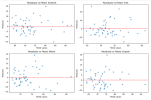
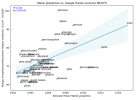
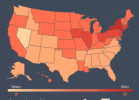
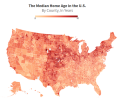
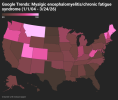
Can we maybe get an interim Discussion section,
@forestglip? What do you think might be implied from the things you are seeing, and to what degree of probability? What if you saw it, would make the conclusions stronger? what would falsify some of these premises?
There seem to be a few main possibilities that all seem plausible:
- People with British or Irish ancestry have a higher genetic predisposition to ME/CFS.
- States with higher British or Irish ancestry have higher levels of an environmental risk factor for ME/CFS (e.g. infections).
- People with British or Irish ancestry tend to be diagnosed with ME/CFS at higher rates due to cultural differences.
- Populations in states with higher British or Irish ancestry tend to use the term "fatigue" while other states use other terms (something like how some state populations say "soda" and some say "pop"). (Very similar to possibility 3.)
- Some other confounder we haven't thought of explains the association.
I really don't know if we can say with any confidence which of these is most likely. I think we have good reason to try to explore the genetic possibility through other avenues, but can't be very certain just based on what we've seen so far.
I haven't thought of how, but I think it'd be good to further explore the possibility of difference in terminology used in different states to describe "fatigue" or "tiredness".
Seeing similar correlations of ancestry with ME/CFS searches in other countries would be interesting, though I'm not sure how much it would help narrow down if it is genetic or something else. If there was no correlation in a different country, that'd probably make an environmental/cultural factor much more likely in the USA.
I'm not really sure what the "optimal" way to test the genetic possibility would be, given unlimited resources. Maybe a population study, similar to
Leonard Jason's studies, and in which the researchers diagnose people as part of the study. They would also ask people their ancestry, or better yet, identify everyone's ancestry through genome sequencing, and see if the risk of ME/CFS is higher in those with British or Irish ancestry. If there are cultural/language differences, I think it's possible this might still bias who gets diagnosed in the study, so the researchers would need to be very careful with diagnosis. If there was no difference in incidence/prevalence in such a study, that would probably suggest that it's not genetic. If there was a difference, there'd still be the question of whether it's due to environmental or genetic factors.
Maybe it could be tested with the DecodeME data. Even though everyone has very similar ancestry in that study, there will probably still be some differences, so maybe they could test if those people with greater similarity to a reference British population have higher risk. I have no idea how feasible that is.
I guess there's also the question of what the implications would be if there
was a higher genetic propensity in those with British or Irish ancestry. It's not obvious to me how knowing this would help with identifying causes. Maybe prioritizing studying these populations? I guess we lucked out that DecodeME was done in the UK, in case there actually is a higher genetic risk in these ancestries.
* Also, I think I have been using the wrong term, since Irish ancestry seems to also be correlated. I was using "British" because of these populations being from the "British Isles", but maybe "British or Irish" would be better.