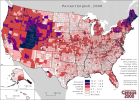
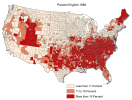
Which perhaps raises a possibillity: if rates of english/scottish heritage and rates of hispanic heritage were inversely correlated, what we could be capturing is low rates of me/cfs among people with hispanic origin. Which would still be an epidemiological insight if there was something to it.
I note that the US census table @forestglip has been using does not include Mexico or any south American countries as places people may say their ancestors came from. It does include "other groups" though, which has a negative coefficient and a low p-value.
Yeah, they put the statistics about Hispanic characteristics in other tables. B03001 has the number of Hispanic people in each state, as well as specific countries of origin. I hadn't realized that other table was there, so thanks for bringing this up.
As another way of looking at the question of who is engaged in thinking about mecfs, I accessed a public petition from the US with 3000+ signatories. And I did some analysis of the surnames.
All the techniques I used were fairly fraught so possibly the simplest trick is just ranking the surnames by frequency. You can see that list below. What this doesn't give you is detailed ethnic origin. Not in any way. What I see though is that this list of names is very similar to the most common names in the USA, if you exclude hispanic names. ref: https://en.wikipedia.org/wiki/Lists_of_most_common_surnames_in_North_American_countries)
Which perhaps raises a possibillity: if rates of english/scottish heritage and rates of hispanic heritage were inversely correlated, what we could be capturing is low rates of me/cfs among people with hispanic origin. Which would still be an epidemiological insight if there was something to it.
I note that the US census table @forestgliphas been using does not include Mexico or any south American countries as places people may say their ancestors came from. It does include "other groups" though, which has a negative coefficient and a low p-value.
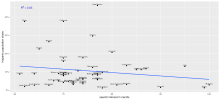
well I ran a little test on this and it doesn't seem to show much. Yes, Montana, Maine and Vermont are low in Hispanic population. but so are South Carolina, the Dakotas, etc.
Just by eye this list seems remarkable homogeneous for the USA, with predominantly surnames of British origin. The sorts of name lists you see in say film credits for America always seem to me very heterogeneous.
Note, there will have been some pressure towards adopting English sounding surnames, perhaps the largest being by African Americans at the end of slavery.
Would the geographical distribution of donations to @dave30th provide any relevant data or would the sample sizes be too small?
I have continued searching for terms that are highly correlated to search interest for "chronic fatigue syndrome" at the metro level, using the program I used before (with some alterations for finding better related terms to test, such as having an AI suggest related terms). I actually restarted, because I decided to first generate a more accurate set of metro scores for "chronic fatigue syndrome" by averaging the scores for each area from 10 different downloads of search interest.
Here is the leaderboard in terms of p-value.
Term
Pearson R
P value
# Metro Areas
chronic fatigue syndrome
0.989
5.90E-174
209
fatigue syndrome
0.953
1.64E-109
209
chronic fatigue
0.930
4.16E-92
209
thoracic outlet syndrome
0.811
5.54E-50
209
hemochromatosis
0.793
1.66E-46
209
nicotine gum
0.770
3.21E-42
209
fibromyalgia syndrome
0.774
4.33E-42
205
ehlers danlos syndrome
0.764
2.81E-41
209
migraine aura
0.763
6.13E-41
208
aura migraine
0.763
6.13E-41
208
vagus nerve
0.749
7.06E-39
209
chronic pain
0.745
2.78E-38
209
piriformis syndrome
0.740
1.46E-37
209
polymyalgia rheumatica
0.740
1.53E-37
209
symptoms celiac disease
0.736
6.05E-37
209
celiac disease symptoms
0.736
6.05E-37
209
rotator cuff injury
0.733
1.56E-36
209
autoimmune disorders
0.732
2.68E-36
209
ehlers danlos
0.729
5.44E-36
209
essential tremor
0.729
8.18E-36
208
hot flash
0.720
1.07E-34
209
dog food recall
0.720
1.17E-34
209
lichen planus
0.718
1.82E-34
209
food recall
0.714
6.65E-34
209
symptoms chronic fatigue syndrome
0.729
8.70E-34
196
chronic fatigue syndrome symptoms
0.729
8.70E-34
196
ankylosing spondylitis
0.712
1.18E-33
209
plantar warts
0.712
1.26E-33
209
symptoms lactose intolerance
0.710
3.32E-33
208
assisted suicide
0.706
6.96E-33
209
ocular migraine
0.705
1.11E-32
209
tendonitis treatment
0.705
2.10E-32
207
raynaud's
0.701
3.02E-32
209
lewy body dementia
0.701
3.41E-32
209
ulnar nerve
0.699
5.40E-32
209
cross stitch pattern
0.699
7.47E-32
208
kidney disease symptoms
0.695
1.58E-31
209
autoimmune diseases
0.695
1.64E-31
209
celiac disease
0.695
1.79E-31
209
plantar wart
0.695
1.95E-31
209
eustachian tube dysfunction
0.696
2.47E-31
207
macular degeneration
0.693
3.23E-31
209
trigeminal neuralgia
0.692
3.73E-31
209
chronic fatigue symptoms
0.698
4.36E-31
204
mast cell activation syndrome
0.696
4.72E-31
205
salivary gland
0.690
7.02E-31
209
migraine symptoms
0.689
8.11E-31
209
anal gland
0.689
8.27E-31
209
jigsaw
0.689
9.68E-31
209
eye problems
0.688
1.13E-30
209
Some ideas for what this is showing:
Many of the top correlations, like ME/CFS, are hard to diagnose or hard to treat conditions with non-specific symptoms, such as thoracic outlet syndrome, fibromyalgia, EDS, migraine, and chronic pain, so these might represent the same people looking for what best describes their own symptoms.
The notable exception, with a very high correlation of R=0.793 (R^2=0.63) and beating everything except thoracic outlet syndrome and terms related to ME/CFS, is hemochromatosis, which is primarily a genetic disorder.
As pointed out by jnmaciuch earlier, hemochromatosis is most common in those of British/Irish ancestry, with the most common mutation responsible for this disorder thought to have first occurred in a person of Celtic origin. [1,2] The disease causes excessive absorption of iron from the diet, leading to diverse symptoms, such as fatigue, joint pain, and liver damage. [3] It is more common in men than in women, and has a prevalence of around 1 in 300 to 500 individuals.
[From Merryweather-Clarke 1997]
The C282Y mutation was most prevalent in north European populations, and absent from 3056 non-European chromosomes studied except for three chromosomes (one Indian and two Jamaican). These results strongly suggest that the mutation originated in northern Europe, which is where haemochromatosis is generally accepted to have arisen.
Simon et al'3 '4 have postulated that the geographical distribution of haemochromatosis is similar to the migration pattern of Celtic peoples, and Smith et al'5 concluded that there was a significantly higher prevalence of haemochromatosis in Americans of British/Irish descent compared with that of Americans of other Caucasian descent. The distribution of the C282Y mutation is therefore similar to that of haemochromatosis. The presence of the allele in Indian and Jamaican populations at trace levels may be because of admixture with Europeans in the history of these peoples.
[From Lucotte 1998]
The aim of this review is to compile the Y allele frequencies of the C282Y mutation for twenty European populations. The most elevated value (6.88%) is observed in residual Celtic populations in UK and France, in accordance to the hypothesis of Simon et al. concerning a Celtic origin of the hereditary hemochromatosis mutation.
One possibility is that hemochromatosis is in some way biologically related to ME/CFS, potentially with the correlation in search interest between the two showing that people with hemochromatosis search for ME/CFS as a way to explain their symptoms before eventually being diagnosed. Considering the rarity of hemochromatosis, and that there is a non-significant, decreased frequency of the main hemochromatosis mutation in the DecodeME ME/CFS cohort (6:26092913:G:A, p=.11, β=-.038 from GWAS-1), this seems unlikely to be the explanation for such a high correlation.
Instead, I think this is more likely a proxy for ancestry, as the prevalence of a genetic disease originating in Celtic/Northern European countries is likely to highly correlate to prevalence of people from those countries.
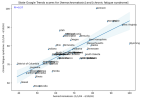
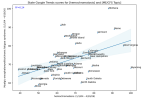
The table above is showing correlations using search interest by metro area. Here is a regression of search interest by state of "chronic fatigue syndrome" with "hemochromatosis", which results in R2=0.57:
Interestingly, the correlation is substantially smaller (R2=0.24) when using the ME/CFS Topic which can include other related terms:
1. Merryweather-Clarke, A T et al. “Global prevalence of putative haemochromatosis mutations.” Journal of medical genetics vol. 34,4 (1997): 275-8. https://doi.org/10.1136/jmg.34.4.275
2. Lucotte, G, and G Mercier. “Celtic origin of the C282Y mutation of hemochromatosis.” Genetic testing vol. 4,2 (2000): 163-9. https://doi.org/10.1089/10906570050114876
3. Alvarenga, Aline Morgan et al. “Haemochromatosis revisited.” World journal of hepatology vol. 14,11 (2022): 1931-1939. https://doi.org/10.4254/wjh.v14.i11.1931
European (and east Asian) people show evidence of neanderthal genetic heritage. Further north, the more you might expect to find more torpor genes, to deal with the cold.
African populations show far lower rates of neanderthal DNA.
Just an idea as to why the coefficients might have the signs they have.
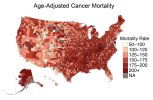
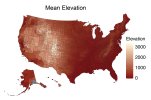
I came across the attached images comparing cancer mortality rates and elevation, and thought of this thread. And I think there are some epidemiological studies showing that living at moderate/high altitude has benefits for health/longevity, even beyond cancer.
Could a comparison between elevation and ME/CFS be made with the ME/CFS prevalence or Google search datasets?
State-level average elevation in the US may not be of much benefit due to variation within states, so it would likely have to be at metro or county level. I do not know enough about European geography/topography to suggest what might be the right scale there.
I just did a quick search for county level elevation data for every county in the US, but had trouble finding a good source. If we do find it, it'd require merging counties into metro areas, as I did previously for county level ancestry data, if we want to correlate against search interest data directly.
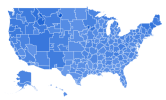
It does look a little darker in the western region, around the area of high elevation in the map above. Though the high searches in the northeast are in a low elevation area.
I came across the attached images comparing cancer mortality rates and elevation, and thought of this thread. And I think there are some epidemiological studies showing that living at moderate/high altitude has benefits for health/longevity, even beyond cancer.
Could a comparison between elevation and ME/CFS be made with the ME/CFS prevalence or Google search datasets?
State-level average elevation in the US may not be of much benefit due to variation within states, so it would likely have to be at metro or county level. I do not know enough about European geography/topography to suggest what might be the right scale there.
Elevation is also correlated closely with obesity (negative correlation) and suicide (positive correlation) so yep, it is potentially biologically relevant and there's reasons to want to control for it.
The county-metro mapping file includes 3097 counties that map to a metro, but I could only obtain elevation data for 3071 of these. For some, the OpenTopo API did not return an elevation for some reason (e.g. for the coordinates for Garrard County) and for others, the Gazetteer file did not provide coordinates for a county (e.g. all the counties in Connecticut seem to use a different system in the Gazetteer file as compared to the DMA mapping file).
The DMA mapping file also does not include the "Palm Springs CA" metro area, even though it is one of the Google Trends areas.
Thus, I had elevation data for 208 out of 210 metro areas, with a few metro area averages not being based on every single county in the metro.
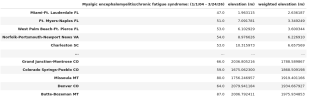
Here are the highest and lowest elevation metro areas based on population weighted average of counties in the metro areas:
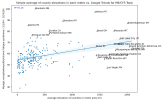
Here is the plot using the simple average (R²=0.15):
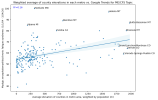
Here is the plot if using the weighted average for elevation (R²=0.16):
So there is a small to moderate correlation. The elevation data could definitely be improved, as this is using the elevation for only one representative point for each county, which might skew the correlation if there are large elevation changes within a county.
All trends scores and elevations used in the plots attached as a spreadsheet.
Thanks for going through the data analysis exercise. For the US, and only moderate correlation, it is more likely explained by other factors already discussed in this thread than elevation itself. (i.e. population demographics/ancestry in those areas vs. lower elevation areas, higher activity levels in the Mountain West, etc.) ... At the very least, it does not look like living at higher elevations is "protective" for ME/CFS, as it might be for some other health conditions.
This site uses cookies to help personalise content, tailor your experience and to keep you logged in if you register.
By continuing to use this site, you are consenting to our use of cookies.