Activation of the Lectin Pathway Drives Persistent Complement Dysregulation in Long COVID, 2026, Keat et al.

SNT Gatchaman

Senior Member (Voting Rights)
Staff member
Activation of the Lectin Pathway Drives Persistent Complement Dysregulation in Long COVID
Samuel B K Keat; Priyanka Khatri; Youssif M Ali; Chanuka H Arachchilage; Gregory Demopulos; Kirsten Baillie; Kelly L Miners; Kristin Ladell; Samantha A Jones; Helen E Davies; David A Price; Wioleta M Zelek; B Paul Morgan; Wilhelm J Schwaeble; Nicholas J Lynch

Long COVID affects a substantial proportion of survivors of acute infection with severe acute respiratory syndrome-associated coronavirus-2 (SARS-CoV-2), who suffer a variety of symptoms that limit their quality of life and economic activity. Although the aetiology of long COVID is obscure, it appears to be a chronic inflammatory condition. Complement dysregulation is a prevalent feature of long COVID. Specifically, markers of classical, alternative, and terminal pathway activation are often elevated in patients with this condition.

Here, we used a sensitive assay for mannan-binding lectin-associated serine protease-2 (MASP-2)/C1Inh complexes to analyse lectin pathway activation in a previously characterised cohort of patients with long COVID (n = 159) and healthy convalescent individuals with no persistent symptoms after infection with SARS-CoV-2 (n = 76). The data were combined with those from the most predictive complement analytes identified previously to delineate potential biomarkers of long COVID.

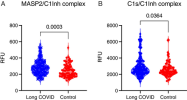
MASP-2/C1Inh complexes were significantly elevated in patients with long COVID (p = 0.0003). Generalised linear modelling further identified an optimal set of four markers, namely iC3b (alternative pathway), TCC (terminal pathway), MASP-2/C1Inh (lectin pathway), and the complement regulator properdin, which had a receiver operating characteristic predictive power of 0.796 (95% confidence interval = 0.664–0.905). Combinations of the classical pathway markers C4, C1q, and C1s/C1Inh were poorly predictive of long COVID.

These findings demonstrate that activation of the lectin complement pathway, which occurs upstream of the alternative and terminal pathways and can be inhibited therapeutically, is a salient feature of long COVID.

Web | DOI | PDF | Immunology | Open Access
 
I know nothing about this, but the differences look very small.

Figure 1
IMG_0575.png
Plasma concentrations of MASP-2/C1Inh are elevated in patients with long COVID. Plasma concentrations of MASP-2/C1Inh (A) and C1s/C1Inh (B) in healthy convalescent individuals (n = 76) and patients with long COVID (n = 159). Significance was assessed using an unpaired t-test.

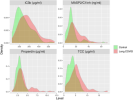
Figure 4
IMG_0576.png
Plasma concentration distributions for MASP-2/C1Inh, iC3b, TCC, and properdin in healthy convalescent individuals and patients with long COVID. Density plots showing the plasma concentration distributions for MASP-2/C1Inh, iC3b, TCC, and properdin in healthy convalescent individuals (green, n = 76) and patients with long COVID (red, n = 159).
 
I think there's a mistake with Table 1--per the methods, it seems like there was supposed to be an extra table that showed demographics and symptom prevalence.

The text says that one persisting symptom was enough to be labeled as LC, so I'm guessing it was a very heterogenous cohort.
 
Okay so in a previous study they ran this analysis and found that a combination of 4 features--2 associated with alternative activation and 2 associated with terminal activation--best differentiated LC and controls with an AUC of 0.785.

They reran the same cohort with more markers specific to alternative activation. Their new feature selection pointed to 4 features, 2 of which were the same as before, with an AUC of 0.796.

They did cross validation but no independent test set.

Their 4 top differential features performed a lot better than a-priori selection of a few markers of classical activation, so they are claiming that alternative activation is the better explanation for slight differences in overall complement activity between healthy and LC.

[Edit: The overall differences are themselves driven by the top features so this bit is circular, I think they just could've stated that more of their top features are relevant to alternative activation and left it at that.]
 
Thank you to the research team for continuing to work on this and applying new advances to revisit the samples. I thought it looked like a carefully done study, with cases and controls well matched. But yes, the definition of long Covid seems very loose and early - one persisting symptom at 12 weeks was enough to qualify someone for the LC group.

I wonder if the team could reanalyse the results, after separating the Long Covid participants into some subgroups based on symptoms. (I know, when researchers get carried away with post hoc subsetting, I criticise. When they don't, I criticise, well, make suggestions.). @V.R.T. or someone, does this team know about ME/CFS, are they part of an ME/CFS research network? Could they potentially characterise their samples based on ME/CFS criteria?

Model ..............................................................AUC
MASP- 2/C1Inh ...............................................0.718
MASP- 2/C1Inh + TCC.....................................0.714
MASP- 2/C1Inh + TCC + iC3b ........................0.742
MASP- 2/C1Inh + TCC + iC3b + Properdin..... 0.796

I am finding it a bit hard to reconcile the somewhat useful utility of the model with the lack of separation in the charts of the individual biomarkers. That makes me even keener to know if there are subgroups where levels of multiple biomarkers are different.

Note the funding sources - some from dementia research funds. That's an interesting angle.
This work was supported in part by the UK Dementia Research Institute (DRI), in part by the National Institute for Health and Care Research/UK Research and Innovation (NIHR/UKRI), grant numbers COV0170 (Humoral Immune Correlates of COVID- 19) and COV- LT2- 0041 (The Immunologic and Virologic Determinants of Long COVID), and in part by Omeros Corporation, Seattle, USA. D.A.P. was further supported by the PolyBio Research Foundation (Balvi B43). W.M.Z. was supported by a Race against Dementia Alzheimer's Research UK Fellowship (520488).
 
Thank you to the research team for continuing to work on this and applying new advances to revisit the samples. I thought it looked like a carefully done study, with cases and controls well matched. But yes, the definition of long Covid seems very loose and early - one persisting symptom at 12 weeks was enough to qualify someone for the LC group.

I wonder if the team could reanalyse the results, after separating the Long Covid participants into some subgroups based on symptoms. (I know, when researchers get carried away with post hoc subsetting, I criticise. When they don't, I criticise, well, make suggestions.). @V.R.T. or someone, does this team know about ME/CFS, are they part of an ME/CFS research network? Could they potentially characterise their samples based on ME/CFS criteria?

Model ..............................................................AUC
MASP- 2/C1Inh ...............................................0.718
MASP- 2/C1Inh + TCC.....................................0.714
MASP- 2/C1Inh + TCC + iC3b ........................0.742
MASP- 2/C1Inh + TCC + iC3b + Properdin..... 0.796

I am finding it a bit hard to reconcile the somewhat useful utility of the model with the lack of separation in the charts of the individual biomarkers. That makes me even keener to know if there are subgroups where levels of multiple biomarkers are different.

Note the funding sources - some from dementia research funds. That's an interesting angle.
All I know about this research group is what JE said about Paul Morgan here:
Paul Morgan is a world class immunologist with a special interest in complement.
There might be recruitment problems for a study of this sort but otherwise I would expect the science to be of high quality.
 
Back
Top Bottom