Article: Every disease is a policy failure — worksinprogress.co

Chandelier

Senior Member (Voting Rights)

Every disease is a policy failure​

Few people know how much medicine has progressed in their lifetimes. Fewer know how much faster it could be progressing.​

11th August 2026
By Saloni Dattani

Massive 4500-word article.
images.webp

images 2.webp

images.webp

images 3.webp

images 4.webp

Screenshot.webp

About the author
Saloni Dattani is an editor at Works in Progress, writes the newsletter Scientific Discovery, and is an advisor to Coefficient Giving on clinical trial reform.

Dattani on Twitter:
This article is a companion to my TED talk, which comes out next week.
 
The article has a heavy focus on drug development and attributes the slowing of progress to bottlenecks in getting drugs to market as far as I can see.

To me the elephant in the room is lifestyle and public health measures. Stopping smoking, isolation for TB, surgery, including obstetrics, and vaccination seem to me to be the big influences. We are now seeing lifestyle deteriorate rapidly with obesity. Gun crime is a major cause of early death, as are car accidents still.

I do think drug development is important but I would disagree with the claim that the problem is not with the science. The science got bogged down in measuring vast numbers of things to no particular purpose. Theories that have been shown to be unhelpful long ago remain mantras, chanted on X daily. Instead of every scientist pursuing a different line, everyone piles in on the same one.
 
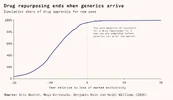
The graph about drug repurposing ending when generics arrive makes sense from a capitalistic perspective, because the incentive to find another use case for a drug decreases for the manufacturers.

Although the incentive increases for the people that have to pay for the drugs.

It could also be argued that after 30 odd years, most of the low hanging use cases should have been found, so you’d expect the rate of new discoveries to trend towards zero.
 
What is the failure of policy? I'd say it's a cultural failure, placing money above all other goals, even when increasing personal wealth past the point where it increases happiness. I suppose for science, it's prestige rather than money. Okay, past a certain reasonable point, extra wealth is for prestige rather than the money itself. Policies are determined mostly by money, so the failure is not policy.
 
It could also be argued that after 30 odd years, most of the low hanging use cases should have been found, so you’d expect the rate of new discoveries to trend towards zero.
I think this is a big part of it. Medicine has largely just been picking the relatively low hanging fruit so far, particularly via the initial benefits of general developments in background science & technology (scanning, microscopes, blood analysis, biochemistry, materials science, refrigeration, computing & communication, plus broader logistics like transport and manufacturing supply, etc).

That is no disrespect to those who found and picked that often highly productive fruit, which required some serious brains and dedication, especially in the face of some serious technical & resource limitations. They have already delivered huge good for the human race, and deserve our gratitude.

I just mean that we have only started on the journey into medical science, and there is far more to come than has already passed.
 
Back
Top Bottom