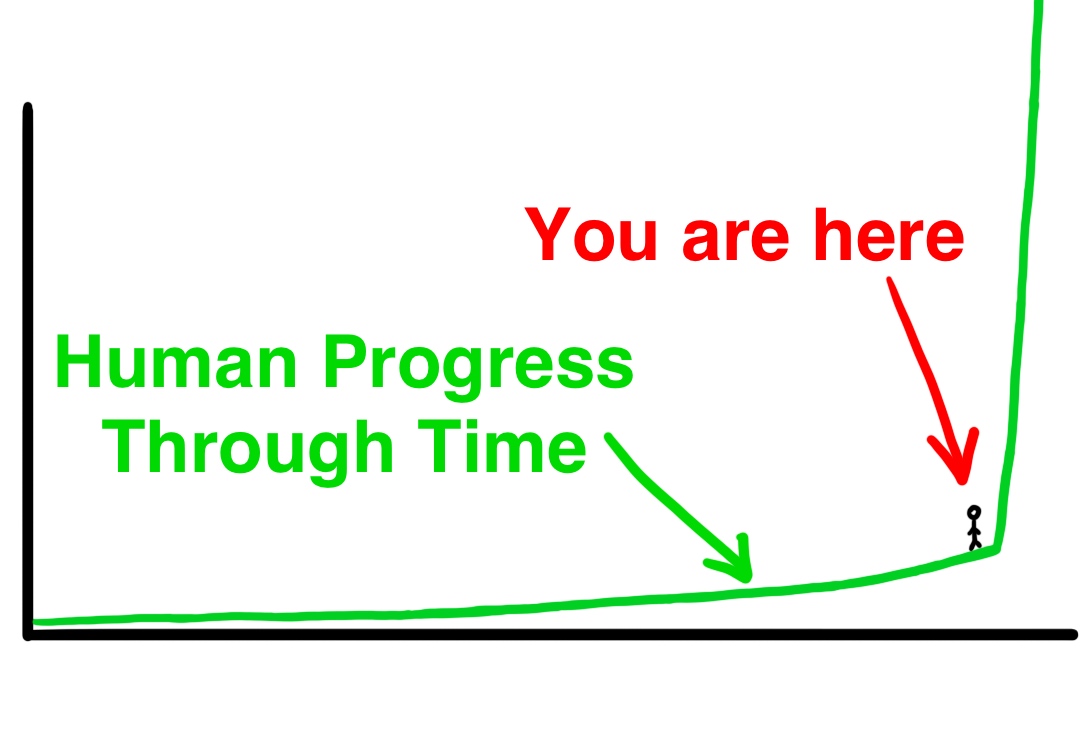
Artificial intelligence will solve ME/CFS, and is the only thing that matters

There are valid arguments about how important traditional research is still needed, such as gathering and processing tissue samples, but it's my prediction that it's already pointless to even bother, because most of it won't contribute anything, and it's too inefficient anyway. If an AI swarm working on ME/CFS arrives at a point at which it needs this kind of real world data, it will simply ask for it, in precise parameters, and organize the logistics of making it happen ASAP. In weeks, even days, not years. And it will organize all the results in a way to optimize its utility in ways that human labor simply cannot achieve. Humans for the most part will only need to push buttons at this point.
This paragraph ends on a key point. Given all that you have written in the past about the deliberate, often willfully cruel dismissal of ME/CFS, why would we think anyone with access to such buttons will actually push the ones we hope they will?
 
AI will solve ME/CFS, likely within two years at most, probably not even that.
Solve, like cure? No. Unless the 'solution' is already out there waiting to be associated with relevant data to combine into a comprehensive solution, I doubt it.

Garbage in equals garbage out implies that quality (experimental) data is required to solve a problem, even with computational techniques including machine learning. I'm a skilled engineer and near daily 'AI' user. I must be profoundly out of touch if I can't see this coming, but I've lived through a few hype cycles in tech and have some perspective.

If you truly believe this, you may as well believe in utopia being achieved on the same timeline. AI or not, <1% of the population with me/cfs has never been and won't likely ever be a priority in terms of difficult problem to solve for civilization.

I don't mean this in an insulting way but without any evidence given for extraordinary claims, the original post may as well be psychosis.

It's going to be a good thread. *microwaves popcorn*
 
Also just want to say even Dario’s grand vision, CEO of Anthropic, says 10 years all diseases cured and he’s the most bullish of them all. ME/CFS other than a handful of studies are shit, we won’t be first in line even if this magical utopia appears purely because there’s nothing to build on. 2 for ME/CFS cured is truly wildly optimistic unless someone forks over an army of sequencers to Chris to build and actual good data set so this magical AI can have even the slightest clue of what’s going on.


By the time AI is good enough to crack ME/CFS with the existing data there will be so many other issues and probably temporary collapse of society due to encryption, breaking and loss of work as my top two fears
 
Last edited:
IMO there's certainly hope that within the next few years there will be a major breakthrough that will kickstart drug research etc. But I don't see how AI is going to learn to do biomed research and solve things itself instead of just being a tool that some like the genetics lot on here use to assist research.

The maths stuff is impressive but I haven't seen that much impressive stuff from biomed research except the AlphaGenome/Deemind stuff. I don't see how LLMs suddenly learns to sift through mountains of garbage data and find the answer to a complex biomedical problem.
 
By the time AI is good enough to crack ME/CFS with the existing data there will be so many other issues and probably temporary collapse of society due to encryption, breaking and loss of work as my top two fears
Im still extremely skeptical that AI is going to collapse society. I think thats criti hype engaged in by people in tech who are trying to market it as much more powerful than it is.
 
Im still extremely skeptical that AI is going to collapse society. I think thats criti hype engaged in by people in tech who are trying to market it as much more powerful than it is.
An argument against the idea that people who appear worried about things like that are just marketing: https://www.astralcodexten.com/p/ai-safety-is-not-a-corporate-plot

The summary:
AI companies like Anthropic and OpenAI have long mentioned the possibility that their products could be existentially dangerous, but this has recently crescendoed into even more dire warnings, including suggestions that we have to pace the frontier, ie coordinate to slow AI progress.

In response, cynical commentators have suggested this is a conspiracy to boost the companies’ stocks. [...]

Many debates about AI are complicated and hard to resolve, but this one isn’t: all of these stories are clearly false. Some evidence:
  • The AI experts who aren’t affiliated with big companies are just as concerned as the ones who are.
  • The AI company leaders giving these warnings were giving the exact same warnings before they had AI companies - and in many cases, before they worked in the industry, or before the industry existed.
  • If these corporate plots were real, they would be incredibly dumb.

 
Im still extremely skeptical that AI is going to collapse society. I think thats criti hype engaged in by people in tech who are trying to market it as much more powerful than it is.
Pre-LLM hype AGI was predicted to hit in the next 50 years. I’ve been following it from 2016 and they said then within 50 years and that was before the breakthrough of transformers. The current lineup are hype men but more sane ppl have called it for decades happening in the middle to late 2000s
 
By the time AI is good enough to crack ME/CFS with the existing data there will be so many other issues and probably temporary collapse of society due to encryption, breaking and loss of work as my top two fears
I have concerns about this too. I personally don't like the way things are heading. We are getting too connected. Along with natural disasters we will have added data disasters, affecting banks, water supply? etc.
 
I'm always a bit out of sync on threads but I just want to say I hope S4ME makes the breakthrough. I'm always impressed by your science minds. I'm very grateful and I longed for this day when I could hear and read the constant concentration on researching our illness. I was in the dark without the internet, alone for my worst years.
 
Have I shared this before? Published in 2015, this is sparked my interest in AGI:

I guess part 2 of this is really “nobody knows and everybody has been arguing about it since forever but most likely on the mid to late 2000s”

I do think recent advancements the people interviewed may have changed their timelines since 2015
 
Back
Top Bottom