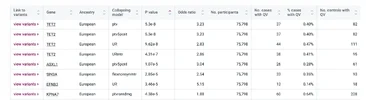
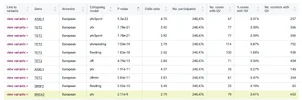
Astrazeneca Phewas analysis using the UK biobank

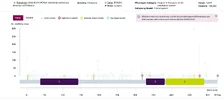
Here you go, should allow easy access to the genecard for each gene and the genehancer info, ensembl info, locuszoom etc for the regulatory elements

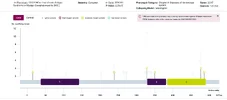
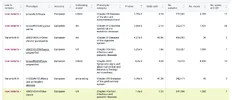
So here’s all the decodeme identified snps in the area whch pass the significance threshold and could be promoters or enhancers for BTN2A1 according to genehancer info.

Picking the top one you can quickly see the location on locuszoom.
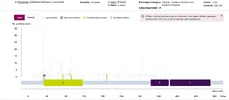
And clicking on the GHID takes you to the genehancer info where you can see that the potential gene targets, which include a novel transcript at the top but also interestingly other DecodeME genes like ABT1, ZNF322, H4C8 and BTN2A2 as possible targets.

Which is to say, it’s complicated. There’s probably a better way of working out all this than my janky scripts (buyer beware). I suspect it’s the sort of thing some bioinformatics pipeline does, but hopefully this is useful for others to prod around
 
I am trying to understand this graph presented on the PheWAS page:
1782085214510.webp

Looking at this a "majority" of the variants they detected occur in the SPRY and PRY regions. These regions seem to be a "sandwich" internally inside the cell that when activated by pAgs (possibly IPP from the melvonate pathway, but traditionally from HMBPP that bacteria produce in the non-melvonate pathway) that puts out receptors on the outside of the cell to tell dGT-cells to come over and attack it.

It's too bad from this we can't determine which way these variants effect the SPRY PRY locking, up or down.

The V-set variant is that external sensor on the outside of the cell. Again we can't tell from this if it is increasing or decreasing affinity.

I think these variants could be run in silico using alpha fold to determine if they are increasing or decreasing affinity? Does knowing if increasing or decreasing affinity tell us anything particularly valuable?

This looks like a good paper on the spry/pry but I don't have access:
Structure and function of the SPRY/B30.2 domain proteins involved in innate immunity
 
I think these variants could be run in silico using alpha fold to determine if they are increasing or decreasing affinity? Does knowing if increasing or decreasing affinity tell us anything particularly valuable?

This is all with the help of Gemini so don't take this too seriously, maybe a real scientist can look at this though? So BTN2A1 is like a little helper to BTN3A1 so I folded them together in alphaFold Server. I took the resulting model .cif converted it back to PBD. I then uploaded this to mCSM-PPI2.

For these parameters I put in for that first mutation we see reported in the PRY region (p.Val328Ile =V328I):
1782090254745.webp

Results:
Predicted Affinity Change (ΔΔGAffinity)
-0.547 kcal/mol
(Decreasing affinity)

Gemini - "Because of this mutation, the handshake is significantly weaker. The proteins will struggle to stay locked together long enough to successfully transmit the signal."

Anyone think this is useful? It was at least fun, I always wanted to open alphaFold. This is the least friction I've ever had in a bioinformatics pipeline so it feels too good to be true. I can do the rest of the Pry/Spry variants reported.
 
Variant in PRY/SPRYAmino Acid ChangeTranslatedResult -Predicted Affinity Change (ΔΔGAffinity)
6-26466088-G-Ap.Val328IleV328I-0.547 kcal/mol
(Decreasing affinity)
6-26468013-G-Ap.Val350MetV350M-0.519 kcal/mol
(Decreasing affinity)
6-26468394-C-Tp.Arg477CysR477C0.044 kcal/mol
(Increasing affinity)
6-26468421-C-Ap.Pro486ThrP486T-0.207 kcal/mol
(Decreasing affinity)

Overall it seems like the reported PRY/SPRY mutations make these dudes a bit worse at cleaning up. Gosh I can't wait for sequenceME. Huge caveat on all of this btw, not a scientist.
 
Last edited:
Actually I think this is all hot garbage: "weak link is that you're scoring an apo, membrane‑less, full‑length model whose interface may not be the real one." Also the first variant doesn't even sit totally in the PRY/SPRY: 6-26466088-G-A.
 
Last edited:
Back
Top Bottom