Brain Retraining treatment for ME/CFS and Long COVID - discussion thread

I feel your pain @Covidivici - I’m going through much of the same.

Found this when I googled her name. Sounds like she had a tough experience getting sick for roughly two years (well within the range of self-resolving post-viral fatigue), and I’m happy she’s doing better. Now she’s seemingly committed to spreading toxic positivity and a personal recovery journey narrative far and wide.

The blog was posted feb 2025.


She says’s she’s been feeling amazing for months, but it’s 11 months since she took the course. So she presumably «stopped» having LC when she took the course, but gradually recovered over maybe half a year.

The rest of the blog reads like something out of Paul Garner’s personal notes of «evidence» for brain retraining. This seems to be the depth of her critical reasoning around the whole thing:
I so feel you both, @Utsikt and @Covidivici

[Edited because I hit Reply accidentally].

A friend of mine told me this weekend that, if I would believe in my doctor and think positively, I would recover. "That's how it works", he said. I told him that that's not how it works and explained why his comment is hurtful (after all, people like my friend are basically saying: If you don't recover, it's your own fault). He then went on to explain why it is his belief that if you believe something strongly enough, it will happen. This was my reply:
**
I don't like that belief, because, as I said, if people don't recover, it sounds like it's their own fault for 'not believing' or 'not being hopeful enough'.

Yes, I know these stories as well, and although I'm of course very happy for these people, I think it's very damaging to those less lucky, to claim that is because of 'their spirit'. You hear it often as well when people recover from cancer "(s)he was so strong and positive, (s)he fought for recovery". As if the people who die from it are not strong and haven't fought! So, that's the other side of the coin.
**

It's so hard to not to just tell people to fuck off and stay friendly!
 
I so feel you both, @Utsikt and @Covidivici

[Edited because I hit Reply accidentally].

A friend of mine told me this weekend that, if I would believe in my doctor and think positively, I would recover. "That's how it works", he said. I told him that that's not how it works and explained why his comment is hurtful (after all, people like my friend are basically saying: If you don't recover, it's your own fault). He then went on to explain why it is his belief that if you believe something strongly enough, it will happen. This was my reply:
**
I don't like that belief, because, as I said, if people don't recover, it sounds like it's their own fault for 'not believing' or 'not being hopeful enough'.

Yes, I know these stories as well, and although I'm of course very happy for these people, I think it's very damaging to those less lucky, to claim that is because of 'their spirit'. You hear it often as well when people recover from cancer "(s)he was so strong and positive, (s)he fought for recovery". As if the people who die from it are not strong and haven't fought! So, that's the other side of the coin.
**

It's so hard to not to just tell people to fuck off and stay friendly!
I’d be looking for something in his life that he wanted but couldn’t achieve and turning it back on him!
 
Some pushback about the very uncritical piece with Gill Deacon:
Although host Ian Hanomansing clarified on air that Deacon doesn’t endorse the brain retraining therapy, the segment still provided national coverage for an unproven therapy. The National failed to mention that there’s no strong evidence CBT, and related brain retraining programs, are effective for Long COVID. The specific brain retraining course Deacon used to recover, according to her Substack, the Lightning Process, has been accused of exploiting people with Long COVID.

At best, this suggests The National did not conduct sufficient background research that would have flagged the problematic nature of the Lightning Process. At worst, the program may have been aware of the concerns surrounding the Lightning Process but chose not to mention it.
I reached out to the CBC to see if they were aware that Deacon attributed her improvement to the Lightning Process and asked them to comment on their rationale for platforming her recovery story in light of the controversy and lack of scientific evidence surrounding the program.

They were unable to provide a response prior to publication. This article will be updated when a response is received.
They mostly go off of the BBC coverage of LP for LC that was highly critical of it, with experts calling it an abuse of scientific terms and quackery.

 
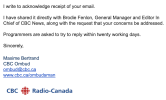
Happy to see it. I wrote a citation-stacked letter to the CBC Ombud to complain about the interview. Her response:

View attachment 29080
Hope they take it seriously!

In the link I posted, it says that she doesn’t endorse LP. But she very clearly does endorse LP in her substack and provides lots and lots of links to others talking about it. I have not watched or listened to the segment, so I don’t know what she actually said. But that discrepancy should have been caught by anyone doing any kind of due diligence prior to the interview..
 
She basically said that her metabolism had been stuck in fight or flight and that a three day workshop started her on the road to recovery though she 'had to do a lot of the work on my own'. So, yeah. BRT.
 
Update. I heard back from the CBC regarding their trash segment on brain retraining:


The re-uploaded edit is longer and includes this (new) narration:

Ever the journalist, Deacon started looking for her own answers. She enrolled in a University Health Network clinical trial in Toronto that explored using medication to treat Long COVID. Her symptoms didn’t improve and she didn’t give up. Instead, she turned to a controversial approach that is not currently offered through public health institutions to treat Long COVID.

It also (now) includes the host asking Deacon about the push-back she must have received (which means they had this all along and had simply chosen not to include it). In her response, she basically says that although she recognizes how discussing neuroplasticity can be incredibly offensive to people suffering from Long COVID "because it makes it sound like it's all in their heads", she insists that it's what helped her.

The good: You now come away from the 9-minute interview more aware that this is one person's opinion and that it doesn't have the medical establishment's backing. She also says that although a nodule has appeared on her thyroid, she chooses to stay positive. "That's why I write this book and try to help other people feel more okay about handling hard stuff and I truly feel the power of adjusting my attitude". So yeah, she comes across as far less credible.

The bad: It didn't air on Canada's flagship news program (as did the initial shorter segment, seen by millions). So as with any footnote correction after the fact, it accomplishes very little.

My bottom line: I'm glad it was addressed, for future segments, for anyone who might belatedly share this segment with their loved ones and in defense of bare-minimum journalistic standards.

Rigueur, esti.
 
Last edited:
For what it’s worth:
Raelan Agle‘s latest newsletter tries to sound all scientific and she links to this literature list https://www.symptomatic.me/bibliography

About ATNS​

The Association for the Treatment of Neuroplastic Symptoms is a 501(c)(3) nonprofit organization. Our mission is to educate the public, patients, and practitioners about diagnosis and treatment of neuroplasticity pain—also known as neuroplastic pain—and related illness and illness that affects over 50 million adult Americans. Founded and led by volunteer medical and mental health practitioners, researchers and patient advocates with decades of experience, ATNS provides the information and tools needed to recognize and treat neuroplastic conditions; explains and promotes the latest scientific research; advocates for healthcare policies that support access to quality treatment; and empowers people to advance their own healing.
The board consist of the same people as always:
  • David D. Clarke, MD​

    PRESIDENT & CO-FOUNDER
  • Howard Schubiner, MD​

    CO-FOUNDER
  • Etc…

Newsletter by Raelan:

Harvard Trial leads to recovery in just 5 weeks!​


What’s in store for today:

  • How getting clear on your values can aid in recovery
  • A Harvard clinical trial that helped Nora recover in just weeks
  • The new tool that gives you the same recovery plan as the Harvard trial
[td]

Hi friends!
When you're on a recovery journey, it can feel like there are a million opinions pulling you in different directions.
I’ve found that there’s one useful thing that helps me to stay on track:
Getting clear on my values.
These are the things that keep me grounded when the noise gets loud, and if I keep them in mind when I make decisions, I can never stray too far.
I spent some time this week writing down mine and I wanted to share them with you.
Here they are:

Compassion & Kindness – People first. Always. I speak gently, honor stories, and never shame or pressure.
Integrity, Honesty & Evidence-Informed – I tell the truth, acknowledge uncertainty, and base claims on the best knowledge available.
Empowerment & Joy – Everything I create helps people trust themselves more and invites moments of lightness.
Meaningful Impact – My work should genuinely change lives, not just generate views, clicks, or sales.
Fair & Sustainable Compensation – Me and my team serve with heart and are compensated ethically and confidently, in alignment with the value and impact we create.

These are very specific to me and the place I’m at in life right now. But doing this exercise got me wondering about what values my audience holds.
So maybe this is a good point to ask yourself:
What values do I want guiding my health, my choices, and the way I show up in the world?
If you’re willing to share, hit reply!
I’d love to hear your values.
Even if you don’t want to share, I’d encourage you to think about it. Sometimes just saying these things out loud is the first step to living them.

Nora Rodden spent five years trying everything for chronic back pain after being hit by a car at age 20: chiropractors, physical therapy, steroid injections, even nerve ablation procedures where they literally burned the nerves in her back.

Through all this, she still had pain. Then came GI issues. Then insomnia.

Eventually Nora was seeing the best specialists in New York and Boston, but they had zero answers for her until she saw a poster on campus for a neuroplasticity-based clinical trial led by Dr. Michael Donnino. Within weeks, her five-year back pain was completely gone!

WHAT WASN'T HELPFUL

  • Steroid Injections & Nerve Ablations – Still had pain afterward.
  • Endless Specialists – No long-term relief found.
  • Pills, Probiotics, Antibiotics – Didn't resolve GI issues.
  • Every Sleep Aid Available – Insomnia persisted.
WHAT WAS HELPFUL
  • Joining a Clinical Trial – Changed everything within weeks.
  • Looking for Symptom Inconsistencies – Gym didn't hurt, backpack did.
  • Reframing Danger Signals – Taught nervous system safety.
  • ✍️ Expressive Writing – Helped process emotions driving symptoms.
KEY RESOURCES
A SURPRISING INSIGHT

Nora was so impressed when her chronic back pain disappeared in weeks that she applied the same approach to her GI issues and insomnia… and those resolved too!

She used her experience to co-found Nervana, a neuroscience-based app that gives you the same tools from that clinical trial: bite-sized education, expressive writing, nervous system regulation, and a conversational AI coach that provides judgement-free support.


Wishing you a great start to the New Year!

 
Back
Top Bottom