

Chandelier
Senior Member (Voting Rights)
I couldn’t find a study protocol.
From
 www.netzwerk-universitaetsmedizin.de
Information from
 num.charite.de
(machine translation)
num.charite.de
(machine translation)
ELAPSE
Evaluating the Efficacy of Bupropion for the Treatment of Post-COVID-19 Syndrome-associated Fatigue
Project Description
Post-COVID syndrome (PCS) is a multifaceted and complex long-term condition that is still insufficiently understood. While most patients recover from COVID-19 without major complications, according to the World Health Organization, approximately 10–20% experience long-term effects. The most common symptoms are neuropsychiatric in nature, including fatigue (chronic exhaustion), cognitive impairment, and physical limitations. However, there are currently no evidence-based treatment recommendations that specifically address these symptoms.
The study is being conducted as part of the Infection Research Network (SNID).
Prof. Dr. med. Nils Opel, Department of Psychiatry and Psychotherapy, Campus Benjamin Franklin, Contact page
From
RAPID_ELAPSE | Network of University Medicine
www.netzwerk-universitaetsmedizin.de
RAPID_ELAPSE
ABOUT THE PROJECT
The majority of patients recover from a COVID-19 infection without any obvious sequelae, but a significant proportion suffer from long-term consequences known as Post-COVID syndrome (PCS). To date, there is no approved therapy and only the symptoms can be treated. The RAPID_ELAPSE study is investigating whether the drug bupropion helps to combat the severe exhaustion (fatigue) associated with post-COVID and improves the physical functioning of patients with post-COVID. To this end, the study compares the already approved drug with a placebo. The effect of bupropion has already been investigated in other diseases with severe fatigue and has helped many sufferers.
+
-
Project management Contact us
THE MOST IMPORTANT FACTS AT A GLANCE
Project goalsThe main aim of the study is to find out what effect taking bupropion has on the severity of fatigue (fatique) and on the patients' general physical functioning at the end of taking the tablets compared to taking the placebo.
Other study objectives include determining the effect on physical functioning, the severity of fatigue, neuropsychiatric, respiratory and cognitive symptoms and physical performance.
In addition, biosamples will be taken for future patient stratification (categorisation of patients into homogeneous subgroups) and the safety and tolerability of bupropion in patients with PCS will be assessed.
The challengesThe majority of patients recover from a COVID-19 infection without any obvious sequelae, but a significant proportion suffer from long-term consequences known as Post-COVID syndrome. These people have symptoms for months. The causes of this are not yet fully understood. The severity of the symptoms can range from only limited impairments in the private and professional environment to complete incapacity to work with a significantly reduced quality of life. To date, there is no authorised therapy and only the symptoms can be treated.
REALISATION & PROJECT SET-UP
Note: This text is intended for medical personnel.
Participation requirements- Age: at least 18 years
- Patients with confirmed evidence of a SARS-CoV-2 infection at least 3 months ago and the presence of fatigue can participate.
Further inclusion criteria:
At least one other post-COVID symptom from the following list must apply:
- Shortness of breath or shortness of breath
- Limited physical resilience
- Cognitive impairment
- Post-exertional malaise (massive deterioration in health that occurs after physical, mental or emotional exertion)
- Moderate to severe physical impairment
- Symptoms have been present for at least 3 months and no other diagnosis has been found that better explains the symptoms present.
- Ability to understand and follow the nature of the study and associated procedures.
- Correct and consistent use of a highly effective contraceptive method during the study
There are further requirements for participation, which will be explained in a personal discussion between medical staff and patients. Possible participation in the study must always be checked in advance by the medical staff.
Procedure of the study
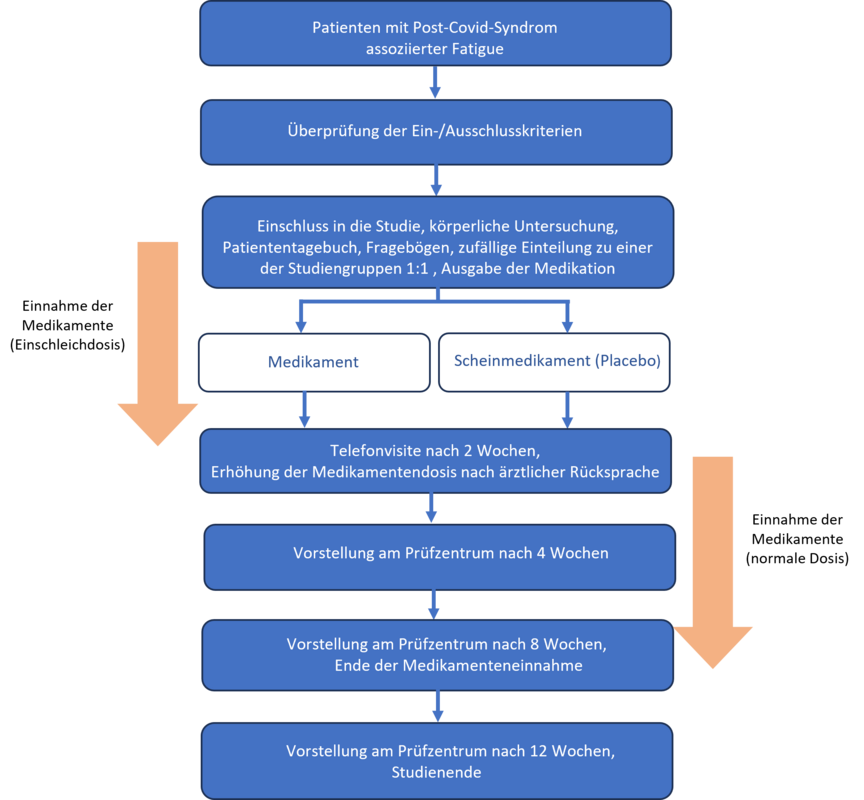
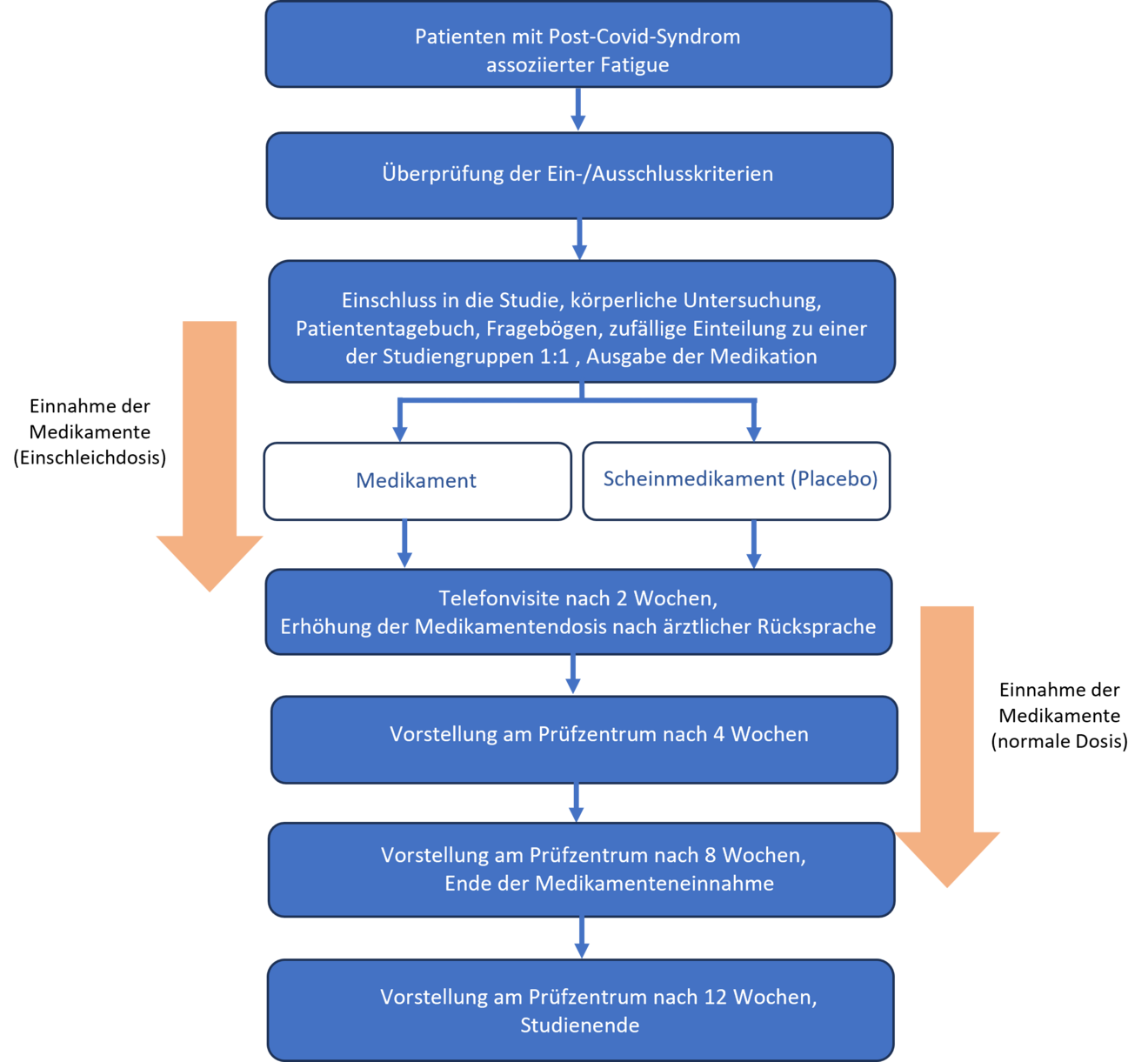
After checking the inclusion and exclusion criteria, the patients are randomly assigned to one of the two study groups (drug / placebo). In one group, the doctors administer drug treatment with the drug, while the other group receives drug treatment with a placebo. In both groups, information on the physical and cognitive condition is collected via questionnaires, tests and examinations.
Participation lasts about 3 months. A total of 5 personal appointments will take place at the trial centre. During this time, the medication/sham medication is taken daily for 56 days. Two weeks after starting the medication, a telephone call is made to the investigator. This is followed by three personal visits to the trial centre. One after 4 weeks, the second after 8 weeks and the last after 12 weeks. The visits to the trial centre include medical check-ups, the collection of questionnaires, blood samples and the distribution of study medication.
LocationsAt present, the sites have not yet started recruiting. Please use the table and the map to find out whether a study centre is active.
| Location | Postcode | Clinic | Contact | Status |
|---|---|---|---|---|
| Jena | 07747 | Jena University Hospital, Department of Internal Medicine IV | elapse@med.uni-jena.de | INACTIVE |
| Berlin | 10117 | Charité, Benjamin Franklin Campus Clinic and University Outpatient Clinic for Psychiatry and Psychotherapy | anmeldung-psychiatrie-pais@charite.de | ACTIVE |
| Gießen/Marburg | 35392 | University Hospital Gießen and Marburg GmbH, Centre for Internal Medicine and Polyclinic II, Outpatient Clinic for COPD | cornelia.kisselbach@uniklinikum-giessen.de | INACTIVE |
| Göttingen | 37075 | Göttingen University Hospital, Central Emergency Department | Tel.: sblasch@gwdg.de 0551-39-68621sblasch@gwdg.de | ACTIVE |
| Cologne | 50937 | University Hospital Cologne, Department of Internal Medicine I, Clinical Trials Centre I for Infectious Diseases | infektiologie-longcovid@uk-koeln.de | INACTIVE |
| Heidelberg | 69120 | Heidelberg University Hospital, Clinical Pharmacology Study Centre (KliPS) | Tel.: 06221 56-38745Klips.MED6@med.uni-heidelberg.de | INACTIVE |
| Freiburg | 79106 | Freiburg University Hospital, Department of Internal Medicine II, Division of Infectious Diseases | covidnachsorge@uniklinik-freiburg.de | INACTIVE |
A total of eleven trial centres across Germany are taking part in the project, located at the following sites: Frankfurt University Medical Centre, Charité – Berlin University Medical Centre, Ludwig Maximilian University of Munich, Jena University Hospital, Göttingen University Medical Centre, Freiburg University Hospital, Schleswig-Holstein University Hospital (Kiel Campus), Cologne University Hospital, Würzburg University Hospital, Giessen and Marburg University Hospital, and Heidelberg University Hospital.
Other collaborating partners:
Sponsor: Goethe University Frankfurt
Coordinating study centre: Göttingen University Medical Centre
Other NUKLEUS partners: NUKLEUS CDM, EC, LIMS, RPA, THS and TO, NUM-MB BCU
How can you participate?Patients can participate in the RAPID_ELAPSE study if they are at least 18 years old, have post-COVID syndrome-associated fatigue and fulfil the other above-mentioned participation requirements. In this study, there are detailed guidelines as to which patients may participate in the study. Potential patients are therefore intensively examined in advance by a study doctor. A detailed informed consent discussion also takes place before enrolment in the study.
In the future, 11 locations in Germany will participate as shown on the map (see figure Study centres).
Data protection and ethicsThe use of all data and biomaterials collected in the study is subject to the strictest data protection guidelines. Each collection of data and biospecimens has been approved by an independent medical ethics committee. All data in the study that identifies individuals (name, date of birth, address, etc.) is encrypted. Individual patients are therefore not directly identifiable. All data is subject to the General Data Protection Regulation.
Subject insurance is also taken out for all participants in a clinical trial of a medicinal product.
Information from
ELAPSE: Charité – Universitätsmedizin Berlin
num.charite.de
ELAPSE
Evaluating the Efficacy of Bupropion for the Treatment of Post-COVID-19 Syndrome-associated Fatigue
Project Description
Post-COVID syndrome (PCS) is a multifaceted and complex long-term condition that is still insufficiently understood. While most patients recover from COVID-19 without major complications, according to the World Health Organization, approximately 10–20% experience long-term effects. The most common symptoms are neuropsychiatric in nature, including fatigue (chronic exhaustion), cognitive impairment, and physical limitations. However, there are currently no evidence-based treatment recommendations that specifically address these symptoms.
Table of Contents
- Project Description
- Aim of the Project
- Who Is Involved?
- Project Duration
- Role of Charité
- Contacts at Charité
- Further Information
Aim of the Project
The placebo-controlled, randomized clinical trial “Evaluating the Efficacy of Bupropion for the Treatment of Post-COVID-19 Syndrome-associated Fatigue” (ELAPSE) constitutes the second sub-protocol of the adaptive platform trial RAPID, which has the same master protocol (NAPKON-TIP). The target population comprises patients with post-COVID syndrome (PCS) and significant fatigue. The study investigates the efficacy of treatment with the active substance bupropion (a dopamine–noradrenaline modulator) over a period of 56 days. The primary endpoint is the change in fatigue and physical functioning.The study is being conducted as part of the Infection Research Network (SNID).
Who Is Involved?
The study project is coordinated by Charité – Universitätsmedizin Berlin, Jena University Hospital, University Hospital Frankfurt, and LMU Munich. A total of 14 university hospitals, the Helmholtz Centre Munich, and one patient organization are participating in the study.Project Duration
1 February 2026 to 31 July 2028Role of Charité
Charité, together with University Hospital Frankfurt, coordinates the network and represents it externally. In addition, Charité is involved both in the development of the study design—particularly with regard to psychiatric expertise focusing on the neuropsychiatric aspects of post-COVID syndrome (PCS)—and in the recruitment of patients.Contacts at Charité
Prof. Dr. med. Christian Otte, Department of Psychiatry and Psychotherapy, Campus Benjamin Franklin, Contact pageProf. Dr. med. Nils Opel, Department of Psychiatry and Psychotherapy, Campus Benjamin Franklin, Contact page
