Preprint Evidence of Accumulating Neurophysiologic Dysfunction in Persistent Post-COVID Fatigue, 2025, Germann et al

forestglip

Moderator
Staff member
Evidence of Accumulating Neurophysiologic Dysfunction in Persistent Post-COVID Fatigue

Germann, Maria; Maffitt, Natalie J; Burton, Olivia A; Ashhad, Amn; Baker, Anne M.E.; Zaaimi, Boubker; Ng, Wan-Fai; Soteropoulos, Demetris S; Baker, Stuart N; Baker, Mark R

[Line breaks added]

Abstract
A major consequence of the COVID-19 pandemic has been the emergence of post-COVID syndrome (PCS), and more specifically, post-COVID fatigue (pCF), with an estimated prevalence of ~2%. We previously showed that, compared to healthy controls, people with pCF exhibit changes in muscle physiology, cortical circuitry, and autonomic function.

Here we present results from a cohort of people with pCF (N=145), between 12 weeks and 45 months post-infection. We report self-perception of fatigue; objective measures of cortical circuits via transcranial magnetic stimulation and reaction time tasks; peripheral muscle fatigue; and autonomic function such as heart rate variability.

Those with pCF persisting >200 days had significantly more fatigue and showed increased cortical excitability, slower reaction times and increased peripheral muscle fatigue compared to those with <200 days of pCF .

In pCF, if there is no spontaneous recovery, fatigue worsens, and patients continue to accumulate significant neurophysiologic abnormalities.

Web | PDF | DOI | medRxiv | Preprint
 
This looks pretty interesting because they tested a lot of different objective nervous system metrics. I don't know much about these measures, but there's measurements related to things like reaction time, cortical excitability, blood oxygen saturation, and peripheral fatigue. Some examples:
pCF participants had an increased level of peripheral fatigue (size of maximum twitch evoked by direct electrical stimulation of the muscle after a sustained contraction compared with baseline; TI_PeriphFatigue p<0.001)
Central activation, which assesses the ability of the CNS to activate muscle maximally voluntarily, was significantly reduced in pCF, either assessed at baseline (TI_CA_baseline p=0.002) or after a fatiguing contraction (TI_CA_fatigue p<0.001).
The StartReact effect, which measures the acceleration of a visual reaction time by a loud (startling) sound and has been proposed to assess reticulospinal pathways, was also significantly increased in both muscles (STR_StartReact_Bic p<0.001 and STR_StartReact_1DI p=0.009),
1767021970699.png

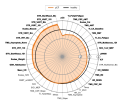
The plot shows the effect size for each metric. Bold measures were significant after multiple test correction.
Because each measure has different units and scales, data were normalized as a Z-score to allow easy comparison of differences. Z-scores were calculated by taking the difference in means of a measure between datasets (pCF vs healthy controls or pCF less than vs greater than 200 days) and dividing it by the standard deviation of the normative dataset (healthy controls or pCF less than 200 days). This is a measure of effect size and similar to Hedge’s g measure.

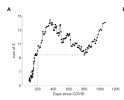
Also, they looked at how difference from controls changes with increasing time since infection (this is cross-sectional, not looking at individuals over time):
1767022780932.png

Each dot represents 20 individuals with post-COVID fatigue, and they use a sliding window. So if patient 1 has the shortest time since infection, patient 2 has the second shortest time, etc, then the first dot represents patients 1-20, the second dot represents patients 2-21, and so on.

For each group of 20 patients, they created a z-score for each metric for those patients, same as above, to see how much they differed from healthy controls, then added all the z-scores for all the metrics together and that's what the height of the points represents.

The plot shows that the difference from healthy controls is larger in patients who had been ill longer.
 
Last edited:
They combined data from two groups of people with post-COVID fatigue. A group of 37 that they analyzed previously, plus data for another group of 108 patients.
For this study, data from 145 participants (108 females) who were suffering from pCF by self-104 report were analysed. This included data from a pCF cohort of 37 participants (27 females) that were collected for our previous studies15,16 and baseline data (prior to any intervention) from individuals with pCF (108 participants, 81 females) that went on to participate in a vagus nerve stimulation trial (ISRCTN registry; ISRCTN18015802).

Here are the threads for the previous studies (refs 15, 16):
- Neural dysregulation in post-COVID fatigue 2023 Baker et al
- Recovery of neurophysiological measures in post-COVID fatigue: a 12-month longitudinal follow-up study, 2024, Maffitt et al.
 
Last edited:
How will these measurements be affected by regular deconditioning?

One of the interesting findings was —

In terms of body composition, pCF participants weighed significantly more (Scales_Weight p<0.001), but their body weight actually consisted of more muscle mass (Scales_Muscle p<0.001) and less fat by percentage (Scales_Fat p<0.001)

pCF>200 also had higher peripheral muscle fatigue (TI_PeriphFatigue p=0.009) and a lower body fat percentage (Scales_Fat p<0.001).

On first read this paper looks pretty good and, as @Turtle notes above, I can't help but wish these investigators had been involved in the NIH intramural study.

Our previous studies used the twitch interpolation procedure, which allows assessment of an individual’s ability to activate a muscle voluntarily maximally, before and after a sustained (fatiguing) contraction. […] The individual supramaximal stimulus level was set by increasing the intensity until the twitch response (recorded by the dynamometer) grew no further.

Upon receiving an auditory cue, subjects performed a 3s long maximal voluntary contraction until a stop tone sounded. Electrical stimulation to the biceps was given during MVC, 2s after the go cue and at rest, 5s after the stop cue. […] If a subject truly performs a maximal voluntary contraction, a superimposed electrical stimulus should not be capable of generating extra force. The size of any elicited twitch thus measures a central activation deficit. Stimulation of a fatigued muscle at rest after the long contraction produces a smaller twitch than that seen before the sustained MVC, indicating peripheral fatigue.

Maximal voluntary contraction (TI_MVC p=0.090) was not significantly reduced in pCF, suggesting no deficit in force production for brief contractions. There also was no difference in maximal M-wave (Mmax p=0.919), or their maximal elicited muscle twitch (TI_TwitchMax p=0.838). However, after a prolonged maximal contraction, pCF participants had an increased level of peripheral fatigue (size of maximum twitch evoked by direct electrical stimulation of the muscle after a sustained contraction compared with baseline; TI_PeriphFatigue p<0.001).

Central activation, which assesses the ability of the CNS to activate muscle maximally voluntarily, was significantly reduced in pCF, either assessed at baseline (TI_CA_baseline p=0.002) or after a fatiguing contraction (TI_CA_fatigue p<0.001).
 
Last edited:
Maybe one has too look at the other studies to see cohort details, but with things written as they are in this study I find the cohort too badly characterised to tell you anything useful. I'm disappointed that this is still the type of thing that gets published after 4 years of Post-Covid research.

What is the justification for the 200 day split? Arbitrary, because of something else or post-hoc because it strengthened results?
 
What is the justification for the 200 day split? Arbitrary, because of something else or post-hoc because it strengthened results?
After seeing the data and seeing that these metrics seemed to be worse in people who had been ill longer, they decided to split into two groups to see what the difference between the two groups might be.

They chose 200 days because it splits them cleanly into two groups by their calculated scores (see dotted lines in second plot in post above).
We chose this cut off point, because all bins with more than 200 days since COVID have higher sum of Z than those with less than 200 days since COVID.
 
One thing I'm not sure about is whether testing for the newly added 108 participants was done totally separately from the original 37 from the last study.

They say everyone from that last study was ill for up to 179 days ago at the time of testing:
These results largely replicate our previous findings15, which included individuals that had pCF for up to 179 days back in 2021.

So they would all be in the <200 group, and would make up the majority of it, because it was 44 total people in that group. That means the 101 people in the >200 group were all newly added individuals.

So I wonder if testing all the people in the newly added cohort separately from the original 37 might be part of why the scores are different between the two illness durations, for some reason unrelated to the actual duration of illness.
 
In terms of body composition, pCF participants weighed significantly more (Scales_Weight p<0.001), but their body weight actually consisted of more muscle mass (Scales_Muscle p<0.001) and less fat by percentage (Scales_Fat p<0.001)
Presumably this would be because of higher levels of pre-illness fitness? Loss of muscle mass over years of sedentary life is simply a given, and it's distinct from deconditioning.
 
Presumably this would be because of higher levels of pre-illness fitness? Loss of muscle mass over years of sedentary life is simply a given, and it's distinct from deconditioning.
But at the same time maybe those of us able to be active maintain muscle mass better than other sedentary people through some mechanism? I've been surprised at my muscle mass% when measured being in the upper range of normal/slightly above, and that with various activity levels to say the least. The measurement tool have often been bioimpedance scales though, and those may be influenced by water retention (which I often get when in PEM), but even after long periods of low activity levels I have been in better shape than other sedentary individuals I know.
 
Back
Top Bottom